Mars Reconnaissance Orbiter (MRO)
|
|
|

PSP_008523_2060_RED_abrowse-01.jpgSubchannels in Kasei Valles (EDM - MULTISPECTRUM; credits for the additional process. and color.: Dr Paolo C. Fienga - Lunexit Team)82 visiteCaption NASA:"This Region is very dusty, and therefore Dust Streaks can be seen covering the flat Mesas. Within the Channels, large Dunes of Dust have formed from Winds blowing through the Channels themselves. On the steep Slopes of the Dunes, smaller set of Ripples can be seen".MareKromium
|
|
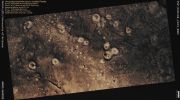
PSP_008548_2205_RED_abrowse.jpgMounds in Acidalia Planitia (Enhanced Absolute Natural Colors; credits for the additional process. and color.: Dr Paolo C. Fienga - Lunexit Team)186 visiteCaption NASA:"This image shows bright mounds scattered throughout a rather flat, dark landscape. These mounds range approximately between 20 and 500 meters (yards) in diameter.
The largest among them show central crater-like depressions which give them an appearance similar to terrestrial volcanoes. The origin of these mounds is still unclear. The most widely accepted hypotheses involve extrusion of underlying fluid-like materials (lava, wet/icy sediments) through weak points in the surface.
Similar mounds have been observed elsewhere in the Northern Lowlands (the Northern Lowlands encompass a vast region of Mars younger than the rest of the Planet, as shown by lower number of impact craters, and well below its average altitude). Mounds such as the ones shown in this image may hold important clues for scientist to decipher the history of the Northern Lowlands: an old ocean basin?
The site of continental-scale volcanism?
Detailed analysis of HiRISE and other complementary datasets will help solve this mystery".MareKromium
|
|
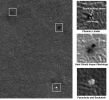
PSP_008585_2915_.jpgPhoenix Lander "Hardware" (Night-Time Frame)74 visiteCaption NASA:"MRO's HiRISE camera acquired this image of the Phoenix Landing Site 11 hours after landing. The image shows 3 unusual features, which were not present in the earlier, pre-landing HiRISE image.
We expect to find three main pieces of hardware: the Parachute attached to the Back-Shell, the Heat-Shield, and the Lander itself. The Parachute (lower right) is easy to identify because it is especially bright, although this image doesn't clearly reveal the Back-Shell.
The double dark marking at upper right seems most consistent with disturbance of the ground from impact and bouncing of the Heat-Shield, which fell from a height of about 13 Km.
The last object (upper left) appears to be a about the right size and height for the Lander and with dark objects on each side (to the East and West) consistent with the solar arrays.
This image was acquired in the nighttime, when the Arctic Sun was only 12° above the horizon to the North-East. Later images will be acquired in the daytime with the Sun higher in the sky and to the South-West, and could confirm our initial interpretations. North is about 7° to the left of straight up in this image.
These objects were later confirmed on the subsequent HiRISE observation acquired 22 hours after landing".MareKromium
|
|

PSP_008591_2485_cut_a.jpgPhoenix Lander "Hardware" (Day-Time Frame)69 visiteCaption NASA:"MRO’s HiRISE camera acquired this image of the Phoenix Landing Site 22 hours after landing. The image shows three unusual features which were not present in a pre-landing HiRISE image.
We expect to find three main pieces of hardware: the parachute attached to the backshell, the heat shield, and the lander itself.
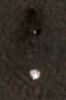
The Parachute (bottom) is easy to identify because it is especially bright, and this image also clearly shows the Back-Shell. We can even see the stripes on the Parachute.
The dark marking (middle right) appears most consistent with disturbance of the ground from impact and bouncing of the Heat-Shield, which fell from a height of about 13 kilometers.
The last object (top) is the Lander, and we can clearly see the solar arrays on each side. The solar arrays were relatively dark in the image acquired 11 hours after landing, but are brighter than the Mars surface in this daytime image acquired with the HiRISE blue-green filter.
There are dark halos around all three locations, perhaps due to disturbing a thin dust coating.
North is about 7°to the right of straight up in this image and illumination is from the lower left".MareKromium
|
|

PSP_008591_2485_cut_b.jpgPhoenix! (Natural Colors; credits: NASA/JPL/University of Arizona)85 visitenessun commentoMareKromium
|
|
PSP_008591_2485_cut_c.jpgBack-Shell and Parachute (MULTISPECTRUM; credits: Lunexit)88 visitenessun commentoMareKromium
|
|

PSP_008591_2485_cut_e.jpgPhoenix Lander "Hardware" (Day-Time Frame; MULTISPECTRUM process.)76 visitenessun commentoMareKromium
|
|

PSP_008598_2155_RED_abrowse~0.jpgLineated Valley Fill in Coloe Fossae (MULTISPECTRUM; credits: Lunexit)80 visiteThis Region consists of several relatively straight and narrow canyons located near the boundary between the high-standing, heavily cratered areas of the Southern Hemisphere and the low, uncratered plains that cover most of the Northern Hemisphere of Mars.
Transitional areas such as this are known as the “Fretted Terrain” and are characterized by a complicated mix of cliffs, mesas, buttes, and canyons.
This image reveals a canyon with relatively steep and smooth walls. The floor of the canyon displays a complex set of ridges and grooves that are generally parallel to the canyon walls.
The material comprising the canyon floor is common observed in Fretted Terrain and is called "Lineated Valley Fill" (LVF).
The cause of the LVF texture is not well understood but may result from patterns of ice rich soils or ice loss. The linear alignment may be caused by the downhill movement of ice-rich soil, or glacial flow in dirty ice or ice-rich soil.MareKromium
|
|

PSP_008681_2550_RED.jpgTransverse Dunes in Vastitas Borealis (natural colors; credits: Lunexit)73 visiteThe Vastitas Borealis Region, or Northern Lowlands, is a large area of low-lying surface that surrounds Mars’ North Pole.
On average, the Region is 4-5 Km lower in elevation than the mean radius of the Planet. How this basin formed is not known, although researchers have postulated that it could have been the result of a very large-scale impact sometime in Mars’ distant past. As of this writing, it is Summer in the Martian Northern Hemisphere, allowing the HiRISE camera to image this Region in full sunlight.
The sinuous landforms are dunes composed of sand that is made of basalt (a volcanic rock) or gypsum (a hydrous sulfate). There is a transition of modified barchanoid (crescent shaped dunes, generally wider than they are long) and transverse chains into star dunes; the winds change a lot in this area. The orientation of the barchanoid and transverse dunes indicate that the winds that formed them blow from the East (right side of image).
In some areas there are a few linear dunes. The light-toned, smaller bedforms are designated Transverse Aeolian Ridges (TARs).
MareKromium
|
|
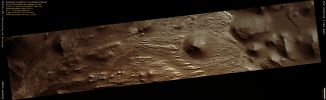
PSP_008708_1780_RED_abrowse.jpgGeologic Contacts in Juventae Chasma (MULTISPECTRUM-2; credits Lunexit)69 visiteMany of the Troughs of Valles Marineris contain mounds composed of light-toned Layered Deposits and Scientists have been debating both the origin of these Layered Deposits and their age of deposition relative to the Troughs themselves.
Some scientists think that the Layered Deposits formed first and then were covered by lava flows that make up the plains. Later, formation of the troughs of Valles Marineris created large openings through the plains that exposed the buried Layered Deposits.
Others have argued that the light-toned Layered Deposits formed after the Troughs and filled up portions of the canyons.
The chaotic terrain in Juventae is believed to have formed when subsurface water in the ground flowed away, causing collapse of the ground and leaving behind numerous hills along the floor of the Trough.
In this HiRISE image, the geologic contacts between the wallrock (darker units on the left - Sx - of the image), light-toned Layered Deposits, and darker hills of the chaotic terrain are visible. By studying the image, scientists hope to determine what are the relative ages of these different units in order to decipher the Geologic History of this Region.
(note: a stereo image of this location could be even more helpful because it will show the three-dimensional relationships between the different units, thus revealing more information about their relative ages)
MareKromium
|
|

PSP_008710_1710_red-PCF-LXTT.jpgLava Flows in Tharsis Region (Enhanced Absolute Natural Colors; credits for the additional process. and color.: Dr Paolo C. Fienga - Lunexit Team)237 visiteThis image shows a relatively dark Lava Flow on the Tharsis Volcanic Plains, East of Arsia Mons.
The entire Region is composed of a thick stack of volcanic flows. The Lava Flow in the Northern part of the image (Sx) is distinctly darker than its surroundings, which are buried under a layer of dust.
Most of the image has a fluffy, blurry texture. This is the mantle of dust or volcanic ash that commonly coats Volcanic Regions on Mars. The Dark Flow is buried by this material along its South-Eastern boundary; it appears that the mantle is being stripped off of the flow surface. Perhaps this flow is somewhat smooth at a fine scale and traps relatively little dust.
This flow is probably young. The Western Edge of the "Dark Region" does appear to be the edge of the Lava flow, indicating that this flow is relatively high-standing. This could make it more exposed to the wind and allow the mantle to be stripped. MareKromium
|
|
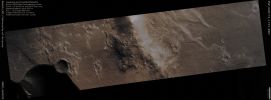
PSP_008774_1755_RED_abrowse-PCF-LXTT.jpgLayers and more Inverted Topography (Absolute Natural Colors; credits for the additional process. and color.: Dr Paolo C. Fienga - Lunexit Team)218 visitenessun commentoMareKromium
|
|
| 2236 immagini su 187 pagina(e) |
 |
|
|
|
|
144 | |
|
|
|
|








