Mars Reconnaissance Orbiter (MRO)
|
|
|
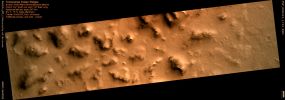
PSP_008323_1735_RED_abrowse-00.jpgTARs and Unusual "Star Ripples" (MULTISPECTRUM; credits: Lunexit)73 visiteThis blocky terrain is southwest of Schiaparelli Crater and is surrounded by a field of Transverse Aeolian Ridges (TARs) and unusual "Star Ripples" (dunes).
TARs are linear ripples with crest-ridge morphologies that can vary in shape; these morphologies include forked, sinuous, barchanoid, networked or feathered characteristics. The ridges also appear to transition into star dunes.
Star Dunes are complex features and are not yet fully understood on Earth. They form by multidirectional wind regimes with a dominant Primary Wind. Chains of Star Dunes often appear to have a massive linear appearance, or can be modified linear or Barchan Dunes with the formation of secondary slipfaces (on the steeper slope). On Earth, there are incipient Star Dunes, such as in the Dumont Dune field in the Mojave Desert, that display similar characteristics. The Dumont embryonic Star Dunes may result from dunes merging as they overrun one another, or are modified preexisting dunes, which could also be the case in this image.
Martian weather models predict that the dominate wind comes from a South-Westerly direction. This direction aligns nicely with the Transverse Ripples and the main arms of the Star Ripples.
This suggests that the Star Ripples were also affected by a different wind pattern or "Secondary Winds" or "Secondary Airflow". (Secondary Airflow is the airflow and sediment transport around the slopes of the dune).
Formation of incipient Star Dunes depends on the nature (strength, direction, and duration) of the Primary Wind and the volume of the sand to create the dune. Secondary airflow maintains the dune arms. The last factor is the deposition or removal of the sand by grainfall or grainflow avalanching. Grainfall and grainflow transports material from the main crestline slipface and along-slope or down-slope which maintains the secondary arm crest.MareKromium
|
|
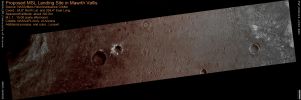
PSP_008324_2050_RED_abrowse.jpgProposed MSL Landing Site in Mawrth Vallis - ellipse 4 (MULTISPECTRUM; credits: Lunexit)89 visiteMawrth Vallis has a rich mineral diversity, including clay minerals that formed by the chemical alteration of rocks by water. The CRISM instrument detects a variety of clay minerals here, which could signify different processes of formation. The high resolution of the HiRISE camera helps us to see and trace out layers, polygonal fractures, and with CRISM, examine the distribution of various minerals across the surface.
This surface is scientifically compelling for the MSL Rover, although some of the terrain can be somewhat rough. Scientists use HiRISE images to find the safest possible Landing Site for the Rover.MareKromium
|
|
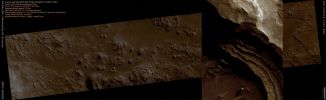
PSP_008338_1525_Erratic_Boulder-EB-LXTT-0.jpgLayers and "Monolith-like" Erratic Boulder in Uzboi Vallis (CTX Frame and EDM - an Image-Mosaic in Absolute Natural Colors by Elisabetta Bonora and Paolo C. Fienga - Lunexit Team)101 visiteMareKromium
|
|
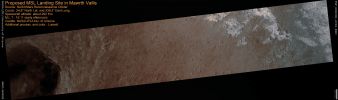
PSP_008390_2050_RED_abrowse.jpgProposed MSL Landing Site in Mawrth Vallis - ellipse 4 (MULTISPECTRUM; credits: Lunexit)66 visiteMawrth Vallis has a rich mineral diversity, including clay minerals that formed by the chemical alteration of rocks by water. The CRISM instrument detects a variety of clay minerals here, which could signify different processes of formation. The high resolution of the HiRISE camera helps us to see and trace out layers, polygonal fractures, and with CRISM, examine the distribution of various minerals across the surface.
This surface is scientifically compelling for the MSL Rover, although some of the terrain can be somewhat rough. Scientists use HiRISE images to find the safest possible Landing Site for the Rover.
MareKromium
|
|
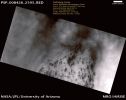
PSP_008426_2595_RED_abrowse-00.jpgPolygons, Crater Layers, and Defrosting Dunes (ctx frame - MULTISPECTRUM-2; credits: Lunexit)77 visiteThe North Polar Region is surrounded by a large sea (erg) of dark sand dunes that become covered by seasonal CO2.
As the Northern Hemisphere begins to warm in the Spring, the frozen CO2 sublimates.
The wind blows from an East-Northeasterly direction and leaves dark streaks behind (exposed basalt) from the evaporating Carbon Dioxide. This image displays defrosting sand dunes in an unnamed crater.MareKromium
|
|
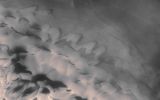
PSP_008426_2595_RED_abrowse-01.jpgPolygons, Crater Layers, and Defrosting Dunes (edm n. 1 - MULTISPECTRUM-2; credits: Lunexit)69 visiteThe dune morphology in this image is complex. Because of the presence of the ice, it is difficult to determine all of the dune types. These jumbled dunes may result from erosion of the layers within the crater walls that act as a dune source. However, two common types of dunes can be classified: the outer ring of the dune field is composed of chains of Barchan Dunes whereas the central area of the field contains transverse dunes.
Barchans are characterized by their crescent-shape with steep horns in the downwind direction. The transverse dunes have asymmetric, nearly parallel ridges and are oriented perpendicular to the wind direction.MareKromium
|
|
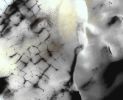
PSP_008426_2595_RED_abrowse-02.jpgPolygons, Crater Layers, and Defrosting Dunes (edm n. 2 - MULTISPECTRUM-2; credits: Lunexit)73 visiteAnother feature of interest is the Sublimating Polygons that have very small ripples on top of them. Polygons are created from a freeze-thaw processes similar to features on Earth that undergo annual contraction of the Permafrost Regolith.MareKromium
|
|
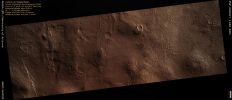
PSP_008427_1380_RED_abrowse-00.jpgAutumn in Hellas Basin (ctx frame - MULTISPECTRUM-2; credits: Lunexit)94 visiteIt is now fall in the Southern Hemisphere and in the giant impact crater known as Hellas Basin small boulders cast long shadows. The long shadows emphasize small scale topographic features and wind erosion is responsible for much of the morphology in this Region.
MareKromium
|
|
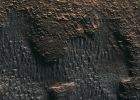
PSP_008427_1380_RED_abrowse-01.jpgAutumn in Hellas Basin (edm n. 1 - MULTISPECTRUM-2; credits: Lunexit)79 visiteFrost is condensing, and shows up as silver/gray patches in this MULTISPECTRUM image: this is seasonal CO2 frost.
Closer to the Pole, CO2 condenses from the atmosphere and forms a Seasonal Polar Cap. At this latitude we do not expect a thick layer to form but rather the frost collects in cold protected areas on poleward-facing slopes.MareKromium
|
|
PSP_008427_1380_RED_abrowse-02.jpgAutumn in Hellas Basin (edm n. 2 - MULTISPECTRUM-2; credits: Lunexit)73 visitenessun commentoMareKromium
|
|

PSP_008469_2040_RED.jpgCharacterize Surface Hazards and Science of Possible MSL Rover Landing - Mawrth Vallis (natural colors; credits: Lunexit)64 visitenessun commentoMareKromium
|
|
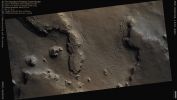
PSP_008508_1870_RED_abrowse.jpgPeri-Equatorial Pedestal Crater's Margin (Absolute Natural Colors; credits for the additional process. and color.: Dr Paolo C. Fienga - Lunar Explorer Italia)212 visitenessun commentoMareKromium
|
|
| 2236 immagini su 187 pagina(e) |
 |
|
|
|
|
143 | |
|
|
|
|








