Mars Reconnaissance Orbiter (MRO)
|
|
|
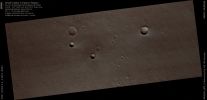
PSP_008213_1965_red-abrowse-PCF-LXTT.jpgSmall Craters in Elysium Planitia (Absolute Natural Colors; credits for the additional process. and color.: Dr Paolo C. Fienga - Lunexit Team)149 visitenessun commentoMareKromium
|
|
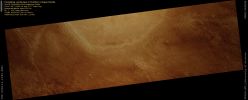
PSP_008214_2285_red.jpgPeriglacial Landscape in Northern Utopia Planitia (Saturated Natural Colors; credits for the additional process. and color.: Dr Paolo C. Fienga - Lunexit Team)81 visitenessun commentoMareKromium
|
|

PSP_008218_1815_red.jpgCharacterize Surface Hazards and Science of MSL Rover Landing Site - Equatorial Regions (Saturated Natural Colors; credits for the additional process. and color.: Dr Paolo C. Fienga - Lunexit Team) 87 visitenessun commentoMareKromium
|
|
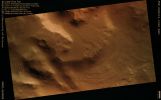
PSP_008233_1920_RED_abrowse.jpgCrater Floor Fan (MULTISPECTRUM; credits: Lunexit)69 visiteThis image shows a Fan of material deposited on the floor of a large Impact Crater.
The material was transported into the Crater through a valley, likely by running water. The end of the valley is visible in the West (lower) part of the image. Arcuate steps visible in the East are probably due to layers of different strength or cohesion; these suggest variations in the flow conditions.
A faint Trough is carved into the upper surface of the Fan. This could have been cut by the last water to flow across the surface. If the channel was flowing into a lake, this might indicate a drop in lake level, leading to erosion.
The surface of the Fan has many small dark spots, particularly on the upper tier.
The largest spots, most commonly around impact craters, are big enough to show that these are boulders.
If these boulders are original and not due to the hardening of fan sediments into rock, it suggests that the flows which deposited the Fan were relatively energetic events able to carry rocks across several feet.MareKromium
|
|

PSP_008234_2405_red-PCF-LXTT.jpgPeriglacial Landscape in Northern Tempe Terra (Enhanced Natural Colors; credits for the additional process. and color.: Dr Paolo C. Fienga - Lunexit Team)77 visitenessun commentoMareKromium
|
|
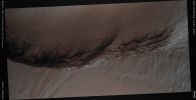
PSP_008244_2645_RED_abrowse.jpgNorth Polar Layered Deposits (MULTISPECTRUM; credits: Lunexit)75 visiteThe North Polar Layered Deposits of Mars form a layered stack of dusty ice up to 3 Km (about 2 miles) thick. The differences from layer to layer are thought to reflect differences in the climate of Mars that existed when the layers were formed.
We can see these internal layers exposed on the faces of the many troughs and scarps that cut through these deposits.
One of these scarp faces is shown here; it is situated at the head of a large canyon (named Chasma Boreale) that cuts through these Polar Layered Deposits.
The terrain on the upper side of the picture is higher and consists of the upper surface of the icy layered deposits in this area while the terrain on the lower side of the frame consists of the rocky ground that underlies the layered deposits. The cliff that separates these two areas runs down the center of the image with a relief of about 700 meters (about 2300 feet).
The section of the Layered Deposits that is exposed on this cliff face is unusual in that, as well layers of dusty ice, there are also layers of sand present. Small structures, called cross-beds, visible in the sandy layers indicate that each layer was originally a dune field that only later became covered with ice. Some of this sandy material is being removed from the cliff face and is forming new dunes at the foot of the cliff.MareKromium
|
|

PSP_008265_1860_RED_abrowse-PCF-LXTT.jpgFeatures of Elysium Planitia (Absolute Natural Colors; credits for the additional process. and color: Dr Paolo C. Fienga - Lunexit Team)185 visitenessun commentoMareKromium
|
|

PSP_008272_1560_RED.JPGCharacterize Surface Hazards and Science of MSL Rover Landing Site - Southern Lowlands/Margaritifer Terra (natural colors; credits: Lunexit)64 visitenessun commentoMareKromium
|
|
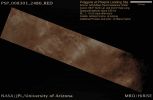
PSP_008301_2480_RED_abrowse-PCF-LXTT-00.jpgFeatures of Vastitas Borealis: Polygons (CTX Frame - Absolute Natural Colors; credits for the additional process. and color: Dr Paolo C. Fienga - Lunexit Team)142 visiteCaption NASA:"This image is one of many that have been taken over the Phoenix Landing Site. The Phoenix Lander launched from Cape Canaveral, Florida in August 2007 and will reach the surface of Mars on 25 May 2008. One of the reasons that this Region of Mars was selected for the Landing Site is based on the overall lack of rocks that could prove hazardous to the Lander. Among the many science goals, Phoenix will analyze the Surface Dust as well as dig into an ice-rich layer which is predicted to lie within inches of the Martian Surface. The Polygons are most likely the result of temperature oscillations which cause this ice to crack resulting in the Surface that is visible today. MareKromium
|
|

PSP_008301_2480_RED_abrowse-PCF-LXTT-01.jpgPolygons in Vastitas Borealis (EDM - Absolute Natural Colors; credits for the additional process. and color: Dr Paolo C. Fienga - Lunexit Team)153 visitenessun commentoMareKromium
|
|

PSP_008311_1835_RED_abrowse-00.jpgFeatures and Mineralogy of Aram Chaos (context-frame - MULTISPECTRUM; credits: Lunexit)118 visiteThis image is from Aram Chaos, a large crater connected to the Ares Vallis Outflow Channel. It is called “chaos” because of the rough floor topography, large slumped blocks and large fractures that may have been caused by removal of subsurface material.MareKromium
|
|

PSP_008311_1835_RED_abrowse-01.jpgFeatures and Mineralogy of Aram Chaos (extra-detail mgnf - MULTISPECTRUM; credits: Lunexit)67 visiteIn this extra-detail mgnf, the lighter-toned area is a heavily fluted and pitted Capping Unit. This surface tends to trap dark sand in the lows.
The dark sand can also be seen to form dunes below the cliff.
Sulfates have been detected in the cliff walls in some areas within Aram Chaos, as well as Hematite. It has been suggested that these materials were deposited within a lake setting.MareKromium
|
|
| 2236 immagini su 187 pagina(e) |
 |
|
|
|
|
142 | |
|
|
|
|








