Mars Reconnaissance Orbiter (MRO)
|
|
|

PSP_007977_2385_RED_abrowse-04.jpgUnnamed Northern Crater with "Gullies" (CTX Frame - Natural Colors; credits for the additional process. and color.: Dr Paolo C. Fienga - Lunexit Team)92 visitenessun commentoMareKromium
|
|

PSP_007977_2385_RED_abrowse-05.jpgUnnamed Northern Crater with "Gullies" (EDM - Natural Colors; credits for the additional process. and color.: Dr Paolo C. Fienga - Lunexit Team)82 visitenessun commentoMareKromium
|
|

PSP_008011_1975_RED_abrowse-00-PCF-LXTT.jpgFresh and Rayed Unnamed Crater in Tharsis Region (CTX Frame - Absolute Natural Colors; credits for the additional process. and color.: Dr Paolo C. Fienga - Lunexit Team) 168 visiteThis image shows a small Rayed Impact Crater, about 160 mt (530 feet) in diameter, in the Tharsis Region. Relatively recent impacts form Rays of Ejecta that spray out radially from the Crater. In addition to relatively fine material, large boulders and smaller secondary craters are visible in the rays surrounding this crater. Secondary Craters are recognized by their shallow depths (in comparison to Primary Impact Craters), irregular shapes, and appearance in Clusters and Linear Chains.
Mars Local Time: 15:02 (Early Afternoon)
Coord. (centered): 17,4° North Lat. and 248,8° East Long.
Spacecraft altitude: 274,1 Km (such as about 171,3 miles)
Original image scale range: 27,4 cm/pixel (with 1 x 1 binning) so objects ~ 82 cm across are resolved
Map projected scale: 25 cm/pixel
Map projection: EQUIRECTANGULAR
Emission Angle: 0,2°
Sun-Mars-Spacecraft (or "Phase") Angle: 42,8°
Solar Incidence Angle: 43° (meaning that the Sun is about 47° above the Local Horizon)
Solar Longitude: 57,4° (Northern Spring)
Credits: NASA/JPL/University of Arizona
Additional process. and coloring: Dr Paolo C. Fienga - Lunar Explorer ItaliaMareKromium
|
|

PSP_008011_1975_RED_abrowse-01-PCF-LXTT.jpgFresh and Rayed Unnamed Crater in Tharsis Region (EDM n.1 - Absolute Natural Colors; credits for the additional process. and color.: Dr Paolo C. Fienga - Lunexit Team) 161 visiteMars Local Time: 15:02 (Early Afternoon)
Coord. (centered): 17,4° North Lat. and 248,8° East Long.
Spacecraft altitude: 274,1 Km (such as about 171,3 miles)
Original image scale range: 27,4 cm/pixel (with 1 x 1 binning) so objects ~ 82 cm across are resolved
Map projected scale: 25 cm/pixel
Map projection: EQUIRECTANGULAR
Emission Angle: 0,2°
Sun-Mars-Spacecraft (or "Phase") Angle: 42,8°
Solar Incidence Angle: 43° (meaning that the Sun is about 47° above the Local Horizon)
Solar Longitude: 57,4° (Northern Spring)
Credits: NASA/JPL/University of Arizona
Additional process. and coloring: Dr Paolo C. Fienga - Lunar Explorer ItaliaMareKromium
|
|

PSP_008011_1975_RED_abrowse-02-PCF-LXTT.jpgFresh and Rayed Unnamed Crater in Tharsis Region (EDM n.2 - Absolute Natural Colors; credits for the additional process. and color.: Dr Paolo C. Fienga - Lunexit Team) 199 visiteMars Local Time: 15:02 (Early Afternoon)
Coord. (centered): 17,4° North Lat. and 248,8° East Long.
Spacecraft altitude: 274,1 Km (such as about 171,3 miles)
Original image scale range: 27,4 cm/pixel (with 1 x 1 binning) so objects ~ 82 cm across are resolved
Map projected scale: 25 cm/pixel
Map projection: EQUIRECTANGULAR
Emission Angle: 0,2°
Sun-Mars-Spacecraft (or "Phase") Angle: 42,8°
Solar Incidence Angle: 43° (meaning that the Sun is about 47° above the Local Horizon)
Solar Longitude: 57,4° (Northern Spring)
Credits: NASA/JPL/University of Arizona
Additional process. and coloring: Dr Paolo C. Fienga - Lunar Explorer ItaliaMareKromium
|
|
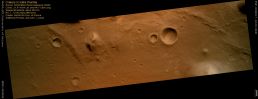
PSP_008017_2020_RED_abrowse.jpgCraters in Isidis Planitia (MULTISPECTRUM; credits: Lunexit)78 visiteThis image shows a young impact crater in the Northern part of Isidis Planitia. The crater is fresh enough to preserve some fine textures that are eroded around other craters.
The ejecta blanket of material thrown out of the crater is distinctly dark and rough, with many small boulders and rugged texture. To the South of the crater there is a wedge-shaped area with little ejected material. This may indicate that the impactor which formed this crater came from the south, since at moderate impact angles ejecta is preferentially thrown in the direction of motion of the impactor.
Eventually, a combination of erosion and mantling by dust will smooth and obscure the ejecta and cover over the crater, turning it into a shallow depression like the others in this image. Reworking of the crater is already beginning, as shown by the network of fine ridges (wind-blown ripples) on the crater floor.MareKromium
|
|

PSP_008060_1770_RED_abrowse.jpgLayers and Phyllosilicates in Miyamoto Crater (MULTISPECTRUM; credits: Lunexit)94 visiteThis observation was taken in Miyamoto Crater in South-West Meridiani, an area near the Equator of Mars. This image is located to the East of one of the potential Mars Science Laboratory Landing Sites and is near the contact between the Hematite-bearing plains unit to the North-East (where the MER Opportunity is exploring) and the phyllosilicate-bearing unit to the South-West.
Aeolian (meaning "wind deposited") processes are active here, which are visible in dunes and ripples, most likely made of basaltic sand. The bedrock contains Phyllosilicates (such as Clay Minerals), which form in the presence of water. Phyllosilicates have been detected in higher concentrations in other areas of Mars such as Mawrth Vallis and Nili Fossae, but detections of lesser abundance have been noticed in Meridiani as well.MareKromium
|
|

PSP_008075_1590_RED_abrowse.jpgLight-toned Rocks (MULTISPECTRUM; credits: Lunexit)91 visiteThis observation shows a portion of an approximately 30 kilometer diameter impact crater located to the south of Valles Marineris.
The image reveals that the central uplift inside the crater is a mixture of dark-toned and light-toned materials. It’s likely that some of the rocks in the center of the crater represent units at depth that we wouldn’t otherwise see along the plains that surround the crater. The light-toned units in particular are not visible in the plains surrounding this crater so they could be material that is buried beneath the plains and only visible inside craters or other vertical exposures, such as those created by faults.
Some of the light-toned material appears angular and blocky, consistent with material that has been disrupted and uplifted by an explosion associated with the crater’s formation. The reason why some material appears light-toned is unknown but could be due to a different composition than the darker-toned unit.
Many light-toned units seen elsewhere on Mars, including within Valles Marineris, are made of sulfates so there may be sulfate-rich rocks buried beneath the plains at this location and the formation of the crater exposed them. In any case, the distinct materials visible within impact craters suggest that the crust on Mars may contain many units of variable composition.MareKromium
|
|
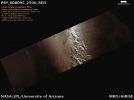
PSP_008095_2500_RED_abrowse.jpgLouth Crater, Southern Rim (MULTISPECTRUM; credits: Lunexit)100 visitenessun commentoMareKromium
|
|

PSP_008100_1790_RED_abrowse.jpgLayered Rocks in Iani Chaos (MULTISPECTRUM; credits: Lunexit)81 visiteThis image shows rocks on the floor of Iani Chaos, a Region of collapsed and disorganized Terrain.
The Chaotic Terrains on Mars may have been the sources of floodwaters that carved the giant outflow channels. They typically contain irregular hills like the one in the center of this image. In some cases, they also have light-toned rocks exposed on the floors. The point of interest is to determine whether these rocks predate the chaos or formed after the collapse; however, the contacts may be obscured by later material mantling the ground.
The rocks here are light-toned, and have dark low patches which are likely a thin cover of wind-blown sand. At a coarse scale, linear features are also visible in the rock, likely reflecting aeolian (wind) erosion in a preferred direction. A variety of processes could have contributed to forming these rocks, from volcanic eruptions to lake deposition or accumulation of wind-blown sand.
Stepped layers occur in places, suggesting a repetitive process. This argues for an origin as aeolian or lake-bed sediments, since volcanic eruptions may be of variable strength.MareKromium
|
|
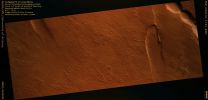
PSP_008130_1745_RED_abrowse-00.jpgSmall but deep Collapse Pit, North of Arsia Mons (context frame - MULTISPECTRUM; credits: Lunexit)80 visitenessun commentoMareKromium
|
|
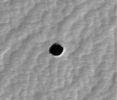
PSP_008130_1745_RED_abrowse-01.jpgSmall but deep Collapse Pit, North of Arsia Mons (extra-detail mgnf n. 1; credits: Dr G. Barca)81 visitenessun commentoMareKromium
|
|
| 2236 immagini su 187 pagina(e) |
 |
|
|
|
|
140 | |
|
|
|
|








