Mars Reconnaissance Orbiter (MRO)
|
|
|

ESP_012725_2015_RED_abrowse.jpgBranched Features on the Floor of Antoniadi Crater (Natural Colors; credits: Lunar Explorer Italia)77 visitenessun commentoMareKromium
|
|

ESP_012774_1080_RED_abrowse-00.jpgDefrosting Dunes in Richardson Crater (ctx frame - Natural Colors; credits: Lunar Explorer Italia)77 visiteThis image shows a portion of the Dunes that fill Richardson Crater, a 55-Km-diameter crater in the South Polar Region of Mars and a frequent repeat target for the HiRISE camera.
During Southern Fall and Winter, these Dunes are coated with seasonal CO2 frost, which then sublimates into the Atmosphere as the temperature rises in Spring and Summer.
This Natural Color shows a boundary between Dunes that are mostly covered with Seasonal Frost and Dunes that have mostly thawed. The color of many dunes on Mars can change dramatically depending on the Season. Frost tends to be very bright in HiRISE images, particularly in the blue-green filter, but the Dune sand itself is very dark.
The dark streaks and spots on the frost-covered regions represent areas that are in the process of thawing out. In some areas, the frost has sublimated away. In others, a small avalanche of sand or dust may have spilled on top of the frost. Some of them may also be patches of coarse-grained ice that are relatively clear so that we can see the sand below. As Spring advances toward Summer in the South on Mars, these Dunes continue to appear darker and more red to HiRISE.
Dunes near the Polar Regions of Mars are studied both by scientists who are interested in the effects of this seasonal cycle of thawing and frosting over, and by scientists who wait for the frost to disappear so that they can study the dunes themselves.MareKromium
|
|

ESP_012774_1080_RED_abrowse-01.jpgDefrosting Dunes in Richardson Crater (edm - Natural Colors; credits: Lunar Explorer Italia70 visitenessun commentoMareKromium
|
|

ESP_012853_1480_RED_abrowse-00.jpgTerra Cimmeria (ctx frame - Natural Colors; credits: Lunar Explorer Italia)84 visiteThis image shows a network of small valleys in the Terra Cimmeria Region of the Martian Southern Highlands. This location is approx. 1000 Km (about 600 miles) South of Gusev Crater, the Landing Site of the Mars Exploration Rover Spirit.
The valleys in this image are carved into light-toned bedrock exhibiting a range of colors, which likely reflect a range of mineralogical compositions. The bedrock is pervasively fractured, and some of the fractures appear to be filled with material of a different color, possibly composed of minerals that crystallized or were cemented together when fluids (perhaps water) circulated through the fractures.MareKromium
|
|

ESP_012853_1480_RED_abrowse-01.jpgTerra Cimmeria (edm - Natural Colors; credits: Lunar Explorer Italia)70 visiteOn the right side of this edm, is a valley filled with dark material and a central, bright ridge. If the valley was carved by liquid water, then this ridge may mark a former stream channel where coarse-grained sediment was deposited, which has survived erosion more effectively than the finer-grained sediment in the valley outside the channel.
Similar "Inverted Channel Deposits" are visible elsewhere on Mars, and some examples in the Southern Highlands have been inferred to contain chloride salts (similar to table salt).
The color and texture of the possible Inverted Channels in this image are similar to those inferred to contain chlorides, which may have been deposited when salty water evaporated.
Considered together, the features in this image attest to a history of water-related activity at this location on Mars.MareKromium
|
|

ESP_012873_1075_RED_abrowse.jpgPolar Pit (Natural Colors; credits: Lunar Explorer Italia)81 visiteThis image features the North Wall and Floor of a Polar Pit in the Southern Hemisphere. The Pit Wall is sculpted into a row of gullies. Gullies typically have a triangular start upslope, followed by a channel that transported material, and a triangular debris fan downslope.
Polar Pit Gullies might be related to seasonal changes in frost coverage, but their exact origin is currently unknown. The Gullies appear bright because they probably have seasonal frost on them. The Pit Floor contains a field of dark Sand Dunes.
Wind has transported sand across the Martian Surface, and it was deposited in this Pit and formed dunes.
Some of the sand in the Dunes might have come from the gully debris fans or other erosion of the Pit wall. The bright material within the dunes and along the floor is seasonal frost that is probably composed of CO2 and water ice.MareKromium
|
|

ESP_012912_1320_RED_abrowse.jpgGullies in Noachis Terra (Natural Colors; credits: Lunar Explorer Italia)79 visiteGeologically young Gullies are a prime target for the HiRISE camera. Gullies are located in a variety of settings and are found all over Mars.
This "Ring Trough" or "Eroded Pit Crater", is located in the rugged Southern Highland Terrain known as Noachis Terra. The HiRISE image shows the layered, boulder-rich wall rock facing to the North-East and Gullies that are transporting material downslope.
The material collects into debris aprons along the walls, which often exhibit narrow channels along its surface.MareKromium
|
|

ESP_012926_1365_RED_abrowse.jpgLohse Crater (Natural Colors; credits: Lunar Explorer Italia)73 visiteThis image is of the Eastern half of the Central Peak of Lohse Crater located in the Southern Hemisphere.
The crater itself is highly degraded and is roughly 80 miles in diameter. Of specific interest are the pristine looking Gullies that appear to have sourced from layers below the top of this uplifted region.
Smaller Gullies appear to emanate in all directions from the uplifted region, but of special interest is the larger Gully located on the northern most slope of the Central Peak. This Gully has a larger alcove and a better developed debris apron than surrounding Gullies. This implies that either this gully formed over a longer time period or that more fluid was involved in its formation.
Gullies are present on many slopes on Mars, especially between the latitudes of 30 and 70° in both Hemispheres. Gullies are formed by fluids and have three distinct parts to them: an eroded “alcove” at the top, a sometimes sinuous “channel” section, and finally a large “debris apron” where the material eroded by the Gully is deposited.MareKromium
|
|

ESP_012934_1070_RED_abrowse.jpgTroughs and Scarps in Planum Australe (Natural Colors; credits: Lunar Explorer Italia)79 visiteThis image shows an outcrop of the South Polar Layered Deposits (SPLD). The SPLD consist of layers of ice and admixed dust and make up the bulk of the dome-shaped Planum Australe.
Planum Australe is, in some ways, analogous to the Antarctic ice sheet. Troughs and scarps carved into Planum Australe by erosional processes have exposed SPLD layers within it.
In this image, the darkest area at the bottom of the image is the bottom of the Scarp. Except for the dark material at the bottom of the slope, much of the changes in brightness in this image are due to the lighting angle, such as the direction from which the Sun is illuminating the slope.
Much like ice cores from Greenland and Antarctica and deep sea sediment cores, the icy-dusty layers of the SPLD may have preserved a record of recent Mars Climate History. Understanding that record is a complex process and involves, among many other types of analyses, examining the differences and similarities in appearance between each layer and attempting to classify layer types. This image shows nice examples of different layer textures. But what is especially interesting about this image are the Faults cutting through the Layers. These Faults appear as diagonal lines, on either side of which, the layering is offset.
Note that the Faults are not clean, single lines, but appear in long groups of short lines. What caused these Faults is still under investigation, but, among other possibilities, they could be related to an earlier time when temperatures were higher and the ice was flowing at a much faster rate than it is today.MareKromium
|
|
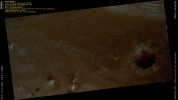
ESP_012940_1655_RED_abrowse-00.jpgThe Floor of Eos Chasma (ctx frame - Natural Colors; credits: Lunar Explorer Italia)72 visiteThe scoured and scabby floor of Eos Chasma, located East of Valles Marineris, is covered with Dunes or Ripples and Eroded Craters. The reddish-brown color likely represents older, eroded Basalt and much of this erosion may have been accomplished by water.MareKromium
|
|

ESP_012940_1655_RED_abrowse-01.jpgThe Floor of Eos Chasma (edm - Natural Colors; credits: Lunar Explorer Italia)77 visiteAn Eroded Crater exposes compositional differences below the Surface: the bluish tones are probably fresher, boulder-rich exposures of Basalt and the lighter-toned material near the base of the crater wall may have a different composition.
The bottom of the crater is filled with material that is similarly-toned to the Surface of Eos Chasma, and was likely eroded and transported there by the wind.MareKromium
|
|

ESP_012941_0930_RED_abrowse.jpgLandforms on the South Polar Residual Cap (Natural Colors; credits: Lunar Explerer Italia)66 visiteThis HiRISE image is located on the Carbon-Dioxide (CO2) rich Residual South Polar Ice Cap near 86° South Lat. and 353° East Long.
These rounded landforms evolve relatively quickly and erode into the surface of the Ice Cap (approximately 4-5 meters or 15 feet per year).
Their interesting shapes make for a striking appearance on the Surface.MareKromium
|
|
| 2236 immagini su 187 pagina(e) |
 |
|
|
|
|
14 | |
|
|
|
|








