Mars Reconnaissance Orbiter (MRO)
|
|
|

PSP_007805_2505_RED_abrowse-01.jpgThe "Frozen Lake" of Vastitas Borealis, alias Louth Crater (extra-detail mgnf - MULTISPECTRUM; credits: Lunexit)81 visiteThis extra-detail mgnf shows a comparison of these dunes acquired in late Northern Summer (see PSP_001700_2505, top) with the newer image. It is hard to believe this is the same piece of ground because the brightness patterns are so different due to the large temperature changes throughout the year.
Nota Lunexit: dunque il famoso "Lago di Ghiaccio" - situato all'interno di un cratere senza nome il quale venne individuato nella Regione Nordica di Vastitas Borealis dalla Sonda ESA "Mars Express" - non è un lago, ed il cratere "senza nome" è, in realtà, il Cratere "Louth". Ora, se ci consentite una piccolissima ironia (naturalmente corredata da elementi fattuali), vorremmo dire che il modo in cui ESA e NASA si comportano, alle volte, è davvero "bizzarro" (tanto per usare un eufemismo...).
Andate a leggerVi (o a "rileggerVi", se volete) quello che l'ESA scrisse riguardo questo Cratere. Noi, tanto per semplificare, Vi riportiamo il tutto qui di seguito e Voi, se non vi fidate (un Vostro sacrosanto Diritto) e volete verificare di persona, andate qui: http://www.esa.int/SPECIALS/Mars_Express/SEMGKA808BE_1.html
Caption ESA:"The HRSC on ESA's Mars Express obtained this perspective view on 2 February 2005 during orbit 1343 with a ground resolution of approximately 15 metres per pixel. It shows an unnamed impact crater located on Vastitas Borealis, a broad plain that covers much of Mars's far Northern Latitudes, at approximately 70,5° North and 103° East.
The crater is 35 Km wide and has a maximum depth of approximately 2 Km beneath the crater rim. The circular patch of bright material located at the centre of the crater is residual water ice.
The colours are very close to natural, but the vertical relief is exaggerated three times. The view is looking East.
Credits: ESA/DLR/FU Berlin (G. Neukum)".
Allora: dato e premesso che si sta parlando SENZA OMBRA DI DUBBIO del medesimo rilievo, vorremmo un pò capire come mai il "cratere senza nome" è diventato "Louth Crater".
E da quando?
E' intervenuta la IAU per battezzarlo?
O si tratta di un nome convenzionale adottato dalla NASA ma non ufficiale? Mistero.
L'ESA aveva battezzato questo rilievo come "Lago Ghiacciato" ed ora si scopre che l'unica cosa ghiacciata (rectius: ricoperta di semplice brina gelata) è il "mound" (dosso) che caratterizza solo un versante del cratere. Il "residual water ice" di cui parlava il Dr Neukumm dell'ESA - osservando il "fondo" del cratere - è "sparito" e la NASA, infatti, non lo menziona neppure (anzi! Semmai la NASA avanza l'ipotesi/suggerisce che, oltre ad un minimo di ghiaccio d'acqua, il "grosso" della componente ghiacciata che si vede sul "dosso" imbiancato che giace posizionato sul fondo del cratere, sia semplicemente "frozen CO2").
Volete la nostra ipotesi? Ne abbiamo due, a dire il vero.
Prima Ipotesi: la "scoperta" dell'ESA non era una scoperta reale. Le immagini MRO hanno pesantemente ridimensionato il fenomeno del presunto Lago Ghiacciato (il quale si è rivelato essere un cratere con un pò di brina su alcune porzioni del suo fondo) ed i Signori della NASA, tanto per non dare espressamente degli incompetenti a coloro che formano lo STAFF Scientifico che cura le imprese della Sonda Mars Express (in generale) ed al Dr Neukumm (in particolare), "fanno finta di nulla" e commentano questo rilievo ignorando (diremmo "per cortesia professionale") la circostanza per cui esso era stato già ampiamente trattato e discusso dai loro Colleghi Europei in ben altri termini.
Morale: la NASA, ivi, per "salvare la faccia" ai Colleghi dell'ESA, commenta "asetticamente" ed ignora il passato.
Seconda Ipotesi: la scoperta del Lago Ghiacciato di Vastitas da parte dell'ESA è una scoperta "vera" a tutti gli effetti ed apre scenari i quali non piacciono all'establishment della NASA. L'ESA viene invitata a non pronunciarsi ulteriormente sulla questione del Lago (o DEI LAGHI!) di Vastitas Borealis e la NASA, piano piano, accantona il fenomeno e quindi lo "cancella" dall'Immaginario Collettivo con queste recenti immagini le quali, effettivamente, mostrano un cratere con, al suo interno, un dosso ricoperto di brina persistente e nulla di più.
Morale: la Scienza "Ufficiale" dice che su Marte NON CI SONO ACQUE SUPERFICIALI e quindi, anche davanti ad una o più evidenze del contrario, bisogna ribadire il "Dogma" per il quale su Marte NON ESISTONO ACQUE SUPERFICIALI, nè liquide, nè ghiacciate.
E' sin troppo semplice immaginare che qualcuno, leggendo l'ipotesi 2, ci bollerà come "Complottisti" e poi, leggendo l'Ipotesi 1, dedurrà che NASA ed ESA lavorano "in sintonia" e che l'una integra, completa e, se necessario, corregge il lavoro dell'altra.
Certo, piacerebbe anche a noi che fosse così.
Ma così non è. Basta leggere (e rileggere) gli articoli ORGINALI ESA e NASA su questo Lago/Non Lago di Ghiaccio/Non Ghiaccio per capire che il "flusso informativo" non è stato nè limpido, nè coerente. E comunque sia, ci piacerebbe sapere chi e quando ha battezzato il Cratere "Senza Nome" in Cratere "Louth".
Ed in conclusione, se questo è il modo - non diciamo di "fare Scienza" ma, se non altro - di fare "Divulgazione" adottato dalla NASA in questo momento storico...Beh, allora noi possiamo solo darVi un suggerimento: studiate ed interpretate tutto DA SOLI. Magari, di quando in quando ed orà più, ora meno, prenderete (come accade a noi) "Lucciole per Lanterne" ma, se non altro, non diventerete mai dei semplici "recettori passivi" del modo (distorto) di Divulgare il Sapere adottato dalla più grande e famosa Agenzia Spaziale del Mondo (che noi ammiriamo sempre tanto ma, stavolta, un pò meno del solito...).
Amen.
p.s.: abbiamo reperito un cospicuo quantitativo di abstracts sul "presunto ghiaccio" di Louth Crater (ATTENZIONE: nome ancora NON ufficiale!) e, anzichè schiarirci le idee, adesso le abbiamo ancora più confuse...
Ma ne verremo fuori, come ovvio, e quindi pubblicheremo un articolo su questo rilievo davvero MOLTO intrigante e, incidentalmente, spenderemo qualche parola sul "modo schizofrenico" di "Fare Scienza" adottato in questo momento storico.MareKromium
|
|
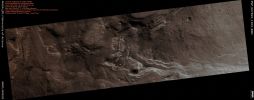
PSP_007820_1505_RED_abrowse-PCF-LXTT.jpgLayered Sediments in Hellas Planitia (Natural Colors; credits for the additional process. and color.: Dr Paolo C. Fienga - Lunexit Team)261 visitenessun commentoMareKromium
|
|
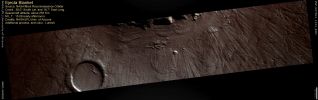
PSP_007822_1415_RED_abrowse~0.jpgEjecta Blanket (MULTISPECTRUM; credits: Lunexit)99 visiteThe Ejecta Blanket of a large (20 Km diameter) impact crater is shown here in vivid detail. The ejecta formed strong linear patterns in the topography that extend radially outward from the crater. This ejecta is rocky material that was ejected from the crater as a result of the high-velocity impact of an object about 100-200 meters in diameter, which probably escaped from the asteroid belt.
Since the impact event, this ejecta has been subject to millions of years of wind erosion that may have etched the surface and accentuated the radial pattern. There are also small-scale landforms such as fractured mounds that may have formed due to the presence of subsurface ice (note: this is a so-called "periglacial phenomenon"). MareKromium
|
|
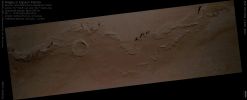
PSP_007896_1890_RED_abrowse-PCF-LXTT.jpgFeatures of Elysium Planitia: Ridges and "Fumes" (Saturated Absolute Natural Colors; credits for the additional process. and color: Dr Paolo C. Fienga - Lunexit Team)73 visitenessun commentoMareKromium
|
|
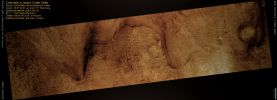
PSP_007925_1990_RED_abrowse-00.jpgChannels in Jezero Crater Delta (context frame - MULTISPECTRUM; credits: Lunexit)87 visiteBillions of years ago, this water-carved channel in Nili Fossae Region transported sediments across the Martian Surface and deposited them on the floor of an impact crater just south of this image.
The sediments were deposited in a delta-like mound on the floor of Jezero Crater, suggesting that the crater may have contained a lake at the time.MareKromium
|
|

PSP_007925_1990_RED_abrowse-01.jpgChannels in Jezero Crater Delta (extra-detail mgnf - MULTISPECTRUM; credits: Lunexit)73 visiteThis extra-detail mgnf shows a section of one channel in greater detail. Wind-blown dunes or ripples now cover much of the channel floor, but in some places the older channel floor is visible. Here, the channel bed has a layered appearance. The plains outside the channel are fractured into polygonal patterns.
The CRISM instrument has detected water-bearing clay minerals in these plains, which were eroded by flows down the channel.
Clays are also seen in the sediments deposited on the floor of Jezero Crater.MareKromium
|
|
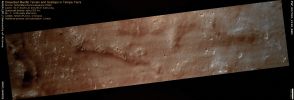
PSP_007930_2310_RED_abrowse-PCF-LXTT.jpgFeatures of Tempe Terra (Absolute Natural Colors; credits for the additional process. and color.: Dr Paolo C. Fienga - Lunexit Team)95 visitenessun commentoMareKromium
|
|
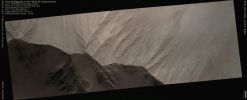
PSP_007946_2035_RED_abrowse-PCF-LXTT.jpgOlympus' Lava (Absolute Natural Colors; credits for the additional process. and color.: Dr Paolo C. Fienga - Lunexit Team)176 visitenessun commentoMareKromium
|
|
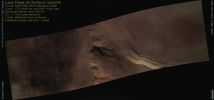
PSP_007959_1980_RED_abrowse-PCF-LXTT.jpgThe Beautiful Colors of Olympus Mons' Summit (Absolute Natural Colors; credits for the additional process. and color.: Dr Paolo C. Fienga - Lunexit Team)273 visiteOlympus Mons, the largest Volcano in the Solar System, has a large depression at its top. This depression, called “Caldera” by geologists, is caused by the collapse of the top of the Volcano as magma is drained out from an underground Holding Chamber.
Previous studies have demonstrated multiple collapses, indicating that there were Holding Chambers in slightly different locations within the Volcano that emptied at various times.
This HiRISE image examines the walls of one such collapse which exposes the Layers of rock within the uppermost part of Olympus Mons.
In the sections not covered by Dust, hundreds of thin discontinuous Layers are visible. The thicknesses and widths of these Layers are similar to those of the Lava Flows seen on the Surface of Olympus Mons. This confirms the assumption that the Volcano is built up of many thousands of similar Lava Flows.
There is also at least one Layer cutting diagonally across the stack of Lava Flows. This is an intrusion of magma, most likely a feeder to some of the uppermost Lava Flows. However, this HiRISE image indicates that such intrusions make up only a minor part of the upper section of the Volcano.MareKromium
|
|
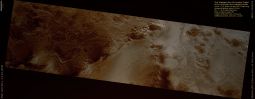
PSP_007961_2530_RED.jpgWestern Rim Region of Korolev Crater (possible True Colors; credits: Lunexit)65 visiteThis image was originally suggested by Ehsan Sanaei’s high school astronomy club in Yazd, Iran. They write, “[We are interested in] exploring the impact region near the northern Martian Pole and observing the contrast between ice-covered and [non-ice covered] Regions.”
Mrs. Stoica’s 9th grade class, at Tudor Vianu High-School of Computer Science, in Bucharest, Romania, helped to analyze the image by writing that “we observe a major crater, a small mountain chain, dunes and a series of small valleys and crevasses which [contain] ice.”
Indeed, this image shows part of the western rim of Korolev Crater, a prominent 80-Km-diameter crater located in the Northern Polar Region. It was taken in Northern Spring and shows dark regions of dust and sediment and bright regions of ice and frost. At highest resolution both bright and dark areas of the surface are covered by polygonal fracture patterns.
Although much of the ice has likely started to sublimate (change from a solid to a gas) in the darker regions, ice fills the fractures.MareKromium
|
|

PSP_007962_2635_RED_abrowse-00.jpgNorthern Dunes (CTX Frame - Possible Natural Colors; credits: Dr Paolo C. Fienga - Lunexit Team)75 visiteThere is a vast Region of Sand Dunes at high Northern Latitudes on Mars.
In Winter, a layer of CO2 ice covers the Dunes, and in the Spring - as the Sun warms the ice - it sublimates.
This is a very active process causing the sand to dislodge from the Dunes' Crests to cascade, often (NOT always!) forming Dark Streaks.MareKromium
|
|
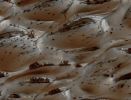
PSP_007962_2635_RED_abrowse-01.jpgNorthern Dunes (EDM - Possible Natural Colors; credits: NASA/JPL/Univ. of Arizona and Dr Paolo C. Fienga - Lunexit Team)73 visiteIn this EDM, falling material has kicked up a small cloud of dust. The color of the ice surrounding adjacent streaks of material suggests that dust has settled on the ice at the bottom after similar events.
Also discernible here are Polygonal Cracks in the ice formed on the Dunes (of course the cracks shall disappear when the ice is gone).MareKromium
|
|
| 2236 immagini su 187 pagina(e) |
 |
|
|
|
|
139 | |
|
|
|
|








