| |

Mars Reconnaissance Orbiter (MRO)
|
|
|

PSP_007653_2010_RED_abrowse-00.jpgBright on Dark (MULTISPECTRUM; credits: Lunexit)77 visiteThis image reveals bright Slope Streaks in Bahram Vallis, a long sinuous valley that winds across North-Eastern Lunae Planum and Xanthe Terra to the circum-Chyrse basin.
Typically, dark and light-toned Slope Streaks appear together on light-toned slopes. This scene is a rare case in which only bright streaks are visible on a dark surface. Slope Streaks generally start at a point source and widen downslope as a single streak or branch into multiple streaks. Some of the Slope Streaks show evidence that downslope movement is being diverted around obstacles, such as large boulders, and a few appear to originate at boulders or clumps of rocky material.
Many hypotheses have been proposed for the formation of slope streaks including dry avalanching, geochemical weathering, liquid stains or flows, and moisture wickering. Recent observations from HiRISE images have revealed that the interior of Slope Streaks is lower in elevation than the surroundings indicating that material must have been removed and then deposited in the formation of the streak.
Slope Streak formation is among the few known processes currently active on Mars. Where they appear together, dark Slope Streaks cross cut and lie on top of the older and lighter-toned streaks leading to the belief that lighter-toned streaks are dark streaks that have lightened with time as new dust settled on their surface. Over the course of several years, MOC images from this Region did not reveal any new dark or light-toned Slope Streaks suggesting that streak formation is not currently active here.
HiRISE will continue to monitor this Region for new slope streaks and changes in tone of old streaks.MareKromium
|
|
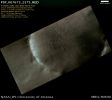
PSP_007673_2575_RED_abrowse.jpgFrosted North Polar Crater (MULTISPECTRUM; credits: Lunexit)72 visiteThis image was taken over the North Polar Region of Mars, just South of the Layered Ice Cap.
The image shows a 10 Km diameter impact crater during Northern Spring, still covered by Carbon Dioxide ice/frost, and perhaps some water ice/frost.
There are color variations due to the presence of reddish dust mixed with the ice/frost in different proportions, and the dark and relatively blue spots form when CO2 is released in small jets from beneath the ice.
There are no clear examples of small impact craters superimposed on the large crater, although there are many shallow depressions that might be degraded craters.
This seems puzzling because small (approx. 10 meters in diameter) craters form much more frequently than 10 Km craters.
In fact, they form about a billion times more frequently! The reason why there aren’t any sharp small craters is due to the fact that the ice destroys them, and does so rapidly, compared with the cratering rate.
Ice on Mars does not melt in the current climate, but it does expand and contract with temperature variations and it can flow.MareKromium
|
|
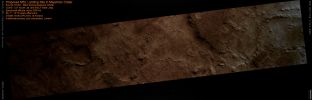
PSP_007678_2050_RED_abrowse~0.jpgProposed MSL Landing Site in Mawrth Vallis (MULTISPECTRUM; credits: Lunexit)70 visiteMawrth Vallis has a rich mineral diversity, including clay minerals that formed by the chemical alteration of rocks or loose “regolith” (soil) by water.
The CRISM instrument on the MRO Spacecraft has detected a variety of clay minerals here that could signify different processes of formation. The high resolution of the HiRISE camera helps us to see and trace out layers, polygonal fractures and, with CRISM, examine the distribution of various minerals across the surface.
This surface is scientifically compelling for the Mars Science Laboratory (MSL) Rover, although some of the terrain might be somewhat rough. Scientists use HiRISE images to find the safest possible Landing Site for the Rover.
This is one of four candidate landing sites in the Mawrth Vallis region.MareKromium
|
|
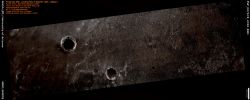
PSP_007704_1765_RED_abrowse~0.jpgProposed MSL Landing Site in Miyamoto Crater (MULTISPECTRUM; credits: Lunexit)76 visiteMiyamoto Crater is located in South-Western Meridiani Planum (and South-West of the Mars Exploration Rover Opportunity Landing Site).
This image shows fairly smooth plains and some areas covered by Windstreaks.
The streaks suggest that wind is an active process here, depositing surface material downwind in this distinctive form. This Landing Site is adjacent to the Hematite-bearing plains unit where the Opportunity Rover sits.
The CRISM instrument has detected Phyllosilicates (Clay Minerals) at this Landing Site, which scientists believe to have formed in the presence of water.
The Mars Science Laboratory rover would investigate the mineral diversity here, which includes Phyllosilicates and Sulfate Minerals.MareKromium
|
|
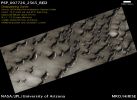
PSP_007726_2565_RED_abrowse-PCF-LXTT-IPF.jpgNorthern Dunes (Absolute Natural Colors; credits for the additional process. and color.: Dr Paolo C. Fienga/Lunar Explorer Italia/Italian Planetary Foundation)116 visiteThis NASA - Mars Reconnaissance Orbiter "HiRISE" image shows a portion of a Dunefield where many large "Barchan" (meaning "Crescent-shaped"), a few "Barchanoid" (meaning a "Non uniformly Crescent-shaped") and some smaller Dome-shaped Sand Dunes can be seen. The Dunefield that contains all these types of Sand Dunes is located in the Northern Regions of Mars and in a specific place where the first significant changes occurring to Sand Dunes was reported on the Red Planet (in the AD 2008). That study made by Dr Bourke (et al.) used a time series of NASA - Mars Global Surveyor (MGS), Mars Orbiter Camera (MOC) images taken over a period of 3 Martian Years (which are equivalent to 6 Earth Years) and showed that 2 (two) approx. 20 meter-wide Dome Dunes disappeared while a third one shrank by an estimated 15%.
Now, the HiRISE image here confirms that the first two Sand Dune studied by Dr Bourke no longer exist but, interestingly, it also suggests that the Sediment removal is still ongoing, since the third Dune has dramatically reduced its volume. On the other hand, it must be noticed and underlined that this "Dune-Changing Process" does not occur in a uniform and generalized way (at least in this specific location), since many of the other large Dunes present in the Dunefield do not show any (apparent/obvious) change; however, more time and some more precise measurements (fit to display evidence of the occurrence of an actual change of the larger Dunes, either in their shape, or their position) are needed in order to achieve a more substantiated conclusion.
In addition to that, we should also consider that it is even possible that the stability of all the other larger Dunes present in the Dunefield might be caused by the circumstance that the Sediment existing inside them is now (let us say "at present time"...) unavailable for removal, due to Induration (meaning that said Sediment became too hard to be blown away by just a simple, even though quite strong sometime, Aeolian Action, but in a future - maybe as a consequence of a dramatic variation in the Surface Temperature of this Region of Mars - its physical conditions could change again, and therefore make it fit to be remodeled, removed or, maybe, totally dispersed).
In the end, the change observed in the small Dome-shaped Dunes indicates, once and for all, that certainly not all Dunes on Mars are effectively and permanently stabilized and immobile, as it was erroneously believed for a long time.
Mars Local Time: 14:10 (Early Afternoon)
Coord. (centered): 76,182° North Lat. and 95,300° East Long.
Spacecraft altitude: 318,0 Km (such as about 198,8 miles)
Original image scale range: 63,6 cm/pixel (with 2 x 2 binning) so objects ~ 1 mt and 91 cm across are resolved
Map projected scale: 50 cm/pixel
Map projection: POLAR STEREOGRAPHIC
Emission Angle: 2,8°
Phase Angle: 62,5°
Solar Incidence Angle: 60° (meaning that the Sun was about 30° above the Local Horizon at the time the picture was taken)
Solar Longitude: 47,6° (Northern Spring- Southern Autumn)
Credits: NASA/JPL/University of Arizona
Additional process. and coloring: Lunar Explorer Italia
This picture (which is a NASA - Original Mars Reconnaissance Orbiter EDM color frame identified by the serial n. PSP_007726_2565) has been additionally processed and then colorized in Absolute Natural Colors (such as the colors that a human eye would actually perceive if someone were onboard the NASA - Mars Reconnaissance Orbiter and then looked down, towards the Surface of Mars), by using an original technique created - and, in time, dramatically improved - by the Lunar Explorer Italia Team.MareKromium
|
|
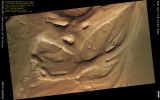
PSP_007738_2145_RED_abrowse.jpgStreamlined Islands in Hrad Vallis (possible natural colors; credits: Lunexit)67 visiteThis image shows a portion of Hrad Vallis, an approx. 400 mt (1300 feet) deep and about 800 Km (approx. 500 mile) long depression located in the Elysium Planitia.
Hrad Vallis is one of several channel systems that are found just West of the Elysium volcanoes. The scoured floor of Hrad Vallis shows the effects of erosion, presumably by water.
Flowing water in the past has carved and sculpted rocky masses into streamlined shapes or islands. The streamlined islands often have sharp edges and are narrower at the downstream end and wider at the upstream end. The streamlined islands visible here are located in an area where the flow condensed from the fractured terrain of the Hrad Valles headwaters (to the South-East) to a more regular channel (to the North-West).MareKromium
|
|

PSP_007767_1970_RED_abrowse-01.jpgMegabreccia inside Toro Crater (EDM - Natural - but strongly enhanced - Colors; credits: NASA/JPL/Univ. of Arizona and Dr Paolo C. Fienga - Lunexit Team)65 visiteThis EDM shows a close-up of one of the features that make Toro Crater a great target for HiRISE images: colorful patches of Megabreccia.
Breccia is a mixture of chunks of rock (clasts) that have been broken by an energetic geologic event, such as a Landslide or Crater-forming Impact, and then that got cemented together in a finer grained material.
Megabreccia features very large clasts that are big enough for HiRISE to see on the surface - some even larger than 30 feet across.
In this 200 meter (about 1/8 of a mile) diameter exposure of Megabreccia, clasts of various colors (indicating different kinds of rocks) and sizes have been exposed in the Uplifted Central Peak of Toro Crater.MareKromium
|
|
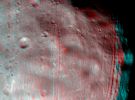
PSP_007769_9010_15.jpgPhobos in 3D (credits: NASA)64 visitenessun commentoMareKromium
|
|
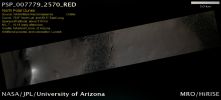
PSP_007779_2570_RED_abrowse~0.jpgDunes of the High Northern Latitudes (MULTISPECTRUM; credits: Lunexit)95 visiteIn this image, we can see that the North Pole is surrounded by a vast “sea” of Basaltic Sand Dunes. In Northern Winter a Seasonal Polar Cap composed of CO2 ice (dry ice) forms and the surrounding dunes become covered with frost. In the Spring, the ice sublimates (evaporates directly from ice to gas) loosening and moving tiny dust particles.
The bright portions of the dunes in this image are areas still covered with seasonal frost while dark spots are areas where the frost is gone or dark dust has cascaded down the sides of the dune.
The dunes imaged here are similar to Barchan dunes that are commonly found in desert regions on Earth. Barchan dunes are generally crescent-shaped with a steep slip face bordered by horns oriented in the downwind direction. Barchan dunes form by winds blowing mainly in one direction and thus are good indicators of the dominant wind direction when the dunes formed.
MareKromium
|
|

PSP_007801_2610_RED_abrowse.jpgDefrosting Dunes in the North Polar Sand Sea (MULTISPECTRUM; credits: Lunexit)74 visiteThis image shows defrosting sand dunes near the North Polar Region of Mars.
Around Mars’ North Pole is a vast Region or “sea” of sand dunes that become covered with CO2 frost or ice in the Northern Hemisphere’s Winter. The light areas indicate that parts of the dunes are still covered in frost or ice.
As Mars’ Northern Hemisphere enters into Spring and begins to warm, the CO2 sublimates. The CO2 sublimates in surprising ways, with trapped gas bursting through the ice in jets that leave dark streaks when the wind is blowing
During the Summer, all the frost will have sublimed leaving dark sand dunes. The unfrosted dunes are dark because the sand is derived from dark volcanic rocks.MareKromium
|
|

PSP_007805_2505-PCF-LXTT-IPF-00.jpgFrost all over Louth Crater (Absolute Natural Colors; credits for the additional process. and color.: Dr Paolo C. Fienga - Lunexit Team)94 visiteThis image shows the changing Seasonal Frost Patterns on Louth Crater, located at about 70° North Latitude, in the Martian Region of Vastitas Borealis. This Crater contains a Mound (---> terrapieno) covered by Water Frost that persists throughout the year (which is an unusual circumstance for this Latitude); however, even the Seasonal Carbon Dioxide (CO2) Frost deposited during the Northern Winter can reach such a Latitude. At the time this image was acquired (such as during the Northern Spring), the Carbon Dioxide Frost was in the process of sublimating back into the Martian Atmosphere. Note that there are Sand Dunes near the edge of the Mound, which become clear of Frost in the Summer.
Mars Local Time: 14:32 (Early Afternoon)
Coord. (centered): 70,228° North Lat. and 103,538° East Long.
Spacecraft altitude: 316,2 Km (such as about 197,6 miles)
Original image scale range: 31,6 cm/pixel (with 1 x 1 binning) so objects ~ 95 cm across are resolved
Map projected scale: 25 cm/pixel
Map projection: POLAR STEREOGRAPHIC
Emission Angle: 1,7°
Sun - Mars - MRO (or "Phase") Angle: 54,7°
Solar Incidence Angle: 56° (meaning that the Sun is about 34° above the Local Horizon)
Solar Longitude: 50,3° (Northern Spring - Southern Autumn)
Credits: NASA/JPL/University of Arizona
Additional process. and coloring: Lunar Explorer ItaliaMareKromium
|
|

PSP_007805_2505_RED_abrowse-00.jpgThe "Frozen Lake" of Vastitas Borealis, alias Louth Crater (context frame - MULTISPECTRUM; credits: Lunexit)94 visiteThis image shows the changing seasonal frost patterns on Louth Crater, located at latitude 70° North. This crater contains a mound covered by water frost that persists throughout the year, which is unusual for this latitude.
The seasonal Carbon Dioxide frost deposited during Northern Winter can also reach this Latitude. At the time this image was acquired in Northern Spring, the CO2 frost is in the process of sublimating back into the atmosphere.
There are sand dunes near the edge of the mound, which become clear of frost in the Summer.
Per avere qualche Informazione in più...
Geophysical Research Abstracts,
Vol. 10, EGU2008-A-10434, 2008
SRef-ID: 1607-7962/gra/EGU2008-A-10434
EGU General Assembly 2008
© Author(s) 2008
Louth crater: Water vapour distribution as seen by CRISM/MRO
R. Melchiorri (1); T.L. Roush (1); R.M. Haberle (1); A. J. Brown (2) ; T. Encrenaz
(3); CRISM team
1) NASA AMES Research Center, Moffet Field, CA, 94035, USA
2) SETI Institute, 515N. Whisman Rd, Mountain View, CA 94043, USA
3) LESIA Observatoire de Meudon 5, place Jules Janssen, 92195 Meudon, France
“Louth” crater (70.5°N, 103.2°E, name submitted to IAU for consideration) has been identified to have a greater resemblance to the polar cap than previously expected [1 and 2]. This crater is a conveniently small and contains a central water ice deposit that is suitable for testing models of volatile stability in the Martian north polar region. A sensitive detector for water stability is the study of water vapour distribution, which could reveal the presence of interactions between the surface and atmosphere by identifying possible sources and sinks. By adapting the water vapour analysis already developed and tested for the
OMEGA/Mars Express data [3 and 4] we have been able to retrieve the total amount of water vapour from the CRISM/MRO data. This retrieval was performed on two independent high spectral-spatial resolution observations of Louth crater.
For the first time a water vapour distribution at the 1/1000 of a degree scale is presented. Opening the possibility of studying atmospheric water dynamics at very high spatial resolution, like on the boundary of the ice mound, and thus providing hints
regarding the presence and extent of the ice under the close dusty regions.
We present the method and some preliminary results of the analysis, showing in detail the distribution of water vapour on and near the ice mound and near the northern crater rim.
References:
[1] A.J. Brown et al; ICARUS (in press) 2008
[2] A.J. Brown et al; LPCI 2008
[3] R. Melchiorri et al ; Plan and Space Sci. 55 (2007) 333–342
[4] T. Encrenaz et al A&A 441, L9–L12 (2005)MareKromium
|
|
| 2236 immagini su 187 pagina(e) |
|
|
|
|
|
138 | |
|
|
|
|
|
|








