Mars Reconnaissance Orbiter (MRO)
|
|
|
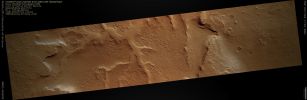
PSP_007394_1750_RED_abrowse~0.jpgInverted Fluvial Channels and Craters with Ejecta Rays (natural colors; credits: Lunexit)65 visiteThe lower part of this image shows well-defined overlapping channels, which have inverted topography (i.e.: they were once low spots that have been filled in with sediments and now eroded in a such a way that they appear as topographically high regions).
The channels have a winding and intersecting geometry indicating the shifting of the channels over time, a feature consistent with the flow of water in rivers. The channels have small craters that have excavated the channel materials and ejected them to form well-defined rays. There are dark slope streaks (toward the top of the image) showing transport of fine dust down the slope of an eroded bedrock terrain.MareKromium
|
|
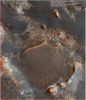
PSP_007454_2020.jpgPossible Phyllosilicates in Mclaughlin Crater (High-Def-3D and Natural Colors; credits: Dr M. Faccin - Lunexit Team)68 visiteAcquisition date: 28 February 2008
Mars Local Time: 14:47 (early afternoon)
Latitude (centered): 21,7° North
Longitude: 337,8° East
Range to target site: approx. 287,5 km (about 179,7 miles)
Original image scale range: 28,8 cm/pixel (with 1 x 1 binning) so objects ~86 cm across are resolved
Map projected scale: 25 cm/pixel and North is up
Map projection: EQUIRECTANGULAR
Emission Angle: 0,2°
Phase (Sun-Target-Spacecraft) Angle: 40,1°
Solar incidence angle: 40° (with the Sun about 50° above the Local Horizon)MareKromium
|
|
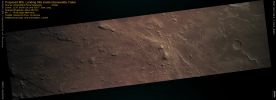
PSP_007481_1560_RED_abrowse.jpgProposed MSL Landing Site in Eberswalde Crater (MULTISPECTRUM; credits: Lunexit)66 visiteThis image covers a portion of Eberswalde Crater, which has an ancient deltaic depositional setting. Eberswalde is an approx. 65 Km diameter, closed basin crater. This image was targeted in the landing ellipse as a possible site for the 2009 Mars Science Laboratory Mission. The image shows resistant mounds and knobs as well as a scoured surface.
The CRISM instrument on board the Mars Reconnaissance Orbiter has detected Phyllosilicates (clays) in the bright layers in the crater. One of the ways clays form on Earth is when water erodes rock and makes fine particles which settle out of water; this often occurs in river deltas and lake beds.
The delta and meandering channels in Eberswalde Crater (to the West of the Landing Ellipse) and the detection of Phyllosilicates provides evidence for possible persistent aqueous activity on Mars.MareKromium
|
|
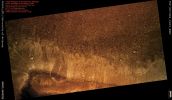
PSP_007492_2265_RED_abrowse-PCF-LXTT.jpgPolygons in Deuteronilus Mensae (Enhanced Absolute Natural Colors; credits for the additional process. and color.: Dr Paolo C. Fienga - Lunexit Team)334 visiteThis image reveals hexagonal and polygonal patterns formed by networks of soil troughs on the floor of a valley in the Deuteronilus Mensae Region, located on the Northern edge of Arabia Terra and borders the Martian Southern Highlands and Northern Lowlands.
The polygonal patterns indicate that the surface has undergone stress, potentially caused by subsidence (sinking), desiccation (drying out), or thermal contraction. These polygon features are similar to permafrost thermal-contraction polygons that form in Polar and High Alpine Regions on Earth by seasonal-to-annual contraction of the subsoil. On Earth, such polygon features are indicative of the presence of ground ice and are commonly referred to as “patterned ground”. The patterns are the result of thermal contraction in ice-cemented soil or permafrost that forms a honeycomb network of small fractures below the surface.
The network of fractures is eventually manifested as shallow troughs at the surface, forming the hexagonal and polygonal patterns visible in this image.
The polygons in this scene average approx. 100 meters (110 yards) in size and appear to be higher in elevation in the center than in the surrounding troughs. Boulders are accumulated in the center of the polygons and dunes are visible in several of the troughs.
The landforms we observe here most likely indicate that ice-rich permafrost is present or has been present in the past.MareKromium
|
|

PSP_007493_2650_RED_abrowse~0.jpgNorth Polar Layered Deposits covered by Seasonal Frost (MULTISPECTRUM; credits: Lunexit)76 visiteThis image shows an exposure of the North Polar Layered Deposits (NPLD). The layering visible here might have been formed by recent climate variations on Mars, similar to ice ages on Earth.
While the Polar Layered Deposits are mostly water ice, exposures such as this are typically covered by a layer of reddish dust, protecting the underlying ice from evaporation during the Summer. This dusty layer hides the internal composition of the Polar Layered Deposits from view, but variations in the slopes of the surfaces of the layers are still visible.
The slope of each layer is probably affected by the internal composition, so the topography of exposures like this is of interest to scientists. When this image was taken (Northern Spring), the surface was mostly covered by seasonal CO2 frost.
This white frost layer helps to highlight the surface slopes because the visible brightness variations are mainly caused by topographic variations. Therefore, this image will be useful for photoclinometric, or "shape from shading" analyses that can yield topographic maps limited only by the resolution of the image.
MareKromium
|
|

PSP_007494_2580_RED_abrowse.jpgNorth Polar "Erg" (Natural Colors; credits for the additional process. and color.: Dr Paolo C. Fienga - Lunexit Team)93 visitenessun commentoMareKromium
|
|

PSP_007547_1895_RED_abrowse-01.jpgRolling Rocks inside Shalbatana Vallis (EDM - False Colors; credits: Dr Paolo C. Fienga - Lunexit Team)90 visiteIn this extra-detail mgnf, the left frame shows boulders moving in two directions, indicating that they had different sources.
The right frame shows a boulder about 4 meters in diameter in the bottom left, having left a track that begins in the upper right. This boulder rolled down the hill, appears to have jumped the crater, bounced a few times, and then rolled to a halt.MareKromium
|
|

PSP_007547_1895_RED_abrowse-02.jpgFeatures of Shalbatana Vallis (EDM n.1 - Absolute Natural Colors; credits for the additional process. and color.: Dr Paolo C. Fienga - Lunexit Team)229 visiteThis image covers an area where the Southern Branch of Shalbatana Vallis opens into Chryse Planitia, showing a variety of boulders that have moved down slope leaving tracks on the surface.
These boulders may have been thrown out from low-energy secondary craters, or simply eroded out of the above rocky cliff.
MareKromium
|
|

PSP_007547_1895_RED_abrowse-03.jpgFeatures of Shalbatana Vallis (EDM n.2 - Absolute Natural Colors; credits for the additional process. and color.: Dr Paolo C. Fienga - Lunexit Team)218 visiteMareKromium
|
|

PSP_007547_1895_RED_abrowse-04.jpgFeatures of Shalbatana Vallis (EDM n.3 - Absolute Natural Colors; credits for the additional process. and color.: Dr Paolo C. Fienga - Lunexit Team)233 visiteMareKromium
|
|
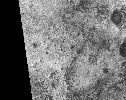
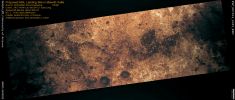
PSP_007612_2045-GIF.gifProposed MSL Landing Site in Mawrth Vallis - Ellipse 2 (GIF-Movie; credits: Carlo Contu)79 visiteSiamo nella Regione di Mawrth Vallis: una Regione di grandissimo interesse geologico (o forse sarebbe meglio dire "Mineralogico", vista la apparente varietà di minerali esposti e già individuati) la quale, forse, in un prossimo futuro, potrebbe costituire la "Casa" del Mars Science Laboratory Rover (anche se noi dubitiamo che il MSL Rover scenda effettivamente in questa zona del Pianeta Rosso...). +
Il dettaglio intrigante che ci viene proposto in questo suggestivo filmato GIF realizzato dal nostro Carissimo Amico e Partner, Carlo Contu, attiene un rilievo tanto piccolo, quanto bizzarro: una modesta collinetta con due lati "piallati".
Si tratterà di una frana o di qualcosa di più - diciamo così... - "esotico" (tipo uno scavo a cielo aperto)?
La Verità, anche in questo caso - e come sempre - non la conosciamo: noi possiamo solo invitarVi a guardare questo filmato ed a riflettere sui suoi particolari (uno su tutti, ma che NON Vi suggeriremo, in attesa che qualcuno di Voi se ne accorga e ne parli, in sede di commento).
Che altro dire? Complimenti a Carlo Contu e...Buona Esplorazione!MareKromium
|
|
PSP_007612_2045_RED_abrowse~0.jpgProposed MSL Landing Site in Mawrth Vallis (MULTISPECTRUM; credits: Lunexit)77 visitenessun commentoMareKromium
|
|
| 2236 immagini su 187 pagina(e) |
 |
|
|
|
|
137 | |
|
|
|
|








