Mars Reconnaissance Orbiter (MRO)
|
|
|
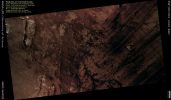
PSP_007095_2020_RED_abrowse~0.jpgInverted Dendritic Stream Channels in Antoniadi Crater (MULTISPECTRUM; credits: Lunexit)67 visiteThis observation is centered within Antoniadi Crater. This crater, even prior to the MRO mission, was identified as a likely ancient lake (now dry) that was supplied by both surface water and ground water.
The image provides further tantalizing evidence of a water-rich past. Most of the flat parts of the image have a polygonal texture, which commonly forms when mud dries. In the center of the image are branched (“dendritic”) features that connect Southward to a larger trunk-shaped landform; the branches resemble stream channels on Earth. Unlike active channels with water, these features are “inverted”, or elevated above the surrounding terrain.
Again, in analogy with such features seen on our Planet, these probably formed when materials deposited by the streams, such as coarse gravel, or chemical cementation after removal of the water, caused the channel bottoms to become resistant. Over time, natural erosion from wind and other processes left the inverted channels elevated above the surrounding terrain.
The branched features are probably remnants of small tributary streams that fed the larger trunk-shaped stream. It appears that the inverted streams lie on top of, and are therefore younger, than the polygons. This area may have first had a lake that later dried to form the polygons, followed by episodes of stream flow and erosion.MareKromium
|
|
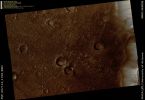
PSP_007119_1700_RED_abrowse.jpgCrater and Plains Deposit North-West of Herschel Crater (Natural Colors; credits: Lunar Explorer Italia)75 visitenessun commentoMareKromium
|
|
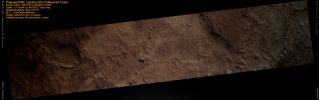
PSP_007124_1765_RED_abrowse~0.jpgProposed MSL Landing Site in Miyamoto Crater (MULTISPECTRUM; credits: Lunexit)63 visiteMiyamoto Crater is located in South-Western Meridiani Planum (and South-West of the Mars Exploration Rover Opportunity Landing Site).
This image shows fairly smooth plains and some areas covered by Windstreaks.
The streaks suggest that wind is an active process here, depositing surface material downwind in this distinctive form. This Landing Site is adjacent to the Hematite-bearing plains unit where the Opportunity Rover sits.
The CRISM instrument has detected Phyllosilicates (Clay Minerals) at this Landing Site, which scientists believe to have formed in the presence of water.
The Mars Science Laboratory rover would investigate the mineral diversity here, which includes Phyllosilicates and Sulfate Minerals.
MareKromium
|
|
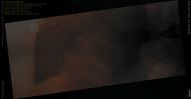
PSP_007126_1210_RED_abrowse~0.jpgLike a "dried-up" Waterfall (True Colors + MULTISPECTRUM; credits: Lunexit)74 visiteThis image shows a large gully in the wall of a crater in the Southern Hemisphere. Such gullies are among the most recent landforms on Mars, and were probably carved by liquid water.
The source of the water is still unknown; it could have been groundwater from a shallow aquifer or melted snow or ground ice from a different climate.
This gully is not particularly fresh, but it is among the largest observed; several sub-channels merge in the alcove on the upper slope, in the north part of the image (Dx).
Numerous faint troughs and lineations are visible downslope, likely indicating old channels that have been buried or reworked. The upper alcove exposes a dense cluster of boulders not seen on the adjacent slope. This could indicate that smaller material has been removed by the gullies, exposing the boulders without transporting them far.MareKromium
|
|
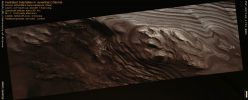
PSP_007126_1755_RED_abrowse.jpgFeatures of Juventae Chasma (MULTISPECTRUM; credits: Lunexit)67 visiteQuesta località è stata analizzata da molti Anomaly Hunters per via dell'esistenza di un PRESUNTO terrazzamento ripreso dalla Sonda Mars Express; un Terrazzamento che avrebbe dovuto (di)mostrare l’esistenza di una possibile cava (ergo di un'Opera Artificiale).
Bene: eccoVi dunque una nuova immagine di Juventae Chasma, questa volta ottenuta dalla sonda MRO e finalmente ad Alta Definizione.
Basterebbe lasciar parlare l’immagine, che più di mille parole può (chissà, forse purtroppo) per smentire una tale e colossale svista da parte della corrente complottista che vide nella elaborazione digitale ESA la prova provata dell'esistenza di una miniera laddove non c'è null'altro se non l'Opera della Natura (intrigante e selvaggiamente ammiccante, MA SEMPRE E SOLO NATURA!).
È verissimo che solo chi fa sbaglia, ma se è vero che a volte si sbaglia anche a non fare, cogliamo questa occasione per analizzare meglio la base di partenza di questa vicenda.
Tutto è nato dalle parole che troviamo nel libro dell’Ing. Piccaluga (che salutiamo) il quale, dopo aver teorizzato che tali pareti siano lavorate in modo troppo simmetrico e regolare per essere "naturale", mostra come controprova (anzi, come “prova che non avrei mai voluto trovare”) il frame Mars Global Surveyor MOC2-433.
Parafrasando il testo dell’Ingegnere, questo frames MGS, pur riprendendo la sagoma del sito, non mostra più i terrazzamenti; la cava è diventata un rilievo assolutamente piatto (e naturale), e quindi non resta che “prendere atto che l’immagine è stata contraffatta completamente (…) non c’è altra spiegazione”.
Ma attenzione: occorre precisare che ci sono anche altre due ipotesi da considerare: o i terrazzamenti sono stati aggiunti dall’ESA (!), o i lavori, la scritta e la cava sono stati eseguiti nell’arco di un anno (la pseudo foto ESA è del 26 marzo 2004).
Insomma, il sito artificiale è troppo evidente, la corrente liberale dell’ESA ha deciso di “lasciare al loro destino la NASA ed i suoi ingannevoli trucchi fotografici” e, per il Caro Ingegnere, “rimane inaccettabile che un Ente tanto prestigioso possa aver operato in modo così scorretto”.
Parole dure, forse condivise da altri Scrittori ed Appassionati, ma anche ingannevoli, come le "pseudo-foto" dell'ESA.
E si, INGANNEVOLI, poichè - diremmo capziosamente - lo scenario sopra delineato non contempla una terza (e diremmo ESSENZIALE) possibilità: l’errore umano dello Scrittore. La "svista", insomma...
Non entrando nel merito delle analisi che mostrerebbero la presunta cava (qui ben visibile come mai...) visto la difficoltà di analisi dei frames orbitali e della loro intrinseca ambiguità (tutti possono vederci tutto ed il suo contrario) dobbiamo evidenziare la svista riferita al frame Mars Global Surveyor come mezzo di prova.
Ebbene quel frame mostra - semplicemente - un altro rilievo, nulla di più… E comunque quel frame sarebbe stato realmente anomalo qualora avesse effettivamente mostrato i terrazzamenti in questione, semmai.
Non solo: la “scorretta NASA”, in realtà e sempre con la sonda MGS, aveva già mostrato (e ben prima dell’ESA!) proprio il rilievo controverso ora in questione: eccovi date e seriali, per Vostra opportuna informazione
16 Ottobre 2000 frame M12-00299
30 Settembre 2003 frame E23- 01035 (con un bel dettaglio della inesistente miniera)
27 Settembre 2004 frame R12-00618
13 Aprile 2006 frame S05-01549
Che dire quindi?
Lasciando la parola ancora al Caro Ingegnere leggiamo che “resto, fino a prova contraria, fermo nella convinzione che gli Americani abbiano cancellato le tracce di un sito artificiale (…) la mia sincera speranza è che ci sia una spiegazione a quanto osservato”.
Giusto.
Speriamo quindi di aver fatto una cosa gradita a TUTTI mostrandoVi svariati, possibili e PLAUSIBILI spunti, scenari e riferimenti i quali, nel loro insieme, costituiscano un'adeguato back-ground per un'auspicabile - e, nei confronti della Ricerca e dei Ricercatori del Futuro (Ricerca e Ricercatori con la "R" maiuscola...) - opportuna ed onesta “errata corrige”.
O no?!?MareKromium
|
|
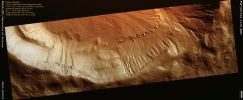
PSP_007143_1370_RED_abrowse.jpgGully Alcoves (MULTISPECTRUM; credits: Lunexit)65 visiteSeveral characteristics of crater wall gullies are visible in this image that provide possible insight into the formation mechanisms of gullies on Mars.
Gullies near the left side (North) of the image are deeper and originate in alcoves near the rim of the Crater. Gullies near the middle of the image are shallow and contain a more complex array of small channels. These smaller gullies initiate from a uniform elevation within the Crater Wall rather than at the Crater Rim. This suggests that the materials which flow down the Crater slopes to form the gullies originates at a specific layer exposed in the Crater Wall.
The undulating pattern of ridges on the Crater Floor (lower side of the image) appear similar to features interpreted as elsewhere on Mars that involve ice-rich materials.MareKromium
|
|
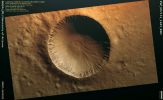
PSP_007151_1445_RED_abrowse-00.jpgColorful Layers in the Walls of an Unnamed Southern Crater (context frame - MULTISPECTRUM; credits: Lunexit)66 visiteThis image shows an unnamed, bowl-shaped impact crater located in the Southern Highlands. The crater is approximately 4 Km (about 2,5 miles) in diameter and 600 meters (approx. 2000 feet) deep.MareKromium
|
|
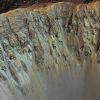
PSP_007151_1445_RED_abrowse-01.jpgColorful Layers in the Walls of an Unnamed Southern Crater (extra-detail mgnf - MULTISPECTRUM; credits: Lunexit)64 visiteThis extra-detail mgnf (enhanced to exaggerate color contrast) shows part of the North-facing walls of the crater, deeply carved by landslides. Rocky layers, mostly purplish in color, can be followed for hundreds of meters, poking through the loose materials that cover the slopes.
Locally, the rocky layers show patches of diverse colors (blue, green, yellow). These colors may be indicative of compositional differences in the rocky layers.MareKromium
|
|
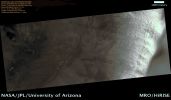
PSP_007153_2505_RED_abrowse.jpgDunes in Vastitas Borealis (MULTISPECTRUM; credits: Lunexit)62 visiteWindblown sand can be used to tell us the wind direction on Mars. Small-scale features, such as Ripples and Wind Tails, indicate the most recent wind directions.
Wind-Tails may be the remnants of a formerly widespread mantle of sediment that has been removed. Alternatively, they may have formed when aeolian sediment is deposited in the wind-shadow zone behind obstacles such as the 1,5 mt diameter boulders on the crater rim (Sx of the image). Their orientation points in the downwind direction and in this frane you can see two wind tails that extend from some boulders, thus indicating winds blowing from at least two different directions.
Ripples occur on the surface of all dunes imaged at HiRISE resolution on Mars and the alignment of Ripples often results from the influence of more than one wind direction.
In this frame, the Ripples are superimposed on a low dome dune.
On Earth, ripples on the surface of sand dunes may re-orientate in a matter of hours, but the time required to re-orientate Ripples on Mars is unknown.MareKromium
|
|

PSP_007162_1915_RED_abrowse.jpgBright and Dark "Slope Streaks" in Arabia Terra (MULTISPECTRUM; credits: Lunexit)93 visiteThis observation is of region between large craters in Arabia Terra, which is a large swath of bright (high albedo) terrain in the Martian Cratered Uplands. At the center of this image is a channel with a sinuous, fluvial-like (such as "river-like") morphology, although it has long since been dry.
The floor of the channel is covered with an array of linear dunes, which are accumulations of windblown sediment.
Of special interest in this scene is a series of dark (low albedo) and brighter (higher albedo) discolorations along the channel walls, also known as slope streaks. Most slope streaks are initially dark, gradually brighten with time, and are thought to be due to dust avalanches that remove a thin layer of bright dust to reveal darker material. Here, many streaks appear brighter than the surrounding undisturbed slope surface, and the origin of these bright streaks is not entirely clear.MareKromium
|
|
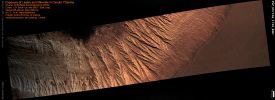
PSP_007166_1740_RED_abrowse-00~0.jpgExposure of Layers and Minerals in Candor Chasma (MULTISPECTRUM; credits: Lunexit)64 visiteScanning across several kilometers of relief, this image shows a cliff along a light-toned layered deposit in Valles Marineris. This particular cliff was targeted because of the excellent exposure of layering and the identification of the minerals Kieserite (a mineral containing Magnesium) and Hematite (an Iron Oxide).
The Hematite appears in the darker low-lying region of the image and the Kieserite is associated with the light-toned layers.
The fact that these minerals are found here with a layered deposit suggests that water may have been involved in the deposition of these minerals and the layers.
Erosion by wind has carved V-shaped patterns along the edges of many of the layers. The layers appear friable (easy to erode) so this is why wind can carve deep grooves along a steep cliff such as visible here.
The top of the layered deposit (lower part of image) is smooth and relatively dark because it is covered by debris laid down by the wind, dust and other fine materials.
The cliff has stronger winds flowing up and down it, plus the effects of gravity, so airborne debris can be shed downslope to expose the fresh brighter layered deposit.MareKromium
|
|
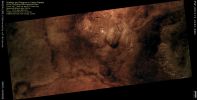
PSP_007173_2245_RED_abrowse-00~0.jpgScallops and Polygons in the Utopia Planitia Region (context frame - MULTISPECTRUM; credits: Lunexit)67 visiteThis image shows a portion of the Utopia Planitia, marked by polygonal features bounded by cracks and depressions in the mantle that possess scalloped edges.
Scalloped pits are typical features of the Martian mid-latitude mantle. Their presence has led to hypotheses of the removal of subsurface material, possibly interstitial ice, by sublimation (ice going directly from the solid state to the gas state). Their formation most likely involves development of oval- to scalloped-shaped depressions that may coalesce together, leading to the formation of large areas of pitted terrain. Scalloped pits typically have a steep pole-facing scarp and a gentler equator-facing slope.
On the surface surrounding the scalloped depressions is a polygonal pattern of fractures. This is commonly associated with scalloped terrain, and indicates that the surface has undergone stress, potentially caused by subsidence (sinking), desiccation (drying out), or thermal contraction. These polygon features are similar to permafrost polygons that form in polar and high alpine regions on Earth by seasonal-to-annual contraction of the subsoil. On Earth, such polygon features are indicative of the presence of ground ice.MareKromium
|
|
| 2236 immagini su 187 pagina(e) |
 |
|
|
|
|
135 | |
|
|
|
|








