Mars Reconnaissance Orbiter (MRO)
|
|
|
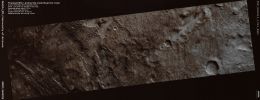
PSP_006913_1765_RED_abrowse-PCF-LXTT-1.jpgPossible MSL Landing Site in Miyamoto Crater (Enhanced Absolute Natural Colors; credits for the additional process. and color.: Dr Paolo C. Fienga - Lunexit Team) 206 visiteMiyamoto Crater is located in the South-Western portion of Meridiani Planum (and to the South-West of the Mars Exploration Rover Opportunity Landing Site). This image shows fairly smooth plains and some areas covered by Windstreaks, suggesting that wind is an active process here, depositing surface material downwind in the form of Streaks.
This possible Landing Site is adjacent to the hematite-bearing plains unit where the Opportunity Rover sits. The CRISM instrument has detected phyllosilicates (clay minerals) at this Site, which scientists believe to have formed in the presence of water. The MSL rover would investigate the mineral diversity here, which includes Phyllosilicates and Sulfates.MareKromium
|
|
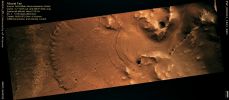
PSP_006941_1825_RED_abrowse~0.jpgAlluvial Fan in Crater East of Maja Valles (MULTISPECTRUM; credits: Lunexit)77 visiteThis image shows a large symmetrical Alluvial Fan at the mouth of a small channel along an unnamed crater. Alluvial fans with a well-defined channel source area are relatively uncommon on Mars.
This fan has a rib-like outer margin and many more terrace-like scarps upslope near the channel mouth. These terraces may indicate the outer margin of sediment deposits during each “pulse” of deposition. Further study of these types of alluvial fans may shed light on past sedimentary environments and conditions on Mars. MareKromium
|
|

PSP_006952_1870_RED_abrowse-00~0.jpgDunefield in West Arabia Terra Unnamed Crater (context frame; MULTISPECTRUM - credits: Lunexit)77 visiteThis image shows dunes in an unnamed crater in the West Arabia Terra region.
The rim of the crater lies to the South of the image (Sx) and a dark, toned field of barchan sand dunes rests on the crater floor in the Northern portion of the observation (Dx). MareKromium
|
|

PSP_006952_1870_RED_abrowse-01.jpgDunefield in West Arabia Terra Unnamed Crater (extra-detail mgnf - RAW Frame; credits: NASA/JPL/Univ. of Arizona)65 visiteBarchan dunes are commonly found on Earth, and are generally crescent-shaped with a steep slip face bordered by horns oriented in the downwind direction (see here).
Barchan dunes form by unidirectional winds and are good indicators of the dominant wind direction. In this case, the strongest winds blew approximately North to South.
These dunes are most likely composed of basaltic sand that has collected on the bottom of the crater. Superimposed on their surface are smaller secondary dunes which are commonly seen on terrestrial dunes of this size.
Many smaller and brighter bed forms — most likely small dunes or granule ripples — also cover the substrate between the larger dark dunes.
The dark dunes overlie the small bright bed forms indicating that the darker dunes formed more recently.MareKromium
|
|

PSP_006952_1870_RED_abrowse~0.jpgDark Dunefield in West Arabia Terra (MULTISPECTRUM and Yellow/Orange Filters ON; credits: Lunexit)78 visiteThis image shows dunes in an unnamed crater in the west Arabia Terra Region.
The rim of the crater lies to the South of the image (Sx)and a dark, toned field of Barchan Sand Dunes rests on the crater floor in the Northern portion of the observation.
Barchan Dunes are commonly found on Earth, and are generally crescent-shaped with a steep slip face bordered by horns oriented in the downwind direction. Barchan Dunes form by unidirectional winds and are good indicators of the dominant wind direction. In this case, the strongest winds blew approximately North to South.
These dunes are most likely composed of basaltic sand that has collected on the bottom of the crater.
Superimposed on their surface are smaller secondary dunes which are commonly seen on terrestrial dunes of this size. Many smaller and brighter bed forms — most likely small dunes or granule ripples — also cover the substrate between the larger dark dunes. The dark dunes overlie the small bright bed forms indicating that the darker dunes formed more recently.
MareKromium
|
|
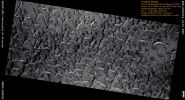
PSP_006959_2610_RED_abrowse-PCF-LXTT.jpgFrozen Dunes (Absolute Natural Colors; credits for the additional process. and color.: Dr Paolo C. Fienga - Lunexit Team)185 visitenessun commentoMareKromium
|
|
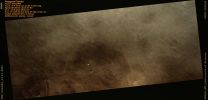
PSP_006962_2215_RED_abrowse.jpgPolygonal Terrain (Natural Colors; credits: Lunexit)88 visitenessun commentoMareKromium
|
|

PSP_006968_1735_RED_abrowse~0.jpgMound of Layers in East Candor Chasma (MULTISPECTRUM; credits: Lunexit)64 visiteThis image shows the Northern portion of East Candor Chasma, part of the Valles Marineris Canyon System. In the center of the image is a light-toned mound that has dozens of layers exposed along its edge. As the upper layers weather and break apart into smaller grains, these grains subsequently fall down the edge, burying layers beneath and producing triangular-shaped debris aprons.
The color image of the mound doesn’t show any significant color variations between the different layers.
However, another instrument on MRO called CRISM (Compact Reconnaissance Imaging Spectrometer for Mars) has observed compositional differences between the layers and these results have been helpful in deciphering the origin of these layers.
This deposit is one of several examples exhibiting sulfate-rich layers with alternating hydration states. Cliff-forming Kieserite-rich layers alternate with slope-forming polyhydrated sulfate layers. (Kieserite is a mineral containing Magnesium).
The apparent lack of slumping, channels, cross-bedding or bed truncation supports quiescent water or deposition from the air as the most likely origin for the layers.MareKromium
|
|

PSP_006969_1725_RED_abrowse-00.jpgThe Floor of Noctis Labyrinthus (context frame - MULTISPECTRUM; credits: Lunexit)67 visiteThis image shows part of Noctis Labyrinthus, the “Labyrinth of the Night.” This is a system of connecting troughs which form a maze-like network at the western end of Valles Marineris, the giant canyon system of Mars.
The individual troughs are usually kilometers across; this image shows part of the floor of one of the troughs, with some intriguing fine-scale features.
Near the center of the image, the floor is broken up into many small knobs and hills, probably eroded remnants of a larger geologic unit.MareKromium
|
|

PSP_006969_1725_RED_abrowse-01.jpgThe Floor of Noctis Labyrinthus (extra-detail mgnf - MULTISPECTRUM; credits: Lunexit)76 visiteThe most striking feature of many of these knobs is a thin, bright band which often wraps around the edges near the bottom, as in this extra-detail mgnf. This image was acquired in order to investigate whether this is an exposed layer of rock or the shoreline of a former body of water.
HiRISE resolves details of the bright band that indicate that this is an unusual layer of rock, rather than an old shoreline. In several places, the band is broken up along cracks, sometimes forming boulders. This indicates that the band is solid rock, while material left on a shoreline should be loose sediments. It is now exposed as rings and arcs where erosion has cut deeply enough to expose the layer.
This band must indicate some unusual event in the geologic history of the region when a different type of rock was deposited; it is strikingly different in color from the other rocks. Although it is not a shoreline, it could be material that was deposited on the floor of a much older lake or sea and then buried by other rock; it could also have been laid down by other sedimentary processes or as volcanic ash.
MareKromium
|
|

PSP_006972_1710_RED_abrowse.jpgRecent Impact (Absolute Natural Colors; credits for the additional process. and color.: Dr Paolo C. Fienga - Lunexit Team)71 visitenessun commentoMareKromium
|
|

PSP_006978_1190_RED_abrowse.jpgSouthern DD Tracks (Absolute Natural Colors; credits: Dr Paolo C. Fienga - Lunexit Team)85 visitenessun commentoMareKromium
|
|
| 2236 immagini su 187 pagina(e) |
 |
|
|
|
|
132 | |
|
|
|
|








