Mars Reconnaissance Orbiter (MRO)
|
|
|

PSP_006528_1120_RED_abrowse-02.jpgSources of Basaltic Sand (extra-detail mgnf n. 2; MULTISPECTRUM - credits: Lunexit)88 visiteThis rocky layer may originally have been a lava flow; Martian lava flows are predominantly composed of basalt, which would account for the dark color of the sand.
The polygonal pattern of the bright upper layer may be due to repeated freezing and thawing of the soil that buries the lava flow. The tracks of Dust-Devils are clearly visible on the smooth, sandy surface but largely vanish when they cross into the polygonally fractured terrain.MareKromium
|
|

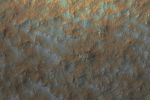
PSP_006538_1035_RED_abrowse-01.jpgSouthern Dunes and Spiders (extra-detail mgnf - MULTISPECTRUM; credits: Lunexit)65 visitenessun commentoMareKromium
|
|
PSP_006538_1035_RED_abrowse-02.jpgSouthern Dunes and Spiders (extra-detail mgnf - MULTISPECTRUM; credits: Lunexit)76 visitenessun commentoMareKromium
|
|
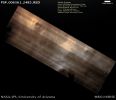
PSP_006561_2485_RED_abrowse.jpgWinter Sunrise in Vastitas Borealis (Absolute Natural Colors; credits for the additional process. and color.: Dr Paolo C. Fienga)89 visiteThis High Latitude image shows a portion of the Landing Ellipse for the Mars Scout Spacecraft Phoenix as seen during late Winter on Mars. Phoenix will land somewhere within the Ellipse on Memorial Day, 2008, but probably not within this image.
While the Phoenix Lander will land in Mid-Spring and operate through the Martian Summer, the current Winter landscape looks somewhat different. The Sun is beginning to rise from the Winter night and is only 10° above the horizon to illuminate the Surface in this image.
As a result, what few rocks are present cast noticeable shadows, and every bump and undulation of the Surface, now matter how small, is accentuated.
In this Winter image, a blanket of CO2 Frost (dry ice snow) about a foot deep covers the Surface. Bright patches in the image are areas where the Frost is relatively clean, while in darker areas over much of the image, the Frost is either dirty with Atmospheric dust or the Frost is somewhat translucent allowing us to see a little of the Soil forming the Surface.
Summertime images of this Region show that small Hexagonal and Polygonal Patterns a few meters (yards) in size ubiquitously cover the entire Region. These Patterns are the result of annual thermal contraction in ice-cemented soil forming a honeycomb network of small fractures below the Surface that manifest themselves as small shallow Troughs (---> canaletti) at the Surface.
Interestingly, these Patterns are not visible in this image. The shallow Troughs that mark the polygons are currently filled in with CO2 Frost making them virtually invisible.
As Spring approaches the CO2 Frost will slowly sublimate (changes directly from ice to gas) and the Polygons will once again become visible. MareKromium
|
|
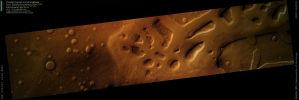
PSP_006567_2220_RED_abrowse-00.jpgFlooded Terrain in Terra Sabaea (MULTISPECTRUM; credits: Lunexit)65 visiteTwo distinctly different terrain types are visible in this image of the Northern Lowlands of Mars: an older, heavily cratered landscape has been inundated by much younger flows.
The valley floors are filled with flows that have relatively smooth surfaces and very few superposed impact craters.
In contrast, the mesas and hills making up the older terrain have blocky surfaces, perhaps fragmented by ancient impacts. MareKromium
|
|

PSP_006567_2220_RED_abrowse-01.jpgFlooded terrain in Terra Sabaea (extra-detail mgnf - MULTISPECTRUM; credits: Lunexit)88 visiteThe smooth surfaces of the flows are punctuated by curved, subparallel fractures oriented transverse to the flow direction.
These cracks resemble crevasses in terrestrial glaciers and were formed when the brittle solid crust of the flow fractured as it was dragged downstream. Detailed images such as this will help determine the role ice may have played in these flows.MareKromium
|
|
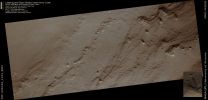
PSP_006569_1915_RED_abrowse-00-PCF-LXTT.jpgFeatures of Henry Crater (Absolute Natural Colors; credits for the additional process. and color.: Dr Paolo C. Fienga - Lunexit Team)96 visiteNamed after a 19th Century French Astronomer, Henry Crater is an about 165 Km (approx. 103 mile) diameter Impact Crater, located in Arabia Terra, on a portion of the Martian Highlands extending into the Northern Hemisphere. This observation shows multiple Layers on the Edge of a Mound on the Floor of the Crater, which is distinct from others in the immediate vicinity.
The Layers represent the eroded remains of Sedimentary Rocks that formed from Sediments deposited within the Crater sometime after its formation. The origin of the Sediments on the Crater Floor in not known but may be windblown Dust and Sand.
The Layers exhibit differences in degrees of hardness and resistance to erosion with resistant Layers forming Cliffs and more easily eroded Layers forming Ledges.
Inset: Several Dark Streaks are visible on the Slopes. Slope Streak formation is among the few known processes currently active on Mars. Streaks are believed to form by downslope movement of Dust in an almost fluid-like manner (analogous to a terrestrial Snow Avalanche) either exposing darker underlying material or creating a darker surface by increasing its roughness. MareKromium
|
|
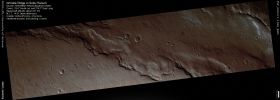
PSP_006573_1560_RED_abrowse-PCF-LXTT.jpgWrinkle Ridge in Solis Planum (Absolute Natural Colors; credits for the additional process. and color.: Dr Paolo C. Fienga)91 visiteThis observation shows a "Wrinkle Ridge" in Solis Planum, located in the Thaumasia Region of Mars, a high-elevation Volcanic Plain located South of the Valles Marineris Canyon System and East of the Tharsis Volcanic Complex.
Solis Planum contains some of the most distinct and well studied arrays of Wrinkle Ridges on Mars. Wrinkle Ridges are long, winding topographic highs and are often characterized by a broad arch topped with a crenulated ridge. These features have been identified on many other planetary bodies such as the Moon, Mercury and Venus.
On Mars, they are many tens to hundreds of kilometers long, tens of kilometers wide, and have a relief of a few hundred meters.
Wrinkle Ridges are most commonly believed to form from horizontal compression or shortening of the Crust due to Faulting and are often located in Volcanic Plains. They commonly have asymmetrical cross sectional profiles and an offset in elevation on either side of the ridge. Large Dunes are also visible bordering the Wrinkle Ridge. The reddish colors seen in this image most likely indicate the presence of Dust (or indurated Dust) and the darker, bluish colors most likely indicate the presence of larger Rocks and Boulders on the Wrinkle Ridge.MareKromium
|
|
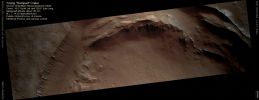
PSP_006588_1615_RED_abrowse-PCF-LXTT.jpgRelatively young "Rampart" Crater (Absolute Natural Colors; credits for the additional process. and color.: Dr Paolo C. Fienga - Lunexit Team)88 visiteThis image captures the Western Side of a relatively young “Rampart” Crater located in the Tharsis Region.
Rampart Craters are surrounded by a fluidized Ejecta Blanket (an Ejecta Blanket is the material thrown out around a Crater when the impact occured, in this case resembling the whites of a fried egg, where the crater is the yolk). Researchers speculate that these may form when an object impacts ground that contains fluid (liquid or frozen) that is released upon impact.
THEMIS images V06896002 and V10266002 provide context images for this side of the Crater and show better its Rampart.
Within the Crater we see evidence of Landslides originating at the upper edges. These Landslides have exposed individual Rocky Layers as well as Outcrops of stronger rock types which are more resistant to erosion.MareKromium
|
|
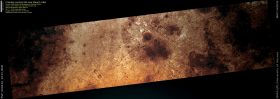
PSP_006610_2035_RED_abrowse~0.jpgPotential MSL Landing Site near Mawrth Vallis (MULTISPECTRUM; credits: Lunexit)65 visiteMawrth Vallis contains clay minerals that formed by chemical alteration of rocks by water. It is one of the short list of potential sites that the Mars Science Laboratory Rover will land at, and the HiRISE team is working to find a safe place to land in this area.
This observation shows a wide variety of scientifically interesting terrains as well as some potential hazards for landing. The central part of the image is dominated by light-toned materials with curving fractures of many different sizes. These fractures do not have a preferred orientation, indicating that they did not form in response to some regional stress pattern.
Instead, they formed by some more uniform process, possibly the drying of a thick mud deposit or the gradual rebound of the area as the overlying material was eroded away. The scattered mounds and sand dunes may or may not prove to be a danger, but it is reassuring to see that many of the impact craters have been smoothed out with a filling of wind-blown sand.MareKromium
|
|
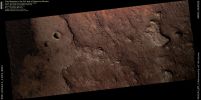
PSP_006625_1405_RED_abrowse-00-PCF-LXTT.jpgClay Minerals in the NW side of Bosporos Montes (Absolute Natural Colors; credits for the additional process. and color.: Dr Paolo C. Fienga - Lunexit Team)85 visiteThe Bosporos Montes make up part of the Rim of the giant Argyre Impact Basin on Mars. The Compact Reconnaissance Imaging Spectrometer (CRISM) identified this as a location with Clay Minerals (---> minerali a matrice argillosa). Such minerals contain water and may have formed under conditions favorable for life.
This HiRISE image was taken to support the CRISM Team’s investigation of this area. While HiRISE does not have the ability to identify minerals the way CRISM can, the enhanced colors in this image are similar to those seen in other Clay-containing parts of Mars.
The light-toned Mesas and Plains are crisscrossed with small Fractures that could have formed as a muddy Clay Deposit dried. However, this material is strong enough to form Boulders where it has been hit by Impact Craters.MareKromium
|
|
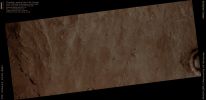
PSP_006633_2010_RED_abrowse~0.jpgPossible MSL Landing Site in Nili Fossae (Absolute Natural Colors; credits for the additional process. and color.: Dr Paolo C. Fienga - Lunexit Team) 98 visiteThe Nili Fossae are Valleys that have cut into the ancient crust of Mars, exposing Clay Minerals. These minerals formed in the presence of water and may be the result of chemical reactions between hot water and rocks. If so, this could have been a favorable location for Martian Life in ancient times.
This HiRISE image is part of a series in search for a safe place the Mars Science Laboratory Rover can land. In the central part of the image, the Terrain is a mix of Sand Dunes and relatively smooth rock exposures. There are some small Knobs but very few large rocks in the area. Instead, the multi-colored rock exposures seem to be mostly a mosaic of flat fractured rock.
On the Southern edge of the image (Dx), an Impact Crater is a potential hazard. In the Northern part of the image, the Scarp marking the boundary of the valley is visible.MareKromium
|
|
| 2236 immagini su 187 pagina(e) |
 |
|
|
|
|
129 | |
|
|
|
|








