Mars Reconnaissance Orbiter (MRO)
|
|
|

PSP_006278_2225_RED_abrowse.jpgUnusual Surface Patterns inside Moreux Crater (MULTISPECTRUM; credits: Lunexit)78 visiteUnusual surface patterns near the center of Moreux Crater suggest a complicated history of glacial flow. A series of ridges and troughs originating from the crater’s central peak to the west of this image terminate in this area in a jumble of twisted patterns and circular depressions.
The superposition of impact craters and sand dunes on top of these ridges and troughs suggests that the flow patterns are old and that any ice may be largely gone. The round depressions may have formed when large sections of relatively clean ice were left in place to melt or sublimate. The ridges would be analogous to moraines in Earth glaciers, formed from rock and debris mixed with the ice that flow with the glacier.
The complicated and twisting patterns indicate that the ice flowed into this area, which is at a lower elevation on the crater floor, and piled up behind itself as the flow stalled. Numerous boulders are also scattered over the surface of ridges and troughs.
Boulders may have been carried into place with the ice and as the ice was removed, the boulders were left in place.
MareKromium
|
|
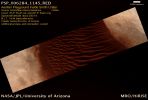
PSP_006284_1145_RED_abrowse-00.jpgLarge Dunefield inside Smith Crater (MULTISPECTRUM; credits: Lunexit)71 visiteThis image shows a Dark Dunefield in Smith Crater. The dark color of the dunes indicates that they are probably made of basaltic sand, a dark volcanic rock that is common on Mars. This is in contrast to dunes on Earth, which are dominated by quartz, a rare mineral on Mars.
The dunes here are “transverse dunes” that, based on analogy with similar features on Earth, form by winds that blow in a direction perpendicular to the crests. However, Secondary ripples on top of the dunes are oriented at right angles; that indicates a second wind regime that has redistributed the sand after the original dunes formed. The multiple orientations of the dunes may be partly caused by their location within the crater, whose own topography can act to redistribute regional wind patterns.
The dark streaks on the lighter terrain outside of the Dunefield are interpreted as DD tracks, where mini-tornadoes reveal darker ground beneath the bright dust of the surface.
Some long DD Tracks are visible in the southern part of the dune field and climb onto the troughs of the transverse dunes. There are also a few faded tracks at the northern part of the dune field.MareKromium
|
|

PSP_006284_1145_RED_abrowse-01.jpgOn the edge of the Dunefield... (MULTISPECTRUM; credits: Lunexit)63 visitenessun commentoMareKromium
|
|

PSP_006284_1145_RED_abrowse-02.jpgOn the edge of the Dunefield... (MULTISPECTRUM; credits: Lunexit)84 visitenessun commentoMareKromium
|
|

PSP_006284_1145_RED_abrowse-03.jpgMedium-sized Boulders inside Smith Crater (MULTISPECTRUM; credits: Lunexit)70 visitenessun commentoMareKromium
|
|
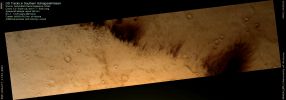
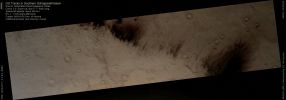
PSP_006477_1745_RED_abrowse-00~0.jpgDD Tracks in Southern Schiaparelli Basin (context frame - False Colors; credits: Lunexit)88 visiteDust-Devils (DD) are vortices of wind that form when air rising from a warm surface encounters shear in the above atmosphere.
Martian Dust-Devils can attain gargantuan proportions, reaching the size of terrestrial tornadoes with plumes that tower up to 9 Km above the surface.
Dust-Devils play an important role in sustaining the aerosols that make up Mars’ Red Sky and in cleaning the Martian Surface after a Dust Storm.
Nota Lunexit: sono quindi i DD, secondo la NASA, la "causa maggiore" del Cielo Rosso di Marte? Interessante riflessioni ed interessante quesito: dunque il Cielo di Marte NON E', naturalmente, "rosso" o "arancio", ma è "tinto di rosso/arancio"!
Pensateci sopra...
MareKromium
|
|
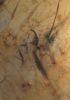
PSP_006477_1745_RED_abrowse-01.jpgDD Tracks in Southern Schiaparelli Basin (extra-detail mgnf - False Colors; credits: Lunexit)65 visiteThis observation shows a Region near the Martian Equator that is a perfect tablet for the scribblings of Dust-Devils. This Region is made up of dark bedrock that is thinly blanketed by bright dust.
Dark tracks form when Dust-Devils scour the surface, exposing the darker substrate. The tracks tend to cluster together, as Dust-Devils repeatedly form over terrain that has been previously scoured and is consequently darker and warmer than the surrounding surface.
Once lofted by a Dust-Devil, the fine dust can be transported great distances before it settles again onto the surface.MareKromium
|
|
PSP_006477_1745_RED_abrowse-PCF-LXTT.jpgDD Tracks in Southern Schiaparelli Basin (CTX Frame - Natural Colors; credits for the additional process. and color.: Dr Paolo C. Fienga - Lunexit Team) 158 visitenessun commentoMareKromium
|
|

PSP_006487_1580_RED.jpgCollapse Features in Tyrrhena Patera (natural colors; credits: Lunexit)65 visiteIn this image you can notice a set of craters around the rim of Tyrrhena Patera. Tyrrhena Patera is a volcano in the Southern Highlands with shallow slopes, and only 2 Km (about 1,2 miles) of vertical relief.
The craters are aligned and are known as Pit Crater Chains. These are common in Volcanic Regions on Mars.
They are not formed by a meteorite impact, but by collapse into some void space underground.
Because the Pit Crater Chains and Concentric Fractures are generally aligned, these are most likely due to extension in the Region, where parts of the Martian Crust pull apart during growth of the volcano or emplacement of dikes.
Another way pit crater chains can occur is when Lava Tubes partially collapse forming chains of holes along the roof of the Lava Tubes themselves.
A third possibility is that these may be associated with collapse of the underground magma chamber.MareKromium
|
|
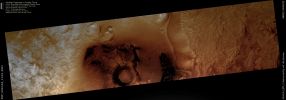
PSP_006504_1910_RED_abrowse-00~0.jpgAeolian Features in Arabia Terra (MULTISPECTRUM; credits: Lunexit)72 visiteThis observation shows part of the floor of a large impact crater in Arabia Terra. This crater formed in the distant past when a large asteroid or comet struck Mars, and it has been heavily modified since formation.
The crater was partially filled by sediments, forming the rock outcrops and layers visible in this image.
After this material was laid down, part of the deposits were eroded away. The central part of the image has been carved especially deeply, forming a distinct depression.
This depression has been a site of aeolian transport of sand in more recent times. A particularly interesting aspect of this site is that there appears to have been multiple styles of aeolian activity. Both large sand dunes (the dark hills) and smaller ripples (sharp, light-toned narrow ridges) are visible.
While ripples are often found in association with dunes, the different colors suggest that the material is not the same.
(At full resolution, the surfaces of both the dunes and the large ripples are covered with much smaller ripples)
Even where the ripples and dunes are in contact, there is a distinct contrast between the materials: dark sand appears to fill a trough between two large light ripples, suggesting that the dark sand has moved more recently. This could be due to different grain sizes, since certain sizes are most easily lifted by the wind.MareKromium
|
|
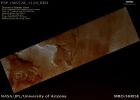
PSP_006528_1120_RED_abrowse-00~0.jpgSources of Basaltic Sand (context frame; MULTISPECTRUM - credits: Lunexit)65 visiteSand dunes are among the most prominent wind-formed features found on Mars. Their morphologies depend on the winds and also on the local supply of sand grains, so they provide clues to the nature of both the Martian Atmosphere and Surface.
Dunes form through the accumulation of coarse sand grains carried by the wind by means of saltation, or bouncing along the surface. Monitoring the present day dune activity can help determine the timescale over which Martian rocks are eroded, as the impacting grains sandblast the surface over time. The sands of Mars must be continually replenished as the coarse grains are ground into fine dust by repeated impacts. Finding the hidden sources of fresh sand is a challenge for HiRISE.MareKromium
|
|

PSP_006528_1120_RED_abrowse-01.jpgSources of Basaltic Sand (extra-detail mgnf n. 1; MULTISPECTRUM - credits: Lunexit)80 visiteThis image was targeted at a point in Mitchell Crater in the Southern Highlands of Mars where sands abruptly appear and spread North.
The sands seem to derive from the edge of an eroding mesa (shown here with an arrow; 8,66 Km, or about 5,4 miles across).
A close-up view of the terrain nearby (see the extra-detail mgnf n. 2) suggests that boulders and sand have been excavated by erosion from beneath brighter, polygonally fractured ground (1,45 Km, or about 0,9 mi across). MareKromium
|
|
| 2236 immagini su 187 pagina(e) |
 |
|
|
|
|
128 | |
|
|
|
|








