Mars Reconnaissance Orbiter (MRO)
|
|
|
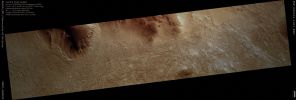
PSP_006162_1365_RED_abrowse-PCF-LXTT.jpgCentral Peak Gullies (Absolute Natural Colors; credits for the additional process. and color.: Dr Paolo C. Fienga - Lunexit Team)122 visitenessun commentoMareKromium
|
|
PSP_006234_1870_RED_abrowse-PCF-LXTT.jpgFeatures of Cerberus Fossae (Absolute Natural Colors; credits for the additional process. and color.: Dr Paolo C. Fienga)221 visitenessun commentoMareKromium
|
|

PSP_006237_1460_RED_abrowse.jpgLandforms of Dao Valles (MULTISPECTRUM-2; credits: Lunexit)70 visiteThis image in a section of Dao Valles contains a multitude of landforms that may result from the actions of ice. Aligned ridges on the valley floors are evidence of glacier-like flow of this material as it gets diverted around obstacles such as the valley walls and local mesas and knobs.
In some areas where the flow appears to have traveled over an obstacle instead of around, a series of fractures occur, analogous to crevasses that form in glaciers on Earth when ice flows over obstacles. The surface we see is covered with rocky debris and soil that may be protecting ice from sublimation.
Throughout the Region, the surface has been mantled by a smooth deposit that appears to have been eroded in a few locations. This sort of mantle is common at Martian High Latitudes and is thought to be a mixture of dust and ice, either ice-cemented soil or very dirty snow. The eroded areas could be due to ice loss trough sublimation, leaving the remaining surface to collapse or be eroded by the wind.
Many gullies are observed that appear to be carved into the valley walls by liquid water. Incised channels in places cut deeply into the surface and fans of debris with crisscrossing small channels indicate where the flow of water slowed and deposited material eroded from upstream. The source of water is as yet unknown. One theory has been proposed involving melting of surface ice or ice-rich soil in the cold Martian climate. Another theory suggests that an aquifer a few hundred meters (yards) below ground is feeding the gullies.
MareKromium
|
|

PSP_006248_1235_RED_abrowse.jpgDark-Reddish Dunes in Terra Cimmeria (MULTISPECTRUM-2; credits: Lunexit)75 visiteThis image shows a set of dark sand dunes within the Northern part of an unnamed crater in the Terra Cimmeria Region.
The dunes have a distinctive shape, with two horns on one end and a rounded edge on the other. The side of the dunes with the horns has a steeper slope and the rounded side a more shallow slope. These types of dunes are called “Barchans” and, by analogy with similar dunes on Earth, form in areas with limited sand supply.
The horns of the barchans point in the downwind direction, thereby indicating that the predominant surface winds in this Region blew from the East (up). Further evidence of this wind regime is apparent when one zooms into the image. “Wind tails” are visible on the Western (down) side of many rocks (many of these rocks may be ejecta from the degraded crater in the Northern part of the image). Wind tails are formed by the accumulation of dust and sand in the lee of rocks, which act as wind shadows. Very small light ripples at a scale of a few meters (yards) are also apparent.
The dark, sinuous forms in the image are tracks left by dust devils, which lift bright dust off the surface, revealing the darker surface. Where dust devils cross the dunes, the fine texture on the dunes is undisturbed, indicating that the particles making up the dunes are coarse and fairly immobile.
MareKromium
|
|
PSP_006250_2200_RED_abrowse-PCF-LXTT-0.jpgFeatures of Nilosyrtis Region (Absolute Natural Colors; credits for the additional process. and color.: Dr Paolo C. Fienga - Lunexit Team)163 visitenessun commentoMareKromium
|
|
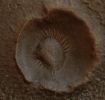
PSP_006250_2200_RED_abrowse-PCF-LXTT-1.jpgUnnamed Crater in Nilosyrtis Region (Absolute Natural Colors; credits for the additional process. and color.: Dr Paolo C. Fienga - Lunexit Team)250 visitenessun commentoMareKromium
|
|

PSP_006252_2220_RED_abrowse.jpgLineated Valley Fill (MULTISPECTRUM; credits: Lunexit)67 visiteFlow patterns dominate this Region of Mars in Deuteronilus Mensae. Many of the valley floors in the area exhibit complex alignments of small ridges, hills, and pits – often called “lineated valley fill”. The cause of the small-scale texture is not known, but it may result from patterns in ice rich soils or the loss of ice.
The linear alignment we see is probably caused by downhill movement of ice-rich soil, or glacial flow in dirty ice or ice-rich soil.
The result is flow patterns, called “stream lines”, that follow the valleys and around obstacles. Many of the large knobs and mesas in this region are also surrounded by aprons of debris that appear to have flowed away from the knobs and may be ice-rich themselves. Around one large knob in this image the debris flow appears to lie on top of the lineated valley fill and is therefore probably a younger deposit.MareKromium
|
|
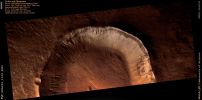
PSP_006261_1410_RED_abrowse.jpgGullies with Meanders (MULTISPECTRUM; credits: Lunexit)71 visiteThis observation features a relatively pristine crater in the Southern Mid-Latitudes. The crater still has a sharp rim on its South end, but it has experienced modification since forming.
The North half of the crater is populated by a large number of gullies that appear to emanate from resistant layers. The layers likely continue around the crater, but the gullies do not. Distinct layers are visible on the South wall of the crater.
It is unknown why gullies form on certain slopes and not others. Interestingly, the gullies themselves are not so pristine. They are covered by dunes and cut by polygonal fractures, indicating that they have been modified by aeolian and periglacial processes, respectively.
There are a large number of boulder tracks visible on the crater walls. Boulder tracks typically are approximately constant in width, and can often be seen at the track ends.
The crater floor has a texture indicative of sublimation processes.
If a soil is ice-rich under Martian conditions, the ice can sublimate causing the ground to collapse and “crinkle” where the ice used to be.
MareKromium
|
|

PSP_006262_1080_RED_abrowse-00~0.jpgExposure of Basal Section of South Polar Layered Deposits (MULTISPECTRUM; credits: Lunexit)86 visiteThis observation shows internal layering exposed in a so-called "Basal Section" of the Polar Layered Deposits.
The South Polar Layered Deposits are composed primarily of water ice with a small amount of dust.
Variations in dust content most likely controls the erosion of the layers. The layers were laid down over a large area near the South Pole, probably over the past few million years. They are believed to record recent global climate changes on Mars in much the same way that polar ice in Greenland and Antarctica provide information about varying climatic conditions on Earth.
Several layers appear to be truncated and most likely represent unconformities. Unconformities form when an episode of erosion that removes all or part of a layer, is followed by more deposition.MareKromium
|
|

PSP_006268_1995_RED_abrowse.jpgThe alleged "Bridges" of Chrise Planitia (MULTISPECTRUM; credits: Lunexit)81 visiteThis image shows part of the surface of Chryse Planitia, near the mouth of several of the giant outflow channels carved by massive floods. At this location the channel is much too large to be seen within a HiRISE image, and this shows an area of level plains near the mouth.
Two geologic units are visible at this site: a relatively dark expanse in the southern part of the image (Dx) and a light, slightly higher-standing area along the northern edge. The light unit may be material that has flowed out from below the surface in a process called mud volcanism. However, many aspects of the history of the Northern Plains of Mars remain uncertain.
A few other prominent features are present. A long trough with aeolian ripples runs through the eastern part of the image. This feature likely formed by contraction of the surface layer. This must have occurred after the formation of the light material since it cuts through the light unit in the northwest part of the image.
There is also a large mound which appears to bury part of the trough, and thus is even younger. Alternatively, two troughs could both terminate at the hill.
Despite the resolution of HiRISE, the nature of this mound is still unclear. It has a rugged surface, which might mean that it has been eroded enough to remove indications of its origin.
MareKromium
|
|
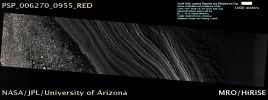
PSP_006270_0955_RED_abrowse~0.jpgSouth Polar Layered Deposits and Residual Ice Cap (natural colors; credits: Lunexit)80 visiteA wide variety of South Polar Terrains are on display in this spectacular HiRISE image. The reddish material on the left of the image is the SPLD. These deposits are a stack of layered, dusty water ice. Scientists believe that these layers record previous climatic conditions on Mars, much like terrestrial ice-sheets provide a record of climate change on the Earth.
This image shows the face of one of the many scarps or shallow cliffs that cut into the SPLD. These scarps expose the internal layers within the SPLD. You can see these climate-recording layers in the last2/3rds of the image, left side, running from lower-left to upper-right.
The terrain in the last third of the image is quite different in both appearance and composition. The bright, white-ish material is a thin covering of CO2 ice draped over the flat areas of the SPLD. This covering of CO2 is being eroded away by expanding flat-floored pits. Parts of the floors of these pits show the reddish brown coloring of the underlying SPLD.
These pits have eroded the CO2 ice layer to such an extent that only isolated mesas remain today and even these shrink in extent by a few meters each year.
These mesas also have several layers within them, indicting that they likely contain a climatic record, albeit a much shorter one than preserved in the SPLD.
Most of the isolated mesas have white-ish tops; however, some (near the foot of the SPLD scarp) have reddish tops. This may either be due to bright CO2 ice thinning to reveal the older (and darker) CO2 ice that makes up the main body of the mesa, or perhaps dust has settled out of the atmosphere to cover the brighter frost.
Remember that there was a large Martian Dust Storm earlier this year which could have caused either effect.MareKromium
|
|

PSP_006271_2210_RED_abrowse.jpgPrimary and Secondary Craters in Arcadia Planitia (MULTISPECTRUM; credits: Lunexit)63 visiteThese unusual craters were spotted in Arcadia Planitia, which is part of an extensive region of Mars blanketed by a thick layer of bright dust.
Light southeasterly winds during southern spring and summer blow the dust towards the northwest (top left of the picture in the cutout above). The dust is trapped temporarily in the lee of crater rims, both inside the craters and along the outside rims where they form streamers that resemble St. Nick’s beard.
MareKromium
|
|
| 2236 immagini su 187 pagina(e) |
 |
|
|
|
|
127 | |
|
|
|
|








