Mars Reconnaissance Orbiter (MRO)
|
|
|

PSP_005748_1075_RED_abrowse~0.jpgBuried Crater in the SPLD (natural colors; credits: Lunexit)66 visiteThis image of the SPLD shows some of the layers cut off against other layers below and right of center. Geologists call this an “angular unconformity” because the layers do not conform to each other across this boundary.
In this case, the angular unconformity was probably caused by erosion of the SPLD followed by deposition of new SPLD on top of the eroded surface, but faulting could also have caused the observed unconformity.
Near the unconformity is an impact crater, one of dozens found on the SPLD. The presence of these craters implies that the surface of the SPLD has been relatively stable (i.e., little erosion or deposition) in the past few million years.
This is in stark contrast to the NPLD, on which craters are very rare, implying very recent erosion/deposition.MareKromium
|
|

PSP_005770_1745_RED_abrowse-00.jpgThe "Martian Black Hole" (False Colors; credits for the additional process. and color.: Dr Paolo C. Fienga - Lunexit Team)77 visitenessun commento
MareKromium
|
|

PSP_005788_1035_RED_abrowse.jpgRepeated Erosion and Deposition in the SPLD (MULTISPECTRUM; credits: Lunexit)65 visiteThis image of the SPLD shows evidence of multiple episodes of deposition and erosion near their base.
The SPLD, like the North Polar Layered Deposits (NPLD), are thought to contain a record of global climate changes on Mars. The surface of the outcrop shown here slopes generally toward the right. The layering is cut off by deposits that partly fill two broad valleys that were previously cut into the SPLD, probably by wind erosion. These more recent deposits appear to cover the flatter, upper part of the SPLD, and have also been eroded to expose layering with them.MareKromium
|
|

PSP_005813_2150_RED_abrowse.jpgUnusual Depression near Elysium Mons (MULTISPECTRUM; elab. Lunexit)76 visiteThis unusual depression and the associated concentric rings are situated within an area thought to have been deposited as a mud flow. Due to the lack of a distinctive, raised rim or other impact-related features, this crater is thought to have formed by the loss of material below the surface and subsequent collapse, rather than by an impact from space.
The exact mechanism for the loss of material is not fully understood, although the missing material was likely water in some form. This feature is near a large volcano, so perhaps there were explosive magma-water interactions that violently removed the water and some magma, followed by surface collapse. Or, less violently, there could have been simple melting of subsurface ice and then collapse of the surface into the resulting void. The rays emanating from the depression suggest some amount of violence before the surface collapse that sprayed material far from the depression.
Some aspects of this and other, nearby features are similar to the collapse pits associated with Grímsvötn volcano in Iceland, which erupts beneath an ice-cap. However, there are no rays formed during the eruptions at Grímsvötn.
MareKromium
|
|

PSP_005817_1515_RED_abrowse.jpgBedrock (MULTISPECTRUM; credits: Lunexit)64 visite
This frame shows part of the floor of an unnamed crater in the Southern Highlands, near Hellas Planitia. It depicts light-colored bedrock and darker wind deposits. The bedrock appears tan-colored and shows subtle signs of layering in places (...).
Layering in terrestrial formations usually indicates that the rock-forming materials were deposited by wind or water.
The bedrock is crisscrossed by a dense network of rectilinear (lines that are parallel or at right angles) fractures; some can be followed for hundreds of meters.
The fractures look bluish in color, indicating that they are occupied by materials that are somehow different from the bedrock. Perhaps wind-carried materials got trapped in the depressed fracture zones.
MareKromium
|
|

PSP_005924_2210_RED_abrowse.jpgFeatures of Cydonia (MULTISPECTRUM; credits: Lunexit)77 visiteThe Cydonia Region on Mars is located in Arabia Terra at the boundary between the Northern Lowlands and Southern Highlands. This Region gained notoriety when Viking imaged a landform that looked like a face.
The “Face” has subsequently been imaged by many orbiters, including HiRISE ( PSP_003234_2210), showing that it is simply a rocky mound, and the face-like appearance was due to a trick of shadows. This observation was taken of a Region slightly to the South-West of that landform.
This Region is characterized by Knobs and Buttes. Knobs are rounded hills and Buttes are hills with steep vertical sides and a flat top. A butte is similar to a plateau, but smaller in scale. These are features that are resistant to erosion, and there are several ways that such features may become more resistant than the surrounding areas. They can be plutonic intrusions or volcanic rocks that are more resistant rock types than the surrounding sedimentary rock. Alternatively, these Regions may be resistant because they have been cemented by water carrying dissolved ions that precipitate as minerals binding the sediment together.
Either way, they provide important information about the geologic history of the Region.
Of note in this image is the interesting pitted and patterned ground. This pitting may have resulted from the sublimation of interstitial ice. Patterned ground is common throughout the Northern Mid-Latitude Plains.MareKromium
|
|
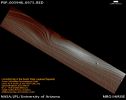
PSP_005946_0975_RED_abrowse-00-PCF-LXTT.jpgUnconformity in the South Polar Layered Deposits - SPLD (Absolute Natural Colors; credits for the additional process. and color.: Dr Paolo C. Fienga - Lunexit Team)70 visitenessun commentoMareKromium
|
|

PSP_005946_0975_RED_abrowse-01.jpgUnconformity in the South Polar Layered Deposits (SPLD) - (extra-detail mgmf - natural colors; elab. Lunexit)86 visiteThe layers in the upper center/right end abruptly (truncate) at a curve in the layers that extend along the left side of the image.
This type of truncation (termed "unconformity" in Geology) is usually due to erosion, wherein the layers in the lower right were eroded, followed by later deposition of the rest of the layers on top of the older layers (layer age likely increases from left to right). It is also possible that flow of these icy layers played a part in the complicated layer geometry exhibited in this extra-detail mgnf".MareKromium
|
|

PSP_005980_1725_RED_abrowse-PCF-LXTT.jpgLayered Collapse Pit in Noctis Labyrinthus (Absolute Natural Colors; credits for the additional process. and color.: Dr Paolo C. Fienga - Lunexit Team)122 visitenessun commentoMareKromium
|
|
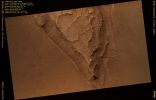
PSP_006005_2050_RED-00-PCF-LXTT.jpgStreamlined Island in Kasei Valles (Saturated Natural Colors; credits for the additional process. and color.: Dr Paolo C. Fienga - Lunexit Team)63 visiteIn this picture there is a Streamlined Island: one of many observed in the large outflow channels on Mars. This outflow channel is called Kasei Valles, and is one of the largest catastrophic outflow channels on Mars.
The Streamlined Island forms as water flows through the channel, but is blocked by some sort of obstacle, such as a crater or other topographic landform. In this HiRISE image, we only see the very tail end of the Streamlined Island, which is over 118 Km in length.
The platy surface within the channels has been attributed to either later lava or mud flows along the surface. The island itself is quite dusty and covered in small craters, so the island may be quite old. Along the edge of the island, however, you can see individual layers of rock.
These layers represent individual rock units that may be volcanic or sedimentary in origin.MareKromium
|
|

PSP_006006_1715_RED_abrowse.jpgLayering in the Upper Walls of Valles Marineris (Enhanced and Saturated Natural Colors; credits for the additional process. and color.: Dr Paolo C. Fienga - Lunexit Team)75 visiteThis observation shows parts of the upper walls of Valles Marineris with layered rocks. These layers extend down to a smooth-appearing slope, that is likely material shed from the upper parts of the chasm walls; down-slope stripes are visible, indicating that material has fallen or slid downhill in a process termed Mass Wasting (nota Lunexit: anche noto come Gravity Wasting).
The layers, exposed in most rock outcrops in this image, are most likely lava flows from flood lavas that once erupted across the region. These layers are located in the upper walls of most of Valles Marineris and are sometimes exposed at depths well below the surrounding plateau, recording extensive volcanism in the history of the region. Similar, thick successions of lava flows are found at some sites on Earth (for example, the Columbia River flood basalts in the North-West of the U.S.).
Mass Wasting: is a geologic term that encompasses the rapid downhill movement of rocks and fine particles due to the force of gravity. One of the most common and generic types of mass wasting features on Earth are landslides, but there are many others such as rock falls, debris flows, soil creep, and debris avalanches. Landslides or any other mass wasting feature, require some type of triggering mechanism to induce the movement of particles under gravity. Some of these mechanisms include volume expansion of fractures (i.e. cracks) in rocks by freeze/thaw processes, increase in soil pore pressure (i.e. water content), undermining or removal of less-resistant material below a stronger material layer, and strong vibrational forces produced from above (e.g., meteorite impact) or below ground (e.g., volcanic eruption, earthquake). On Mars, two of the most common Mass Wasting features are landslides and dust avalanches (also referred to as Slope Streaks). Some of the most spectacular landslides in the Solar System are found in the Valles Marineris Canyon System on Mars and exhibit many of the classic characteristics of landslides on Earth. These characteristics include a semi-circular main scarp in the source region, a hummocky (i.e. irregular) or blocky surface in the upper portion of the deposit, surface ridges parallel to landslide flow direction in the middle portion of the deposit, and a lobate outer margin that has some significant thickness (e.g., tens to hundreds of meters). Dust avalanches are common on dune faces, crater interior walls, mesa slopes, and canyon scarps. The streaks are thought to occur when dust and/or other small particles on a sloped surface begins to move due to sublimation of a thin layer of water frost or by the oversteepening of slopes in localized dusty air fall deposits. MareKromium
|
|

PSP_006133_1410_RED_abrowse-PCF-LXTT.jpgComplex "Folded Terrain" in Hellas Planitia (Absolute Natural Colors; credits for the additional process. and color.: Dr Paolo C. Fienga - Lunexit Team)118 visitenessun commentoMareKromium
|
|
| 2236 immagini su 187 pagina(e) |
 |
|
|
|
|
126 | |
|
|
|
|








