Mars Reconnaissance Orbiter (MRO)
|
|
|

PSP_005609_1470_RED_abrowse-02.jpgInside Hale Crater (EDM n.2 - processing by: Dr M. Faccin; Natural Color credits: Lunexit)75 visitenessun commentoMareKromium
|
|

PSP_005620_1210_RED_abrowse.jpgSouthern Alcoves (MULTISPECTRUM; credits: Lunexit)69 visiteThis image shows the West Wall of a Southern Hemisphere Crater. The scene is covered in Dust Devil Tracks which appear as dark wispy features.
Dust Devils are small-scale funnels that move across the surface kicking up dust as they go, thus leaving trails. The Crater is covered in small polygons in many locations. These polygons are probably related to periglacial processes; for example, temperature cycling of ice-rich material or sublimation, when gases trapped under the surface escape causing the remaining terrain to collapse to form pits.
Also in this Crater are several Gullies on the Southern Wall. These Gullies have very wide alcoves/source regions. It is unknown what is responsible for different Gully Alcove shapes and morphologies.MareKromium
|
|

PSP_005632_1225_RED_abrowse~0.jpgPartially Exhumed Crater in Amphitrites Patera (MULTISPECTRUM; elab. Lunexit)66 visiteThe terrain in this image is located in Amphitrites Patera, South-West of Hellas Basin. This area constitutes the interior of an ancient impact crater that was filled by a layer of smooth material, possibly composed of ash and dust, mixed with interstitial ice (ice filling spaces between dust and ash grains).
The curved ridge toward the lower left of the image is a remnant of the crater rim that was exhumed by erosion of the filling material. The morphology (appearance and shape) of the small, scalloped depressions, which we observe within the smooth material, suggests that the erosion process was sublimation (the process of a material going directly from a solid state to a gaseous state).
Scalloped depressions are a typical feature of the Mid-Latitudes of Mars between 40 and 60°. They usually have a steep pole-facing scarp (cliff), displaying series of small pits and fractures and a gentler, smoother, equator-facing slope. This asymmetry is most likely due to differences in solar heating.
The large scalloped depressions appear to have formed from the coalescing of multiple, smaller scalloped depressions. Their formation may be an ongoing process, although no definitive evidence has been uncovered so far.MareKromium
|
|

PSP_005658_1760_RED_abrowse-00-PCF-LXTT.jpgWinslow Crater (CTX Frame - Absolute Natural Colors; credits for the additional process. and color.: Dr Paolo C. Fienga - Lunexit Team)92 visitenessun commentoMareKromium
|
|

PSP_005680_1525_RED_abrowse-00.jpgPossible ancient Salt Deposits in Terra Cimmeria (Extremely Saturated and ENhanced Natural Colors - credits for the additional process. and color.: Dr Paolo C. Fienga - Lunexit Team)66 visiteThe ancient cratered highlands of the Southern Hemisphere of Mars has an intriguing and complex history as it has been riddled with impact craters and modified by volcanic processes and by the wind.
Additionally, it is one of the most heavily dissected terrains on Mars exhibiting the densest population of Valley Networks: old dried up channels and valleys that may have been formed by surface runoff, the seepage of ground water, or both.
Recently, the Thermal Emission Imaging System (THEMIS) aboard Mars Odyssey, in conjunction with spectral data from the Thermal Emission Spectrometer (TES) aboard the Mars Global Surveyor (MGS) have revealed the presence of a unique surface deposit that may be rich in chloride salts formed from the presence of liquid water. Three separate missions (MGS, MO and MRO) have come to reveal the composition and nature of these unique deposits, which, although they occur as relatively small deposits (less than 25 square Km) are widely distributed in Noachian (most ancient) terrains with fewer occurrences in the Hesperian (middle geologic time) terrains.
The deposit appears to be relatively thin and occurs in low-lying areas. It is also heavily pockmarked and discontinuous, possibly from removal of the material by erosion. Both of these aspects suggest that the deposit is indeed very old.
The presence of such salts is intriguing, and strongly suggests that conditions were favorable for water near or at the surface in the geologic past.
Polygonal cracks can be observed in this image and other images of these deposits elsewhere on Mars (see PSP_003160_1410) and are similar to desiccation cracks (formed from the rapid evaporation and drying of a wet surface) and indicate that these may were more likely deposited at the surface.
However, the volume and duration the water required for these deposits is still being investigated. MareKromium
|
|
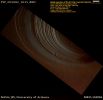
PSP_005682_1035_RED_abrowse-00.jpgBasal Exposure of SPLD (Darkened Absolute Natural Colors; credits for the additional process. and color.: Drr Gianluigi Barca and Paolo C. Fienga - Lunexit Team)78 visitenessun commentoMareKromium
|
|
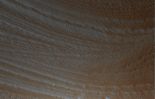
PSP_005682_1035_RED_abrowse-01.jpgBasal Exposure of South Polar Layered Deposits (extra-detail mgnf; possible natural colors - elab. Lunexit)66 visiteSome layers have an irregular wavy appearance that may have been caused by flow of the ice in the past when the now-exposed ice was still buried.
It is currently too cold at the surface in the South Polar Region of Mars for significant flow to be occurring today.
Other layers appear to be converging and some are truncated and may represent the so-called "unconformities" (see here).
Unconformities form when a previous episode of erosion removes all or part of a layer and is later followed by more deposition.MareKromium
|
|
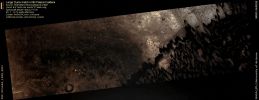
PSP_005684_1890_RED_abrowse-00-PCF-LXTT.jpgDark Dunefield in Nili Patera Caldera (CTX Frame - Enhanced Absolute Natural Colors; credits for the additional process. and color.: Dr Paolo C. Fienga - Lunexit Team)86 visitenessun commentoMareKromium
|
|
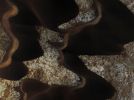
PSP_005684_1890_RED_abrowse-01.jpgDark Dunefield in Nili Patera Caldera (EDM - Enhanced Absolute Natural Colors; credits for the additional process. and color.: Dr Paolo C. Fienga - Lunexit Team)92 visitenessun commentoMareKromium
|
|
PSP_005701_1920_RED_abrowse-1.jpgLandslide in Xanthe Terra (Absolute Natural Colors; credits: Dr Paolo C. Fienga - Lunexit Team)68 visitenessun commentoMareKromium
|
|

PSP_005703_1750_RED_abrowse-PCF-LXTT-1.jpgLayered Sediments in Tithonium Chasma (Absolute Natural Colors; credits for the additional process. and color.: Dr Paolo C. Fienga - Lunexit Team) 71 visitenessun commentoMareKromium
|
|

PSP_005709_1405_RED_abrowse-PCF-LXTT.jpgFeatures of Eastern Hellas Planitia (Absolute Natural Colors; credits for the additional process. and color.: Dr Paolo C. Fienga - Lunexit Team)244 visiteMars Local Time: 14:31 (early afternoon)
Coord. (centered): 39,1° South Lat. and 113,0° East Long.
Spacecraft altitude: 274,9 Km (such as about 171,8 miles)
Original image scale range: 55,0 cm/pixel (with 2 x 2 binning) so objects ~ 1 mt and 65 cm across are resolved
Map projected scale: 50 cm/pixel
Map projection: EQUIRECTANGULAR
Emission Angle: 25,0°
Phase Angle: 27,1°
Solar Incidence Angle: 43° (meaning that the Sun is about 47° above the Local Horizon)
Solar Longitude: 331,0° (Northern Winter)
Credits: NASA/JPL/University of Arizona
Additional process. and coloring: Lunar Explorer ItaliaMareKromium
|
|
| 2236 immagini su 187 pagina(e) |
 |
|
|
|
|
125 | |
|
|
|
|








