Mars Reconnaissance Orbiter (MRO)
|
|
|

PSP_005401_1960_RED_abrowse.jpgVolcanic Channels, East of Olympus Mons (Absolute Natural Colors; credits for the additional process. and color.: Dr Paolo C. Fienga - Lunexit) 118 visitenessun commentoMareKromium
|
|

PSP_005409_1530_RED_abrowse-00.jpgUnnamed Southern Crater with Central Peak (CTX Frame - Enhanced Natural Colors; credits for the additional process. and color.: Dr Paolo C. Fienga - Lunexit Team)125 visitenessun commentoMareKromium
|
|

PSP_005409_1530_RED_abrowse-01.jpgUnnamed Southern Crater with Central Peak (EDM - Enhanced Natural Colors; credits for the additional process. and color.: Dr Paolo C. Fienga - Lunexit Team)122 visitenessun commentoMareKromium
|
|

PSP_005410_1115_RED_abrowse.jpgPolar Pit Gullies (MULTISPECTRUM; credits: Lunexit)79 visiteThis image shows Polar Pit Gullies in a depression. The gullies do not appear to have been active recently, as their channels and alcoves are covered with polygonal fractures and ripples that have formed over time. The alcoves contain boulders from eroding layers up-slope. Several of the alcoves extend to the slope rim, suggesting head-ward erosion.
The rest of the scene contains abundant polygonal ground, thought to have formed by processes involving ground ice. This image is at a High Latitude where polygonal terrain is common. This feature is not found in Equatorial Regions, which supports a relationship with ground ice because ground ice is not stable near the equator today.
There are several muted circles on the plains in the lower half of the image; these are possibly relaxed craters. If a crater forms in ice-rich ground, the ice enhances the degradation of the crater and gives the crater a “softened” appearance.MareKromium
|
|
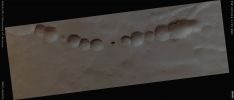
PSP_005414_1735_RED_abrowse-PCF-LXTT-00.jpgPit Chain on Arsia Mons (CTX Frame - Absolute Natural Colors; credits for the additional process. and color.: Dr Paolo C. Fienga - Lunexit Team)169 visiteCaption NASA:"The Chain of Collapse Pits visible in this image formed by collapse as the giant Shield Volcano, Arsia Mons, was pulled apart. While Magma intruding into the Volcano might have pushed the rocks aside, it is also possible that the collapse is caused by the volcano falling apart underneath its own weight.
Acquisition date: September, 22nd, 2007
M.L.T.: 14:14 (Early Afternoon)
Latitude (centered): 6,5° South
Longitude (East): 240,0°
Spacecraft Altitude: 252,4 Km
Original Image Scale Range: 25,3 cm/pixel (with 1 x 1 binning) so objects ~76 cm across are resolved
Map Projected Scale: 25 cm/pixel and North is up
Map Projection: EQUIRECTANGULAR
Emission Angle: 3,9°
Sun-Mars-Spacecraft (Phase) Angle: 38,1°
S.I.A.: 34°, with the Sun about 56° above the Local Horizon
Solar Longitude: 318,2° (Northern Winter)MareKromium
|
|
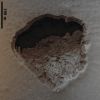
PSP_005414_1735_RED_abrowse-PCF-LXTT-01.jpgPit Chain on Arsia Mons - "Annie" (EDM - Absolute Natural Colors; credits for the additional process. and color.: Dr Paolo C. Fienga - Lunexit Team)214 visiteCaption NASA:"This small Pit located in the middle of the Chain was discovered by a team of scientists from the U.S. Geological Survey and Arizona State University using data from the THEMIS camera onboard the Mars Odyssey Spacecraft during a search for possible Cave Entrances. They informally named this pit "Annie".
A section of the HiRISE image over "Annie" has been specially processed to enhance the contrast in the shadowed areas. This shows that the Pit is is largely filled with wind blown materials. Shadow measurements indicate that the Floor is about 112 meters (367 feet) below the Rim".MareKromium
|
|

PSP_005418_1075_RED_abrowse-00.jpgSouth Polar Features (Absolute Natural Colors; credits for the additional process. and color.: Dr Paolo C. Fienga - Lunexit Team)105 visitenessun commentoMareKromium
|
|

PSP_005418_1075_RED_abrowse-01.jpgDistorted Layers in the SPLD (extra-detail mgnf - MULTISPECTRUM; credits: Lunexit)71 visiteThis enhanced image (1,2 Km or 0.7 miles across) shows a section of the South Polar Layered Deposits, which are an accumulation of layers consisting mostly of water ice and dust. Perhaps their closest analog on Earth would be the Ice Caps of Greenland and Antarctica.
This image is particularly interesting because the layers are not flat-lying but rather appear "wavy" (---> ondeggianti).
This appearance could partly be an “illusion” due to erosion after the flat-lying layers were deposited. In that case, the wavy appearance is due to the fact that the layer edges are wavy, going into and out of the plane of the outcrop exposing the layers.
Alternatively, this waviness could be due to deformation of the layers folding caused by flow of the ice.
Here, the flow probably occurred long ago since current temperatures are too low to allow the ice to flow at a significant rate.MareKromium
|
|

PSP_005419_1380_RED_browse-00.jpgFlow-like Features in Promethei Terra (context frame)65 visiteThis image, part of the south-facing slopes of a massif in Promethei Terra in the Southern Highlands, shows flow-like features (tongue-shaped lobes, parallel ridges) that indicate movement of surface materials downhill and towards the South-West, following the regional slope.
The difference in elevation between the ridge (near the top or northern-most portion of the image) and the valley (to the South) is over 2200 meters (7,200 feet).
These flow-like features are reminiscent of those observed in terrestrial landslides and rock glaciers , in which the downhill movement of rocks and soils is facilitated by an agent (most commonly water in landslides, ice in glaciers) that acts as a lubricant and provides cohesion. Theoretical calculations predict that under current and recent Martian climate conditions, neither water nor ice would be stable near the surface for extended periods of time in this Region.
The temperatures are so low that water would freeze, and then quickly sublime, because the air is very thin and dry. Ice could, though, be stable at present approximately 1 meter (3 feet) or more below the surface.
MareKromium
|
|
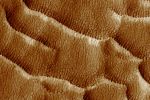
PSP_005419_1380_RED_browse-01.jpgFlow-like Features in Promethei Terra (extra-detail mgnf)66 visiteThe subimage (approx. 390 x 260 meters) shows in detail some of the ridges developed in the slope deposits. Numerous fissures cut through the surface, forming polygons 5 to 10 mt (5,5 to 11 yards) across.
Such well-preserved polygons indicate that the downhill flow had stopped before they formed. Polygonal features similar to these are common in terrestrial periglacial regions such as Antarctica, where ice is present at or near the surface. Antarctica's polygons formed by repeated expansion and contraction of the soil-ice mixture due to seasonal temperature oscillations.MareKromium
|
|

PSP_005424_1700_RED_abrowse~0.jpgAurorae Chaos (MULTISPECTRUM; credits: Lunexit)77 visiteThis observation shows a portion of Aurorae Chaos, chaotic terrain East of the Vallis Marineris Canyon System. Aurorae Chaos extends from Capri and Eos Chasmata on the West, into Hydraotes and Aureum Chaos on the North and East.
Chaotic terrain is thought to form from subsurface collapse following volatile release. It is possible that the Martian crust was at one time enriched in ices that became gases or liquid at relatively low temperatures upon encountering a heat source or was violently shaken. These ices existed in spaces between soil particles. If a large volume of volatiles is suddenly released, then there is a large portion of the soil volume missing. The soil cannot support itself, so it collapses.
Since chaotic terrain is often located at the head of the Martian outflow channels (giant flood plains), it is also possible that the Chaotic Regions are the source of the fluids that formed the outflow channels.
Aurorae Chaos connects to outflow channels via other Chaotic Regions.MareKromium
|
|
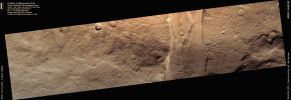
PSP_005442_1660_RED_abrowse-PCF-LXTT.jpgGraben in Memnonia Fossae (Natural Colors; credits for the additional process. and color.: Dr Paolo C. Fienga - Lunexit Team)151 visiteThis HiRISE image shows a Graben (roughly 2,5 Km or 1,6 miles wide) cutting a Ridge near Memnonia Sulci, a Region of Mars West of the massive Tharsis Volcanic Province. A Graben is a Trough created when 2 normal Faults (Faults dipping at an angle, with the overhanging wall sliding downwards) opposite each other lower the block of rock in between them. They are commonly associated with the tectonically-driven extension of a region and are also found in volcanic areas. Graben occur on many planets and moons, including Earth.
In this case, the Graben (running roughly East-West, indicating extension in the North-South direction) is cutting a Ridge, showing that it is more recent. The Ridge may also be tectonic in origin, therefore representing a different epoch and different type of tectonic activity.
Relationships like this can be used to determine the sequence of events in the history of the Region. The Graben Walls can also expose the local rocks at depth; in this case there is no obvious indication of Layering.MareKromium
|
|
| 2236 immagini su 187 pagina(e) |
 |
|
|
|
|
123 | |
|
|
|
|








