Mars Reconnaissance Orbiter (MRO)
|
|
|

PSP_005361_2005_RED_abrowse-00.jpgCatastrophic Outflow Feature in Tharsis (Absolute Natural Colors; credits for the additional process. and color.: Dr Paolo C. Fienga - Lunexit Team)97 visitenessun commentoMareKromium
|
|

PSP_005369_1925_RED_abrowse.jpgFeatures of Terra Sabaea (Absolute Natural Colors; credits for the additional process. and color.: Dr Paolo C. Fienga - Lunexit Team)101 visitenessun commentoMareKromium
|
|

PSP_005370_1845_RED_abrowse-00.jpgExtremely unusually-looking Surface Feature in Sinus Meridiani (CTX Frame - Absolute Natural Colors; credits for the additional process. and color.: Dr Paolo C. Fienga - Lunexit Team)92 visitenessun commentoMareKromium
|
|
PSP_005370_1845_RED_abrowse-01.jpgExtremely unusually-looking Surface Feature in Sinus Meridiani (EDM - Absolute Natural Colors; credits for the additional process. and color.: Dr Paolo C. Fienga - Lunexit Team)90 visitenessun commentoMareKromium
|
|

PSP_005381_0870_RED_abrowse.jpgSouth Polar Layered Deposits with Surface Modification (possible natural colors - elab. Lunexit)70 visiteThis image shows a scarp exposing the south polar layered deposits (SPLD). The polar layered deposits are thought to record recent climate variations on Mars, similar to ice ages on Earth.
Radar data indicate that the SPLD are ice-rich, with variations in dust contamination likely causing the layering visible here. HiRISE images of the SPLD will help to unravel Mars' climate history, but this image illustrates how this effort is complicated.
The development of surface features, by erosion, deposition, or modification of the surface, makes it difficult to determine the characteristics of the layers themselves. Some of the layers appear wavy, perhaps due to folding, flow, or uneven erosion since they were laid down. Short, branching, often radial channel systems are cut into the surface of the layers in places. These may be related to "spiders," thought to be formed as carbon dioxide gas flows along the surface when the seasonal polar cap sublimates in the spring. Pits and polygonal fractures are visible on the layers as well.
Apparently this exposure of SPLD is relatively old, as these features probably take many years to form. While these features are interesting in their own right, they disturb the SPLD outcrops and make it more difficult to measure the thickness of layers and compare them to other outcrops of SPLD.
MareKromium
|
|
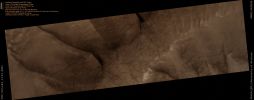
PSP_005383_1255_RED_abrowse-00.jpgDunefield with DD Tracks inside Russel Crater (Absolute Natural Colors; credits for the additional process. and color.: Dr Paolo C. Fienga - Lunexit Team)78 visiteDust Devils make dark, diffuse scribble markings on the Surface by kicking up Dust and are especially active in the Summertime over Dark Surfaces, such as those with many deposits of sand-sized material.
The Surface warms up in the Sunlight, creating the right conditions to form Dust Devils. Mars also has larger dust storms that can deposit a thin layer of Dust and eliminate the Dust Devil Tracks. MareKromium
|
|

PSP_005387_1935_RED_abrowse-00-PCF-LXTT.jpg"Sinuous" Collapse Pits on Ascraeus Mons (Absolute Natural Colors; credits for the additional process. and color.: Dr Paolo C. Fienga - Lunexit Team)93 visitenessun commentoMareKromium
|
|

PSP_005388_1975_RED_abrowse-00-PCF-LXTT.jpgPang Boche Crater (CTX Frame - Absolute Natural Colors; credits for the additional process. and color.: Dr Paolo C. Fienga - Lunexit Team) 119 visitenessun commentoMareKromium
|
|

PSP_005388_1975_RED_abrowse-01.jpgPang Boche Crater (EDM; False Colors; credits for the additional process.: Dr Paolo C. Fienga - Lunexit Team)66 visiteThe interior of Pang Boche Crater contains material that likely slumped off the walls during late stages of its formation. The north wall of the crater has material that has not slumped to the floor, instead forming a terrace.
Also noteworthy is the abundance of small craters that surround, but do not occur within, Pang Boche. These are mostly Secondary Craters that formed when ejecta from an impact hit the surface. If the small craters were Primary Craters (formed from an impactor from space), then they would be expected to be within Pang Boche as well. Secondaries commonly occur in clumps as seen in this extra-detail mgnf (which is approx. 2 km across).
The strong clustering indicates that these craters are Secondaries.MareKromium
|
|

PSP_005392_0995_RED_abrowse-00~0.jpgImpact Crater on the South Polar Layered Deposits (context frame; MULTISPECTRUM - credits: Lunexit)66 visiteThis image covers a portion of the ice-rich SPLD.
Layers in the Mars Polar Regions are of great interest because layers in ice on the Earth, as in the Antarctic and Greenland ice caps, are known to contain records of past atmospheric, environmental, and climate conditions. By studying Mars Polar Layers, we hope to be able to understand the past climate and history of water on the Red Planet.MareKromium
|
|

PSP_005392_0995_RED_abrowse-01~0.jpgImpact Crater on the South Polar Layered Deposits (EDM n.1; MULTISPECTRUM - credits: Lunexit)72 visiteA problem with using craters to determine age on the icy SPLD is that erosion of the icy substrate and relaxation of crater topography (i. e., relief becoming more gentle) is probably more rapid on ice than on harder rocky surfaces.
A detailed study of craters in ice will help better to understand this process of how craters in ice degrade, or deteriorate, with time.
Perhaps then we will know how to use the number and distribution of craters over the icy polar layered deposits in constraining the geologic and climate history of the Mars Polar Regions.MareKromium
|
|

PSP_005392_0995_RED_abrowse-02~0.jpgImpact Crater on the South Polar Layered Deposits (EDM n.2 - Absolute Natural Colors; credits for the additional process. and color.: Dr Paolo C. Fienga - Lunexit Team)97 visiteOf particular interest is the small, approx. 330 meter (360 yard) diameter Impact Crater. The number of Impact Craters on a Planetary Surface is often used to estimate the age of that Surface (because the older a Surface is, the more time that Surface has had to accumulate Craters, and thus the more Craters that Surface will have on it - assuming, of course, a constant "Cratering Rate" - Nota Lunexit: questa è un'assunzione, a dir poco, azzardata...).
The SPLD on Mars are believed to be very young because there are no large Craters on them and very few small Craters. The high resolution of HiRISE will enable these Craters to be studied in detail, perhaps allowing the number of Craters — and thus the Surface age — to be better constrained.MareKromium
|
|
| 2236 immagini su 187 pagina(e) |
 |
|
|
|
|
122 | |
|
|
|
|








