Mars Reconnaissance Orbiter (MRO)
|
|
|

PSP_005149_1715_RED_browse-PCF-LXTT.jpgLight-toned Layering and a huge Collapse Feature near Jus Chasma (Absolute Natural Colors; additional process.: Dr Paolo C. Fienga - Lunexit Team)113 visitenessun commentoMareKromium
|
|

PSP_005155_1030_RED_browse.jpgExposure of South Polar Layered Deposits70 visiteA complex geologic history is on display in this image of the South Polar Layered Deposits. These layered deposits are a mixture of dust and water-ice. Each layer is thought to record information about the state of the Martian climate at the time of its deposition.
The original stack of layered ice has eroded to produce a scarp that exposes the internal layers. Smooth material was then deposited to cover this scarp before being in turn eroded. Deposition on top of an eroded surface like this produces what geologists call an "unconformity in the stratigraphic record". Remnants of this smooth material can be seen on the left of the image and draping the layered scarp near the image center.
Although it looks, at first glance, like this material has flowed down the scarp, that is unlikely to have happened. The extremely cold temperatures at the Martian Poles mean that ice in general does not flow like we see it do here on Earth. There are also no indications of some of the geomorphologic features that flowing ice typically acquires (such as crevasses, compressional ridges or moraines).
MareKromium
|
|
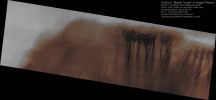
PSP_005160_1150_RED_abrowse-PCF-LXTT-00.jpgGullies in Mantle Terrain in Sisyphi Planum (CTX Frame - Absolute Natural Colors; credits for the additional process. and color.: Dr Paolo C. Fienga - Lunexit Team) 224 visiteCaption NASA:"This observation shows the East-facing Walls of an Unnamed Crater in Sisyphi Planum, near the South Polar Regions. Gullies, as well as Mantle Terrain and Polygons are also visible; these features suggest that at some point in time, liquid and ice may have been present at and near the Surface. The Gullies, which are rather eroded, have ample Alcoves and subdued Channels; dark patches and Ripples in the bottom of the Channels indicate that the most recent activity was Aeolian (such as "wind-driven") in Nature. Mantle Terrains are characterized by their smooth Surface and light, uniform color. They are widely interpreted as Terrains blanketed by a mixture of Ice and Dust, deposited under climatic conditions different from that of today. The Gullies in this image have Alcove Areas that seem to have cut through the Mantle Terrain, exposing the underlying materials". MareKromium
|
|
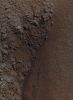
PSP_005160_1150_RED_abrowse-PCF-LXTT-01.jpgGullies in Mantle Terrain in Sisyphi Planum (EDM - Absolute Natural Colors; credits for the additional process. and color.: Dr Paolo C. Fienga - Lunexit Team) 230 visiteCaption NASA:"This EDM shows the Boundary between one of the Alcoves and the surrounding Mantled Terrain. Numerous Fissures arranged forming Polygons some 3 to 10 meters (3,3 to 11 yards) across are visible in the image. These are similar to features found in Terrestrial Periglacial Regions such as Antarctica, where ice is present at or near the Surface. Antarctica's Polygons form by repeated expansion and contraction of the soil-ice mixture due to seasonal temperature oscillations; this results in Polygonal Networks of Stress Fractures".MareKromium
|
|

PSP_005194_1070_RED_browse.jpgFaulting in the South Polar Layered Deposits64 visiteThe scarp shown in this image marks the edge of the Polar Layered Deposits. These layered deposits are a mixture of dust and water-ice. Each layer is thought to record information about the state of the Martian climate at the time of its deposition.
The polar layered deposits were once more extensive, but have been eroded back to their current size. Most of this erosion takes places at inclined scarps (such as this one) which retreat as icy material is ablated away.
Other processes are also operating on these deposits as exemplified by the fault that is visible on the left of the image. Layers appear offset from one side of the fault to another indicating that the layered deposits have been fractured into large blocks that have moved relative to each other. The source of the stress that caused this fracturing is unknown; some possible examples are subsidence of the underlying terrain or perhaps melting of a portion of the base of the ice-sheet.
This particular Region of the Layered Deposits (Ultimi Lingula) contains many examples of this brittle fracture (which is otherwise rare in these Deposits). Another less obvious fault lies near the center of the image at the base of the scarp. This fault does not break through, or even deform, the upper layers which may indicate that the fault occurred when only half the layered deposits had accumulated. These observations point to a history of faulting in this region that at least spans the age range of these Layered Deposits. MareKromium
|
|

PSP_005334_2170_RED_abrowse-00~0.jpgCollapse Pits near Alba Patera (MULTISPECTRUM; elab. Lunexit)64 visiteThis observation shows pits in Acheron Catena, a chain of circular depressions located South-East of Alba Patera, the widest and flattest volcano on Mars.
The layers seen around the pit rims are likely lava flows from Alba Patera or the nearby Tharsis Mons.
The pits probably formed by collapse into empty space beneath the surface as opposed to being formed by an impactor from space. Some of the pits have large piles of material in their centers. These piles are evidence of collapse of the walls, which may have occurred after the main collapse event that formed each pit. The second pit from the right has an indistinct north rim; it appears that there were at least two collapse events here.
A couple of the pits have oval shaped craters on their walls.
The craters were almost certainly circular when they formed, but time and gravity have allowed the deformation of their shape by mass wasting.MareKromium
|
|
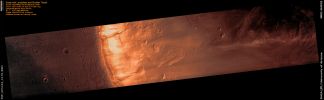
PSP_005343_2170_RED_abrowse-00~0.jpgScarp with Landslides and Boulder Tracks (context frame; natural colors - elab. Lunexit)72 visiteThis observation shows an equatorial scarp (cliff) with possible landslides and boulder tracks.
The cliff has several distinct layers visible near its top. There is a smoother, possibly fine-grained layer on top, underlain by a relatively bright and a dark layer. It is possible that the entire cliff face consists of layers but that erosion has not exposed others yet.
There are two main landslide scars, locations where a landslide has carved into the slope. Both of the scars have boulder tracks, several of which have boulders at their ends as they progress down the slope or reach the end of the slope.MareKromium
|
|
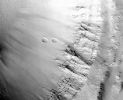
PSP_005343_2170_RED_abrowse-01.jpgScarp with Landslides and Boulder Tracks (extra-detail mgnf)65 visiteThis subimage - or extra-detail mgnf - (approx. 480 meters across) shows boulder tracks from the landslide scar on the left side of the image.
Some boulders can be seen forming trails along the slope at the top part of the subimage, while others can be seen at the end of their trails (...).MareKromium
|
|

PSP_005346_1755_RED_abrowse-00.jpgLow-Order Inverted Streams near Juventae Chasma (context frame - elab. Lunexit)64 visiteThis image shows plains North-West of Juventae Chasma, one of the Martian canyons that are part of the equatorial Valles Marineris System. The two most noticeable features in this scene are craters on mesas (plateaux) and raised, winding ridges. The raised ridges are "Inverted Channels". It is likely that liquid water, either pure or salt water, flowed through these channels. The channels are raised because streams transport sediment as they flow, deposit the heavier sediment on the stream floor, and, eventually fill in once their water supply dwindles. Over time, wind erosion modifies a landscape, and this has played an important role on these plains. It eroded the land around the channels leaving the remnant channels exposed and standing high. The channels did not erode as much since they were more resistant, possibly because the deposited sediment had cemented together.
The craters on mesas are also evidence of active wind erosion: when craters form, they eject material out onto the surrounding landscape.
It appears that several of the craters’ ejecta visible here cemented, making the ejecta more resistant to erosion and leaving them standing high as craters on plateaux.MareKromium
|
|

PSP_005346_1755_RED_abrowse-01.jpgLow-Order Inverted Streams near Juventae Chasma (extra-detail mgnf)65 visiteThis subimage (approx. 1120 meters across) shows a juncture of 2 of the "Inverted Channels".
It is likely that the water flowed from the left to the right of the scene, because channels usually join rather than divert unless there is an obvious obstacle in the way.
No such obstacle is seen here, but one might have been present when the stream originally flowed.
However, there is no way of knowing this.MareKromium
|
|

PSP_005349_0930_RED_abrowse-0.jpgCircular Feature in the South Polar Residual Cap (Absolute Natural Colors; credits for the additional process. and color.: Dr Paolo C. Fienga - Lunexit Team)123 visiteThis 4 Km-diameter Circular Surface Feature near the Edge of the South Polar Residual Cap was recognized in Mariner 9 and Viking Orbiter images taken in the '70s, but its origin could not be inferred. It was therefore targeted for HiRISE stereo imaging.
The bright areas in this image are covered by CO2 frost, and the "Swiss Cheese" terrain typical of the South Polar Residual Cap covers much of the imaged area.
The Dark Walls of the Circular Depression do not have as much Frost on them, and are fractured in a polygonal pattern. Apparently the Surface of the Walls has been extensively modified by thermal expansion and contraction of water ice. It also appears that the "Swiss Cheese" Terrain of the Residual Cap has buried the Floor of the Circular Depression, as well as the Terrain surrounding the Feature, making it difficult to infer its origin.
Its circular symmetry is consistent with an impact origin, but there is no evidence of a Crater Rim or Ejecta Blanket (perhaps because they have been buried).
The Depression may also have formed by collapse, but there is little evidence of extensional fractures that would be expected around a Collapse Pit. Analysis of HiRISE stereo data may help the interpretation of this Feature.MareKromium
|
|

PSP_005349_0930_RED_abrowse-1.jpgCircular Feature in the South Polar Residual Cap (Natural Colors; credits for the additional process. and color.: Dr Paolo C. Fienga - Lunexit Team)116 visiteThis 4 Km-diameter Circular Surface Feature near the Edge of the South Polar Residual Cap was recognized in Mariner 9 and Viking Orbiter images taken in the '70s, but its origin could not be inferred. It was therefore targeted for HiRISE stereo imaging.
The bright areas in this image are covered by CO2 frost, and the "Swiss Cheese" terrain typical of the South Polar Residual Cap covers much of the imaged area.
The Dark Walls of the Circular Depression do not have as much Frost on them, and are fractured in a polygonal pattern. Apparently the Surface of the Walls has been extensively modified by thermal expansion and contraction of water ice. It also appears that the "Swiss Cheese" Terrain of the Residual Cap has buried the Floor of the Circular Depression, as well as the Terrain surrounding the Feature, making it difficult to infer its origin.
Its circular symmetry is consistent with an impact origin, but there is no evidence of a Crater Rim or Ejecta Blanket (perhaps because they have been buried).
The Depression may also have formed by collapse, but there is little evidence of extensional fractures that would be expected around a Collapse Pit. Analysis of HiRISE stereo data may help the interpretation of this Feature.MareKromium
|
|
| 2236 immagini su 187 pagina(e) |
 |
|
|
|
|
121 | |
|
|
|
|








