Mars Reconnaissance Orbiter (MRO)
|
|
|
PSP_004847_1745_RED_browse-00.jpgThe "Martian Black Hole"...Again! (context frame)76 visiteVi invitiamo a leggere l'ultimo articolo sull'argomento (pubblicato su TruePlanets) dal titolo "Velvet Underground".MareKromium
|
|
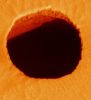
PSP_004847_1745_RED_browse-02.jpgThe "Martian Black Hole"...Again! (EDM - False Colors)164 visiteVi invitiamo a leggere l'ultimo articolo sull'argomento (pubblicato su TruePlanets) dal titolo "Velvet Underground".MareKromium
|
|
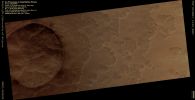
PSP_004867_1220_RED_abrowse-00.jpgIce Processes in Amphitrites Patera (CTX Frame - Natural Colors; elab. Lunexit)95 visiteThis image captures an impact crater on the surface of Amphitrites Patera, an ancient volcano on the southern margin of the giant Hellas Basin. The Hellas Basin was formed by a very large impact into the Southern Highlands early in the geologic history of Mars. The basin has a number of volcanoes along its margin, perhaps because magma could take advantage of the deep cracks in the crust that resulted from the impact.
Amphitrites Patera is far enough South to approach the Martian Antarctic and there is evidence for large amounts of ice in the ground. As in the Polar Regions of Earth, the icy ground (permafrost) is able to move and be modified by a variety of processes. In this case, the rim of the small impact crater is filled with a honeycomb of cracks. These are likely to have formed where dust- and soil-covered ice or ice cemented soil was cracked by thermal contraction in the winter. Subsequently, the underlying ice was able to escape into the atmosphere (sublimate) allowing the ground along the cracks to collapse. The only place where large boulders are visible is along the rim of the crater; this is probably where the boulders were not so deeply buried by the icy layer. MareKromium
|
|
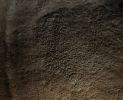
PSP_004867_1220_RED_abrowse-01.jpgIce Processes in Amphitrites Patera (EDM - Natural Colors; elab. Lunexit)76 visiteThe Martian Atmosphere was dusty at the time this image was acquired, so small imperfections in the processing are very visible in the standard image products.
MareKromium
|
|
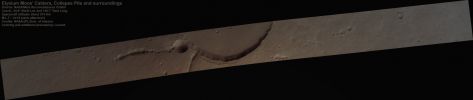
PSP_004903_2050_RED_browse-PCF-LXTT.jpgElysium Mons' Caldera and Collapse Pits (Absolute Natural Colors; credits for the additional process. and color.: Dr Paolo C. Fienga - Lunexit Team)143 visitenessun commentoMareKromium
|
|
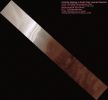
PSP_004917_1080_RED_browse-00.jpgComplex Geology in the South Polar Layered Deposits (context image)65 visiteThis section of the HiRISE image shows a scarp exposing the South Polar Layered Deposits, with illumination from the upper right (scarp slopes toward bottom). The Polar Layered Deposits probably contain a record of relatively recent climate changes on Mars, similar to ice ages on Earth.
The Deposits appear to be composed mostly of water ice, with variations in dust content controlling the erosion of the layers. This image shows that the history of the South Polar Layered Deposits has not been simple accumulation of horizontal layers.MareKromium
|
|
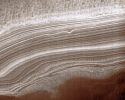
PSP_004917_1080_RED_browse-01.jpgComplex Geology in the South Polar Layered Deposits (extra-detail mgnf)65 visiteAbove and right of center, the layers appear wavy and in places, layers are cut off by other layers. Such structures may be formed by flow or faulting, but in this case they are more likely to be due to erosion of the lower part of the layered deposits before the upper part was laid down over it. For example, deposition may have halted long enough for channels to be eroded into the layered deposits.
When deposition resumes, new layers deposited in the channels could form the structures visible here. However, without more precise topographic information than is currently available, other hypotheses cannot be excluded.MareKromium
|
|

PSP_004959_0865_RED_browse.jpgPolygonal Fracturing of South Polar Layered Deposits65 visiteThis image shows the South Polar Layered Deposits, with curving layer outcrops caused by erosion of valleys into the Deposits.
On closer inspection, polygonal (mostly rectangular) fractures are visible, mostly near the center of the image. Polygonal fractures are also observed in the North Polar Layered Deposits, but typically on a much smaller scale.
Here in the South, the fractures cross layer boundaries, while in the North the fractures are usually confined to a single layer.
Therefore, the fractures in the South Polar Layered Deposits formed after the surface was eroded to the configuration seen here, probably due to expansion and contraction of water ice below the surface.MareKromium
|
|
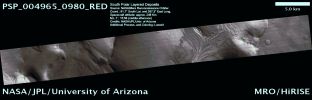
PSP_004965_0980_RED_abrowse-00~0.jpgSouth Polar Layered Deposits - SPLD (Absolute Natural Colors; credits for the additional process. and color.: Dr Paolo C. Fienga - Lunexit Team)133 visiteThe South Polar Layered Deposits (SPLD) are interesting because they were probably formed by global climate changes on Mars, like ice ages on Earth. The Martian SPLD are rich in water ice, but appear to be covered by a dusty layer that protects the underlying ice from evaporation and erosion.MareKromium
|
|

PSP_004965_0980_RED_abrowse-01.jpgSouth Polar Layered Deposits (SPLD; extra-detail mgnf - MULTISPECTRUM; credits: Lunexit)67 visiteThe exposure of South Polar Layered Deposits shown here also appears to be partly covered by additional debris.
The layers appear to have been offset by a fault near the upper right corner.
The faulting and burial visible here complicates the interpretation of the climate history of Mars based on observations of layering.MareKromium
|
|
PSP_004980_1035_RED_browse-00~0.jpgUnnamed "Ghost" Crater near the South Pole (CTX Frame - Absolute Natural Colors; credits for the additional process. and color.: Dr Paolo C. Fienga - Lunexit) 173 visiteThis HiRISE image shows a Circular Structure near the South Pole of Mars. This feature is probably a heavily modified Impact Crater. It is currently expressed as a group of concentric circular features with little vertical expression.
This feature was probably once an Impact Crater many tens of meters deep. (Small impact craters are typically about 1/5th as deep as they are wide).
The original topography has been smoothed by some combination of burial and viscous relaxation. Most burial processes will preferentially fill in low areas like craters; the infilling material may then compact, producing arcuate structures. MareKromium
|
|

PSP_004980_1035_RED_browse-01-PCF-LXTT.jpgUnnamed "Ghost" Crater near the South Pole (EDM - Absolute Natural Colors; credits for the additional process. and color.: Dr Paolo C. Fienga - Lunexit) 254 visiteCreep of the Crater Wall Material may have also played a role in erasing the Crater. This far South, the Surface Material is likely to be ice-rich and will slowly flow downhill. Additional evidence for near-surface ice is provided by the pervasive Polygons in the image, forming due to stresses caused by temperature variations in ice-rich ground.
Regardless of the mechanism, the Crater remains faintly expressed in the surface morphology. Note that the Surface has a similar texture away from the Crater, but not organized into concentric arcs. The residual structure of the Crater provides some control on stresses, producing the ringed pattern. MareKromium
|
|
| 2236 immagini su 187 pagina(e) |
 |
|
|
|
|
119 | |
|
|
|
|








