Mars Reconnaissance Orbiter (MRO)
|
|
|

PSP_003492_1405_RED_abrowse~0.jpgUnnamed Southern Mid-Latitude Crater with "unusually bright" Gullies (MULTISPECTRUM; credits: Lunexit)72 visiteThis image shows a Southern Mid-Latitude (unnamed) crater: it has bright landslides on its South-East and West walls, some of which have noticeable boulder tracks where boulders rolled down the slopes.
The most noticeable features of this crater are the gullies on the North wall. A couple of small gullies appear to emanate from an overhang.
The others originate at or near layers up-slope.
The layers are sturdy and resistant from erosion: the layers that appear to be decaying into resolvable boulders, instead of particles easily moved by the wind, are evidence of this.MareKromium
|
|
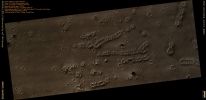
PSP_003494_2075_RED_abrowse.jpgCrater Cluster with Cones and Ridges in Utopia Planitia (Natural Colors; credits for the additional process. and color.: Dr Paolo C. Fienga - Lunexit Team)150 visiteThis image shows Cratered Cones in Utopia Planitia. Cones with Summit Craters join together in places to form Ridges up to several kilometers long, with Troughs running along the Summit.
In many of these cases it is evident that the Ridge Systems formed by merging of multiple Cones, since the arcs of individual Cones can be distinguished.
These features are probably formed by eruption of Subsurface material-Mud or Lava. Lava can form Cinder or Spatter Cones, and eruptions from localized sources along a single Fissure could produce the Ridges.
The absence of obvious (---> evidenti) Lava Flows near the Cones may argue against this mechanism, but ascending Lava could have interacted with Subsurface Water or Ice, leading to a more explosive eruption.
An alternative is eruptions of pressurized Mud from depth ("Mud Volcanism"), a process which occurs in certain environments on Earth.
This observation has a few minor gaps where transmission errors caused data to be lost. These appear as narrow black bars.MareKromium
|
|
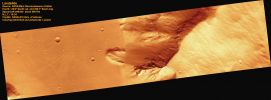
PSP_003516_1540_RED_browse.jpgLarge (and VERY Old) Landslide Deposit67 visiteThis HiRISE image is centered on a large landslide which formed the large lobe at the base of the steep slope. This is material which was transported in a massive rock-slide.
The landslide has several ridge-and-trough lineations in the direction of the flow. These occur in similar landslides on Earth as well. Comparing these features on Mars with similar examples on Earth helps geologists better understand how they work on both Planets.
In this case, the slide is relatively old.
The material has many impact craters superimposed. The steep slope, which was the source of the landslide, has undergone further erosion, so the landslide source area is no longer clear. MareKromium
|
|
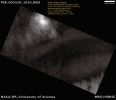
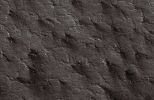
PSP_003520_1010_RED_abrowse-00.jpgSouth Polar Spiders (ctx frame - MULTISPECTRUM-2; credits: Lunexit)65 visiteThis image is located in the South Polar Region of Mars and we can see “spiders” likely caused by the sublimation of Carbon Dioxide ice.
As this happens, the gas moves through channels until it reaches the surface and vents out. These vents show up as the dark streaks because they carry dust and dirt up to the surface.MareKromium
|
|
PSP_003520_1010_RED_abrowse-01.jpgSouth Polar Spiders (edt - MULTISPECTRUM-2; credits: Lunexit)66 visitenessun commentoMareKromium
|
|
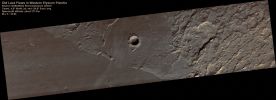
PSP_003532_1845_RED_abrowse-PCF-LXTT.jpgLava Flows in Western Elysium Planitia (Absolute Natural Colors; credits for the additional process. and color.: Dr Paolo C. Fienga - Lunexit Team)191 visitenessun commentoMareKromium
|
|

PSP_003538_1885_RED_browse.jpgAres Vallis' Cataract (Natural Colors; credits: Lunar Explorer Italia)66 visiteThis image shows a dry cataract within Ares Vallis. A cataract is a large waterfall where there is a high, steep drop. The presence of this large cataract in Ares Vallis confirms that this channel was carved by water, probably in one or many large catastrophic flooding events.
This feature has many of the same characteristics as the cataracts on Earth associated with the flood that carved the Channelled Scablands in Washington State, including horseshoe-shaped headcuts and longitudinal grooves. These grooves in the lower portion of the image lead up to the cataract, with the water flowing from the south to the north in this image. It then flowed down the cataract into the smaller incised channel.
The horseshoe-shaped headcut here is only part of a larger cataract system, and probably formed during the last stage of flooding. The inner channels are now filled with dunes formed by wind blowing along the channel floor.MareKromium
|
|
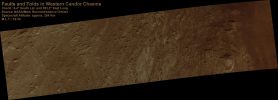
PSP_003540_1735_RED_browse~0.jpgFaults and Folds in West Candor Chasma (Natural Colors; credits: Lunexit)71 visiteThis image shows various interesting structures along the Floor of Candor Chasma, a major canyon of Valles Marineris.
The rocks along the floor of the chasma consist of multiple layers of light-toned material, possibly windblown or water-lain sediment. These layers have been shifted along faults and also folded, giving the layers an apparent wavy appearance as they are exposed at the Surface through erosion.
Some waviness in the Layers may also have formed as these sediments were laid down (for example, in Dunes or large Ripples. Detailed mapping of these Faults and Folds may help reveal the origin of these Layered Deposits and if water played any role in their formation.MareKromium
|
|
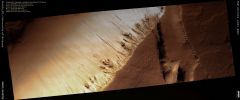
PSP_003545_2025_RED_abrowse-PCF-LXTT-00.jpgIntersection between Hyblaeus and Elysium Chasmata (CTX Frame - Natural Colors; credits for the additional process. and color.: Dr Paolo C. Fienga - Lunexit Team)179 visitenessun commentoMareKromium
|
|
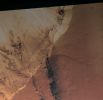
PSP_003545_2025_RED_abrowse-PCF-LXTT-01.jpgIntersection between Hyblaeus and Elysium Chasmata (EDM n.1 - Saturated Natural Colors; credits for the additional process. and color.: Dr Paolo C. Fienga - Lunexit Team)71 visiteA cross-section of Hyblaeus Chasma is visible in this first extra-detail mgnf).
The chasm seems to be filled with a resistant light-toned layer, about 200 mt thick (likely consisting of cemented windblown sand and dust) forming a mantling unit and overlying more resistant boulder-rich layers. The sand and dust was likely blown into Hyblaeus Chasma after it was formed by tectonic processes, possibly in combination with fluvial processes.
The chasmata were subsequently broadened by hillslope erosion: boulders are strewn along the top of this dusty mantling unit. Slumping, possibly caused by faulting, along the Southern Wall of Hyblaeus is visible at the intersection with Elysium Chasma.
This image also shows a number of dark streaks along the walls of Elysium Chasma, further to the south.MareKromium
|
|

PSP_003545_2025_RED_abrowse-PCF-LXTT-02.jpgIntersection between Hyblaeus and Elysium Chasmata (EDM n.2 - Saturated Natural Colors; credits for the additional process. and color.: Dr Paolo C. Fienga - Lunexit Team)83 visiteOne fresh-appearing streak divides around a slight ridge in this extra-detail mgnf n. 2 (about 1 Km across). Other smaller, fainter, possibly older streaks have formed on either side of this ridge, producing a herringbone-like pattern.
A number of explanations have been suggested for these streaks, including the idea that they are formed by dry avalanches of dust.MareKromium
|
|
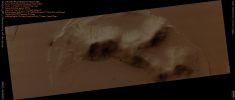
PSP_003570_1915_RED_abrowse-PCF-LXTT.jpgColourful Slope-Streaks in Marte Vallis (Natural Colors; credits for the additional process. and color.: Dr Paolo C. Fienga - Lunexit Team)80 visiteThis image of a large Hill in Marte Vallis has numerous dark- and light-toned Streaks along its Slopes, showing a variety of characteristics observed in other areas with these features.
For example, several dark Streaks have formed "fingers" at their Termini (such as the point where where the Streaks end).
Their formation may be due to the material "feeling" the roughness of the ground as it reaches shallower slopes near the base of the Hill. The dark Streaks also appear to travel over many obstacles along their paths, such as impact craters, small boulders, and rock outcrops. This indicates that the Slope Streaks have sufficient "momentum" and energy early in their descent downslope that they are not affected by such features or the ground.
The Slope Streaks also do not start at a common elevation along the sides of the Hill, suggesting that they are not related to any particular layer(s) of material.
Dark Slope Streaks are thought to fade over time by deposition of a new bright Dust Layer over the old streaked Surface. The presence of light-toned Streaks relative to their surrounding darker-toned surface is particularly interesting.
Scientists have wondered: if dark Streaks fade over time by deposits of new Dust, then how can there be light-toned streaks? Does this mean light-toned Streaks are formed differently? Are the materials of a light-toned Streak different from dark-toned Streaks?
Slope Streaks have been discovered and studied since the early Mariner and Viking Missions to Mars in the '60s and '70s. Scientists are hoping to resolve some of these questions using HiRISE images with its high spatial resolution compared to these previous Mars datasets.MareKromium
|
|
| 2236 immagini su 187 pagina(e) |
 |
|
|
|
|
111 | |
|
|
|
|








