Mars Reconnaissance Orbiter (MRO)
|
|
|

PSP_003234_2210-PCF-LXTT1.jpgThe "Face on Mars" (Natural Colors; credits for the additional process. and color.: NASA/JPL and Dr Paolo C. Fienga - Lunexit Team)77 visitenessun commentoMareKromium
|
|

PSP_003234_2210_RED-MF-PCF-LXTT2~0.jpgThe "Face on Mars" (Absolute Natural Colors; credits for the additional process. and color.: NASA/JPL and Dr Paolo C. Fienga - Lunexit Team)106 visitenessun commentoMareKromium
|
|

PSP_003234_2210_RED_abrowse-HD3D-MF-LXTT.jpgThe "Face on Mars" as you've never seen it before! (High-Def-3D and Natural Colors; credits for the additional process. and color.: Dr Marco Faccin - Lunexit Team)81 visitenessun commentoMareKromium
|
|
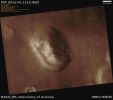
PSP_003234_2210_RED_abrowse.jpgDo You Remember Me? (Absolute Natural Colors; credits for the additional process. and color.: Dr Paolo C. Fienga - Lunexit Team)98 visiteCaption NASA:"HiRISE captured this image (in 2007) of an eroded mesa made famous by its similarity to a human face in a Viking Orbiter image with much lower spatial resolution and a different lighting geometry.
Compared to the original Viking image (dated 1976), HiRISE shows incredible detail, even from about 300 Km above the surface".
Nota Lunexit: una domanda che rivolgiamo, simpaticamente ed ironicamente, al Prof. Richard Hoagland ed ai suoi accoliti: ma la "Faccia" di Marte - e cioè "l'Evidenza Finale - parole di Hoagland - di una pregressa Civiltà Marziana", dov'è andata a finire???...MareKromium
|
|

PSP_003234_2210_red.jpgThe "Face" on Mars... (False Colors; credits: NASA/JPL)108 visiteImage PSP_003234_2210 was taken by the High Resolution Imaging Science Experiment (HiRISE) camera onboard the Mars Reconnaissance Orbiter spacecraft on 05-Apr-2007.
The complete image is centered at 40,7° latitude, 350,5° East Longitude. The range to the target site was 299,4 Km (187,1 miles). At this distance the image scale is 29,9 cm/pixel (with 1 x 1 binning) so objects ~90 cm across are resolved.
The image shown here has been map-projected to 25 cm/pixel and north is up.
The image was taken at a local Mars time of 03:28 PM and the scene is illuminated from the West with a solar incidence angle of 73°, thus the Sun was about 17° above the horizon.
At a Solar Longitude of 213,4°, the season on Mars is Northern Autumn.
|
|
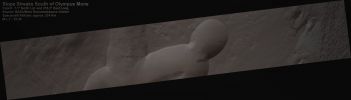
PSP_003239_1870_RED_browse-00-PCF-LXTT.jpgSlope Streaks on Collapse Pits (CTX Frame - Absolute Natural Colors; credits: Dr Paolo C. Fienga - Lunexit Team)369 visitenessun commentoMareKromium
|
|

PSP_003239_1870_RED_browse-01-PCF-LXTT.jpgSlope Streaks on Collapse Pits (EDM - Absolute Natural Colors; credits: Dr Paolo C. Fienga - Lunexit Team)378 visitenessun commentoMareKromium
|
|

PSP_003249_1510_RED_abrowse-00.jpgMineral Diversity inside Ritchey Crater (CTX Frame - Absolute Natural Colors; credits for the additional process. and color.: Dr Paolo C. Fienga - Lunexit Team)323 visitenessun commentoMareKromium
|
|

PSP_003249_1510_RED_abrowse-01.jpgMineral Diversity inside Ritchey Crater (EDM - Absolute Natural Colors; credits for the additional process. and color.: Dr Paolo C. Fienga - Lunexit Team)309 visitenessun commentoMareKromium
|
|

PSP_003249_1510_RED_browse_00~0.jpgLayered Deposits in Ritchey Crater (Enhanced Natural Colors; credits for the additional process. and color.: Dr Paolo C. Fienga - Lunexit Team)71 visiteThis HiRISE image shows eroding layered deposits in Ritchey Crater, a large impact crater in the Southern Highlands.
Three general units can be seen: a relatively dark upper layer, a light middle unit, and the floor material, which may be mostly obscured by dust.
The dark cap layer appears to be relatively hard and resistant, while the light material is weak.
Once the upper layer is removed, the light layer does not last long.
It is unclear how each of these layers formed.
Volcanic ash layers, lake or stream deposits, or sandstone deposited by dunes can all produce horizontal layers. Unraveling the origin would provide important clues to Mars' past.MareKromium
|
|

PSP_003249_1510_RED_browse_01~0.jpgLayered Deposits in Ritchey Crater (edm - possible True Colors; credits: Lunar Explorer Italia)93 visite
This cutout from the top center part of the context image shows this stack.
The dark unit is thin and breaking into boulders. The light material is actually divided into smaller layers, and is pervasively fractured. However, the boulders falling from the edge are mostly small and rarely remain intact if they move more than a few meters.
The cracking of the layer could be due to water loss from the layer, or to regional tectonic effects such as stresses from burial and erosion.
The base unit is partially covered by wind-blown ripples.MareKromium
|
|

PSP_003252_1425_RED_browse-00%7E0.jpgBright Gully Deposit in Terra Sirenum (ctx image - MULTISPECTRUM; credits: Lunar Explorer Italia)82 visiteThis HiRISE image shows a bright gully deposit and other gullies within a crater wall in Terra Sirenum (37,7° South Lat. and 229,0° East Long.).
Three images are available:
(context image - A): The full frame HiRISE image, with the crater at left center; the width of the image is 6 Km;
(close-up of the crater's rim - B): an enlargement showing the crater;
(close-up of the bright gully deposit - C).
Frames B and C have been stretched to enhance contrast. The red box in B shows the location of C. MareKromium
|
|
| 2236 immagini su 187 pagina(e) |
 |
|
|
|
|
108 | |
|
|
|
|








