Mars Reconnaissance Orbiter (MRO)
|
|
|
PSP_002892_1760_RED_abrowse-01.jpgLayered Deposits in Aureum Chaos (EDM - Absolute Natural Colors; credits: Dr Paolo C. Fienga - Lunexit Team)73 visitenessun commentoMareKromium
|
|
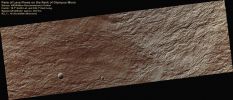
PSP_002909_2000_RED_abrowse-PCF-LXTT.jpgFeatures of Olympus Mons (Absolute Natural Colors; credits: Dr Paolo C. Fienga - Lunexit Team)231 visitenessun commentoMareKromium
|
|

PSP_002917_2175_RED_abrowse-00.jpgDissected Mantled Terrain (CTX Frame - Natural Colors; credits: Dr Paolo C. Fienga - Lunexit Team) 63 visiteA Northern Mid-Latitude scene consisting of Craters, Intercrater Plains and Mantled Material is visible in this HiRISE image.
The Mantled Material seen here covers much of the Middle Latitudes in both Hemispheres of Mars and it has been visibly removed in some locations.
This Terrain is called "Mantled" because it looks as if it's just draped over (meaning that it is "mantling") the topography underneath it.
The Mantled Material is what causes the Craters to have a muted, softened appearance. It's thought to be ice-rich material deposited in a climate different from that of today.
The Mantled Unit is dissected here, meaning that is not pristine and has likely undergone modification since it was originally laid down. The Intercrater Plains have a pitted texture that it is thought to be caused by water ice sublimating and leaving depressions behind.
Unlike that of Earth, the Obliquity (such as "tilt" of the Red Planet's Rotation Axis) of Mars changes wildly. Earth has the Moon to keep its Axis stable, but Mars' satellites, Phobos and Deimos, are not massive enough to do the same.
Today Mars' Obliquity (25,19°) is similar to that of Earth's (23.45°), but this has not always been the case. As the Obliquity changes, the portions of Mars that receive the most sunlight shift. During periods of high Obliquity, Polar Regions receive the most sunlight.
This causes Polar Ices, including water ice and CO2 ice, to sublimate into the Atmosphere. They would then potentially be re-deposited in the Mid-Latitudes, similar to where this image is located.
It is believed that this process is responsible for the existence of the Mid-Latitude Mantled Units.MareKromium
|
|

PSP_002917_2175_RED_abrowse-01.jpgDissected Mantled Terrain (EDM - Natural Colors; credits: Dr Paolo C. Fienga - Lunexit Team) 63 visitenessun commentoMareKromium
|
|

PSP_002917_2175_RED_browse.jpgCrater Cluster in the Northern (Mid-Latitude) Plains71 visiteA Northern Mid-Latitude scene consisting of craters, intercrater plains and mantled material is seen in PSP_002917_2175. The mantled material seen here covers much of the Middle Latitudes in both Hemispheres of Mars; it has been visibly removed in some locations. It's called "mantled" because it looks as if it's just draped over, or mantling, the topography underneath. The mantled material is what causes the craters to have a muted, softened appearance. It's thought to be ice-rich material deposited in a climate different from that of today.
The mantled unit is dissected here, meaning that is not pristine and has likely undergone modification since it was originally laid down. The intercrater plains have a pitted texture that is thought to be caused by water ice sublimating and leaving depressions behind.
Unlike that of Earth, the obliquity (tilt of the planet's rotation axis) of Mars changes wildly.
Earth has the Moon to keep its axis stable, but Mars' satellites, Phobos and Deimos, are not massive enough to do the same.
Today Mars' obliquity (25.19°) is similar to that of Earth's (23.45°), but this has not always been the case. As the obliquity changes, the portions of Mars that receive the most sunlight shift. During periods of high obliquity, polar regions receive the most sunlight. This causes polar ices, including water ice and carbon dioxide ice, to sublimate (evaporate) into the atmosphere. They would then potentially be re-deposited in the mid-latitudes, similar to where this image is located. It is believed that this process is responsible for the mid-latitude mantled unit.
MareKromium
|
|
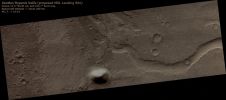
PSP_002919_1915_red-abrowse-PCF-LXTT.jpgPossible MSL Landing Site between Xanthe Terra and Hypanis Vallis (Absolute Natural Colors; credits for the additional process. and coloring: Dr Paolo C. Fienga - Lunexit Team)211 visitenessun commentoMareKromium
|
|

PSP_002922_1725_RED_abrowse-00.jpgGlacier-like Flow on Arsia Mons (CTX frame - Natural Colors; credits for the additional process. and color.: Dr Paolo C. Fienga - Lunexit Team)75 visiteThis observation shows a "Glacier-like Flow" in a Depression located on the flanks of Arsia Mons.
Arsia Mons is one of the large Martian Volcanoes that sits near the Equator on the Tharsis Rise. Downslope is towards the upper right of CTX frame, and the Flow is in this direction. It is interesting to note that the Depression is not directly radial from the Volcano's Peak, but rather oriented approximately 45° away, along the Flanks of the Volcano.
The pitted texture of the material suggests that sublimation is occurring or has occurred. The Surface Temperature and Pressure on Mars are such that water in ice-rich material can easily sublimate leaving behind a depression where the volatiles were removed.MareKromium
|
|

PSP_002922_1725_RED_abrowse-01.jpgGlacier-like Flow on Arsia Mons (EDM - Natural Colors; credits for the additional process. and color.: Dr Paolo C. Fienga - Lunexit Team)68 visiteIt is possible that the Flow Features that we can see in this image are "Relict Glaciers". The Flow Lobes and Surface Lineations are similar to those found on Glaciers on Earth. The merging of the Lobes seen in the bottom of the CTX Frame as well as in the EDM might imply that multiple walls are shedding material.
It is likely also that the Flanks of Arsia Mons contain ice-rich material - possibly deposited during a different Obliquity (Obliquity ----> Tilt of Mars' Spin Axis) or Climate Regime.MareKromium
|
|

PSP_002922_1725_RED_abrowse-02.jpgPossible Volcanic "Mouth", on Arsia Mons' Flank (EDM - RAW Natural Colors - credits for the additional process.: Dr Marco Faccin)68 visitenessun commentoMareKromium
|
|

PSP_002922_1725_RED_abrowse-03.jpgPossible Volcanic "Mouth", on Arsia Mons' Flank (EDM - Natural Colors - credits for the additional process.: Dr Paolo C. Fienga)113 visitenessun commentoMareKromium
|
|

PSP_002922_1725_RED_abrowse-04-PCF-LXTT.jpgPossible Volcanic "Mouth", on Arsia Mons' Flank (EDM - Absolute Natural Colors - credits for the additional process. and color.: Dr Paolo C. Fienga - Lunexit Team)1283 visitenessun commentoMareKromium
|
|

PSP_002932_1445_RED_abrowse-00.jpgSection of the Outer Rim of Hale Crater (CTX Frame - Absolute Natural Colors; credits for the additional process. and color.: Dr Paolo C. Fienga - Lunexit Team)115 visiteThis observation shows Hale Crater, a rather large, pristine elliptical crater approximately 125 x 150 Km in diameter. Hale Crater possesses sharp features, impact melt bodies ponded through out the structure and few overprinting Impact Craters. These attributes indicate that it is relatively young and certainly well-preserved - likely the youngest crater of this size on Mars.
Present on the Crater Walls are a large number of Gullies, some with Light-Toned Deposits. The Gullies visible here are very well developed, and many are cut deeply into the Hale's Walls. Several have "Braided Channels" suggestive of repeated flow. Some of the Gullies have Boulders littered throughout their Channels. This could be a result of a fluid preferentially transporting smaller particles and leaving larger rubble behind.
The composition of the Light-Toned Deposits are currently unknown. The CRISM Visible-InfraRed Spectrometer, HiRISE's sister instrument on MRO, may be able to shed some light on the composition of these materials.
In one place along the Crater Rim, Gullies are visible on both sides of the Rim (see the EDM that follows). This has only been seen in a few locations on Mars.MareKromium
|
|
| 2236 immagini su 187 pagina(e) |
 |
|
|
|
|
105 | |
|
|
|
|








