Mars Reconnaissance Orbiter (MRO)
|
|
|

PSP_001942_2310_RED_abrowse-00.jpgSigns of Fluids and Ice in an Unnamed Crater in Acidalia Planitia (CTX Frame - Absolute Natural Colors; credits for the additional process. and color.: Dr Paolo C. Fienga - Lunexit Team) 210 visiteThis image shows an Unnamed Crater approx. 11 Km (about 7 miles) in diameter, located in Acidalia Planitia, part of the Northern Plains. Several features in and around this Crater are suggestive of fluids and ice at and near the surface.
The muted topography of the Crater and its surroundings, the relatively shallow floor (300 mt or 330 yards), the convex slope of its Walls — all are consistent with ice being present under the Surface, mixed with rocks and soil. Ice would have acted as a lubricant, facilitating the flow of rocks and soils and hence smoothing landscape's features such as ridges and Craters' Rims.
The concentric and radial fissures in the Crater's Floor may indicate decrease of volume due to loss of underground ice. Piles of rocks aligned along these fissures and arranged forming polygons are similar to features observed in terrestrial periglacial regions such as Antarctica.
Antarctica's features are produced by repeated expansion and contraction of subsurface soil and ice, due to seasonal temperature oscillations.
The funnel-shaped depressions visible in the Crater's Floor could be Collapse Pits, further evidence of ice decay; alternatively, they could be smoothed-out small Impact Craters.
MareKromium
|
|

PSP_001942_2310_RED_abrowse-01.jpgSigns of Fluids and Ice in an Unnamed Crater in Acidalia Planitia (EDM - Absolute Natural Colors; credits for the additional process. and color.: Dr Paolo C. Fienga - Lunexit Team) 66 visiteThe South-looking (or Equator facing) walls of this Unnamed Crater are cut by numerous Gullies such as the ones shown here (500 x 600 mt or 550 x 650 yards), with well developed Alcoves, sinuous Channels and Terminal Fan Deposits.
These Gullies seem to originate at the same height, suggesting that the carving agent may have emanated from one single layer exposed in the Crater's Wall.
Contrastingly, no Gullies are observed in the North-looking (or Pole facing) wall of this Crater. Terrestrial Gullies very similar to the ones shown in this image are produced by surface water.
The arrows in this frame show fissures that may indicate detachment of surficial materials possibly held together by subsurface ice, sliding en masse down the crater's wall.MareKromium
|
|

PSP_001948_1425_red.jpgGorgonum Chaos (Original NASA/JPL/University of Arizona b/w Frame)65 visitePSP_001948_1425 shows part of Gorgonum Chaos, a large cluster of chaotic terrain found in the Southern Hemisphere.
Many regions of chaotic terrain are found at the head of large outflow channels that were scoured by ancient floods. Gorgonum Chaos is one region that is not associated with an outflow channel. Chaotic terrain can form when subsurface volatiles (such as water) are catastrophically released and the overlying surface collapses. It is not known whether isolated chaotic terrain — such as that shown in this image — formed in the same way that the chaotic terrain near the outflow channels did. Wind erosion might play a role in their formation.
Gorgonum Chaos is an especially interesting area because gullies thought to have been eroded by liquid water are located on its mesas. The gullies have a wide range of orientations and many appear to emanate from a distinct layer in the mesas.
It is not known why gullies form on one slope rather than another, but insolation (amount of sunlight received), availability of water, and regional slope are possible contributing factors.
|
|

PSP_001970_1655_RED_abrowse.jpgLandslide in Coprates Chasma (Natural Colors; credits for the additional process. and color.: Dr Paolo C. Fienga - Lunexit Team)66 visiteThis observation shows a Landslide in the Coprates Chasma Region of Valles Marineris that occurred when a large unstable area of rock broke away from the Cliffs that can be seen on the right side of the frame. This mass of falling rock broke into many small pieces as it slid downhill and came to rest at the base of the Cliff, forming the Lobate (curved) Mound visible on the left part of the image.
The smooth textured Ripples that can be seen in the central part of the frame are Sand Dunes. Sand Dunes form as wind-blown particles roll across the Surface and accumulate. Since the air on Mars is very thin, Sand Dunes take much longer to form on Mars than they do on Earth.
The presence of large Sand Dunes - along with many small Impact Craters - on top of this Landslide indicates that movement of the slide occurred a very long time ago; perhaps hundreds of millions of years.
This Landslide was probably caused by a strong Marsquake, but a nearby (significant) impact could have generated a deep shock-wave that was sufficiently strong to cause it. Alternatively, movement along nearby Faults may have triggered the Landslide.
The Valles Marineris Region is cut by many Faults and in fact contains many more Landslides such as this one. Some scientists believe that these Landslides represent a record of seismic activity in this area.
It is obvious that a better understanding of the history of seismic activity in this specific Region may help scientists to predict the likelihood that Marsquakes still occur on the Planet.MareKromium
|
|
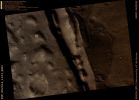
PSP_002014_1415_RED_abrowse-00.jpgTrough in Gorgonum Fossae (Absolute Natural Colors; credits for the additional process. and color.: Dr Paolo C. Fienga - Lunexit Team)112 visitePSP_002014_1415 shows Gullies in a Trough that is near Gorgonum Chaos, a Region filled with Gullies.
The Trough Gullies, like many of the Gullies on nearby Gorgonum Chaos' Mesas, appear to originate at a distinct Layer. There are Mounds within the Trough that have Layers exposed near their Peaks. The Layers in the Mound and on the Trough Walls are resistant, meaning they do not break up mostly into small particles that the wind can easily carry away.
Instead, they are breaking up into Boulders up to several meters wide that HiRISE can see (the fact that the Layers are eroding as boulders tells us that the material is not easily broken up into smaller and smaller pieces, so it is therefore termed "resistant to erosion").
However, it is not completely resistant to erosion as we can see by the Boulders rolling down the Slopes.
Gullies are thought by many to require liquid water to form and a major debate is whether this water comes from the surface (i.e., melting surface ice or melting snow) or the subsurface (i.e., from an aquifer).
Gullies are often found to originate at layers, like those seen here.
The subsurface water theory states that water travels under the surface to slope faces where it flows down the slope to form gullies. Visible layers are suggested to be impermeable, such that water cannot penetrate them, which is why the gullies originate from beneath the layers.
Often Gullies will originate between Layers, which suggests that there is a permeable Layer trapped between impermeable Layers.
It is also possible that the Layer preferentially traps ice or snow that may melt to form Gullies, thus providing a surface source of water to form the Gullies.
Please note that the stripe-like features on the lower side of the image are camera artifacts and not real features.MareKromium
|
|

PSP_002036_1655_RED_abrowse-PCF-LXTT.jpgMesa in Coprates Chasma (Natural Colors; credits for the additional process. and color.: Dr Paolo C. Fienga - Lunexit Team)214 visiteMars Local Time: 15:40 (Middle Afternoon)
Coord. (centered): 14,4° South Lat. and 304,2° East Long.
Spacecraft altitude: 258,8 Km (such as about 161,7 miles)
Original image scale range: 25,9 cm/pixel (with 1 x 1 binning) so objects ~ 51,8 cm across are resolved
Map projected scale: 25 cm/pixel
Map projection: EQUIRECTANGULAR
Emission Angle: 2,3°
Sun-Mars-Spacecraft (or "Phase") Angle: 61,4°
Solar Incidence Angle: 59° (meaning that the Sun is about 31° above the Local Horizon)
Solar Longitude: 160,0° (Northern Summer)
Credits: NASA/JPL/University of Arizona
Additional process. and coloring: Dr Paolo C. Fienga - Lunar Explorer ItaliaMareKromium
|
|

PSP_002066_1425_RED_browse-00~0.jpgGullies and Ice-rich Material (CTX Frame - Natural Colors; credits: Lunexit)66 visiteThis picture shows Gullies in an Unnamed Southern Crater.
Gullies typically form when flowing water has sufficient energy to erode soil and soft rock in a channelized flow.
The Gullies in this image have narrow, overlapping channels and are deeply incised into the slope. Overlapping channels may suggest multiple flow events on this slope wall.
It is unknown what happened to the water that flowed in these Gullies. Some of the water may have evaporated or gradually sublimated into the Atmosphere or became incorporated as ice in the Gully Debris Aprons located downslope at their Termini.
Sublimation is a process similar to evaporation, except that solid ice (instead of liquid water) returns to the atmosphere as a gas. Sublimation is common on Mars because the temperature and pressure are so low on Mars today that liquid water is only rarely stable.
Nota Lunexit: la NASA dice che "...liquid water on Mars is only RARELY stable...". Raramente, quindi, e NON "mai"!
A questo punto ci piacerebbe davvero sapere quando ed a quali condizioni occorre questa "stabilità" (che, a nostro parere, potrebbe e dovrebbe occorrere ANCHE oggi)...MareKromium
|
|

PSP_002066_1425_RED_browse-01~0.jpgGullies and Ice-rich Material (EDM - Natural Colors; credits: Lunexit)63 visiteIn this EDM (approx. 500 mt across) we can notice that the crater floor is covered in boulders, dunes and textured material.
The boulders are likely a “sublimation lag” that provides evidence that material on the crater floor is, or once was, ice-rich. A sublimation lag forms when ice-rich material sublimates leaving the boulders and rocks behind. It is possible that the boulders on this crater floor represent such a process.
The pitted texture around boulders may also be an indicator of ice sublimation.MareKromium
|
|

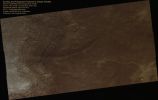
PSP_002070_2250_RED_abrowse-00.jpgPolygons in Utopia Planitia (Absolute Natural Colors; credits for the additional process. and color.: Dr Paolo C. Fienga - Lunexit Team) 105 visiteThis observation, in the Utopia Planitia, is marked by Depressions in the Mantle, several of which have coalesced together and now possess Scalloped edges and Layers.
Scalloped pits, such as these, are typical features of the Mid-Latitude Mantle and are most commonly found at approx. 55° both North and South Latitude; in the Utopia Planitia, Scalloped Terrain is found between 45-50° North latitude where the Mantle is highly discontinuous. The presence of Scalloped Pits has led to hypotheses of the removal of Sub-Surface material, possibly interstitial ice, by Sublimation. Scalloped Depressions in the Utopia Planitia have also been interpreted to be "Thermokarst Lakes" created by melting of Permafrost (frozen ground) and collapse of the dry Surface Layer.
Scalloped Pits typically have a steep Pole-facing Scarp and a gentler Equator-facing Slope. This is most likely due to differences in solar heating.MareKromium
|
|

PSP_002070_2250_RED_abrowse-03.jpgPolygons in Utopia Planitia (EDM - Absolute Natural Colors; credits for the additional process. and color.: Dr Paolo C. Fienga - Lunexit Team) 118 visiteOn the Surface surrounding the "Scalloped Depressions" there are several large Boulders (see this EDM). Sources for these rocks may include Ejecta from nearby Craters, Volcanic Floods, or Boulders emplaced by Glaciers or Periglacial Processes.
Also on the surrounding Surface is a Polygonal Pattern of Fractures. This is commonly associated with Scalloped Terrain, and indicates that the Surface has undergone stress, potentially caused by Subsidence, Desiccation, or Thermal Contraction.
Variations in the sizes of the Polygons seems to be partly dependant on their location with small Polygons appearing within the Scallops and larger Polygons appearing outside the Scallops on the Surface of the Mantle. Several cracks cut through the side of the Scallops indicating that they must be at least as deep as the Scallops. The Polygons may have been present previous to the erosion of the Mantle. The formation of some Scalloped Depressions is believed to be an ongoing process today. MareKromium
|
|
PSP_002070_2250_RED_browse-00~0.jpgPolygons in Utopia Planitia (Natural Colors; credits for the additional process. and color.: Dr Paolo C. Fienga - Lunexit Team)134 visitenessun commentoMareKromium
|
|
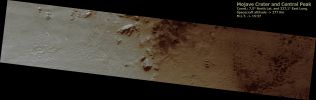
PSP_002101_1875_red-00~0.jpgMojave Crater Floor and Central Uplift (CTX Frame - Natural Colors; credits: Lunexit)65 visiteThis full HiRISE image shows that the Crater Floor - South of the Central Uplift - is densely pitted and fractured. These Pits, many of which are partially filled with dark sand, lack raised rims and a circular form.
This suggests that they are not impact craters. In fact, very few definite impact craters are seen on the Floor and Walls of Mojave, implying that it is incredibly young and relatively well preserved for a crater of its size.
HiRISE images covering Mojave Crater and the surrounding Region are yielding new insights into impact processes on Mars. MareKromium
|
|
| 2236 immagini su 187 pagina(e) |
 |
|
|
|
|
100 | |
|
|
|
|








