|
|

Dyson_Swarm_-_01.jpgThe Dyson Swarm143 visiteSome have suggested that Dyson Sphere habitats could be built around white dwarfs or pulsars.
In 2022 it was suggested that a Dyson Swarm around the Sun could be launched from either Mercury or Mars.
In order to transmit the energy back (Microwaves and high frequency IR Radiations maybe?), far-field radiative wireless power transfer was proposed, a technology that is not yet fully developed. But the question remains open...
A Dyson swarm is a hypothetical megastructure that orbits a star to capture its radiant energy. Proposed as an alternative to the solid, unbuildable "Dyson Sphere," it consists of a vast cloud of independent satellites or habitats that harness massive amounts of stellar power.
The Inspiration: Physicist Freeman Dyson first proposed the concept in 1960. He theorized that highly advanced alien civilizations would require exponentially more energy than a single planet could provide, prompting them to build structures around their host star.
Dyson Sphere vs. Dyson Swarm: Dyson Sphere vs. Dyson Swarm: While a traditional "Dyson sphere" is often imagined in sci-fi as a single, solid shell around a star, this is mechanically impossible due to immense gravitational stresses. A swarm solves this by using millions or billions of independent solar collectors, mirrors, and space habitats traveling in their own individual orbits. MareKromium
|
|
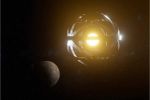
Dyson_Swarm_-_03.jpgThe Dyson Sphere170 visiteHow It Works: each satellite in the Swarm absorbs or reflects the star’s sunlight and beams it to where it is needed—such as to an inhabited planet or orbital space stations.
Uses: the captured energy could power an entire civilization, propel massive spaceships using photon sails, or run planetary-scale supercomputers and artificial intelligence networks.
Materials: constructing a comprehensive Swarm requires a staggering amount of raw materials. Theorists suggest that disassembling an entire rocky planet, like Mercury, could provide enough mass to build the initial stages of a Swarm.
Gradual Build: our Civilization wouldn't build a full Swarm all at once. We would likely start with a "proto-swarm" consisting of space-based solar arrays, expanding it over thousands of years.MareKromium
|
|
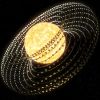
Dyson_Swarm_-_04.jpegThe Dyson Swarm163 visiteBecause these megastructures absorb so much starlight, they would emit a unique infrared signature (waste heat). Astronomers look for these anomalies when searching for highly advanced, Extraterrestrial Civilizations (so-called "Technosignatures").MareKromium
|
|

EASTER ISLAND PLANETS.jpgArt will outlive the Artist103 visite"...Tutta l'Arte che un Artista potrà mai creare, ora usando pietre ed ora usando ferro, sopravviverà - lungamente - al suo Creatore.
E dunque, se questo è vero, nella nostra Arte Mortale ci deve pur essere, in fondo, almeno una particella dell'Eternità..."
P.C. Floegers - "Conversations for Tomorrow"
|
|

EOD.jpgShards of a Planet135 visiteComunicazione ai Lettori di Lunar Explorer Italia: a partire - formalmente - da oggi, 22 Giugno 2011, è cessata ogni collaborazione tra la nostra Fondazione ed il Sito "PianetaMarte.net", gestito dal Sig. Matteo Fagone.
La decisione, triste ma necessaria, è divenuta inevitabile a causa della - ormai - profondissima diversità di vedute, approcci, stili, argomenti e collaborazioni esistente fra le due Entità in questione. Rammentiamo, per onor del vero, oltre che per Correttezza (Virtù sempre più rara), che fu lo stesso Sig. Fagone, circa due mesi fa, a chiedere la cancellazione (come Partner e come "link" in uscita) del Suo nome e del Suo Sito da Lunar Explorer Italia.
I motivi della Sua richiesta non vennero precisati, ma questo non ha più importanza.
Per quanto attiene i nostri motivi, possiamo solo dire che una Partnership, piccola o grande che sia, per mantenersi e sostenersi necessita, come sanno tutti, di alcuni elementi essenziali, tra cui evidenziamo, ad esempio: la Comunione di Intenti e di Vedute, la Compatibilità degli Approcci adottati e dei Fini perseguiti nonchè una sostanziale "affinità" di Sensibilità e Culture.
Ebbene, tutto questo, da ormai molto tempo, non esisteva più tra PianetaMarte.net e Lunar Explorer Italia e quindi la decisione di cancellare anche formalmente la predetta Partnership a noi sembra, oltre che inevitabile, anche giusta e corretta.
Auguriamo (ed auguro, personalmente) il meglio al Sig. Fagone ed alla Sua "Creatura" PianetaMarte.net, e siamo/sono certi/o che le Sue scelte e filosofie, recenti e meno recenti, lo ripagheranno adeguatamente e pienamente.
Dr Paolo C. Fienga - Lunar Explorer Italia
Presidente e Socio co-FondatoreMareKromium
|
|

Earth.jpgUs, from the distance...180 visite"...Se la Fisica Quantistica non vi confonde, allora vuol dire che non l'avete capita..."
(Massima attribuita a Niels Bohr, Fisico - Copenaghen, 7 Ottobre 1885 - Copenaghen, 18 Novembre 1962)MareKromium
|
|

Earth.pngMother Earth83 visiteDalla Rubrica "NASA - Picture of the Day", del giorno 23 Novembre 2009:"Goodbye Earth!
Earlier this month, ESA's interplanetary Rosetta Spacecraft zoomed past the Earth on its way back across the Solar System.
Pictured above, Earth showed a bright crescent phase featuring the South Pole to the passing rocket ship. Launched from Earth in 2004, Rosetta used the gravity of the Earth to help propel it out past Mars and toward a 2014 rendezvous with Comet Churyumov-Gerasimenko.
Last year, the Robot Spacecraft passed asteroid 2867 Steins, and next year it is scheduled to pass enigmatic asteroid 21 Lutetia. If all goes well, Rosetta will release a probe that will land on the 15-Km diameter comet in 2014". MareKromium
|
|

Earth_Eclipse.jpgThe "Diamond Ring"...from the Moon!96 visiteUno splendido montaggio che ci mostra una ipotetica veduta dalla Luna di un Eclisse Totale di Sole. Bellissima ricostruzione, davvero, ma...c'è un errore davvero grande in questa "Scena di fantasia": durante una eclissi totale di Sole (ed anche nel momento in cui si forma l'Anello di Diamante - come in questa immagine) la superficie della Luna si troverebbe immersa nella più totale oscurità e quindi risulterebbe ai nostri occhi solo appena distinguibile, in forma di vaghe e quasi indefinibili ombre scure, con le stelle ben visibili nel cielo.
Ma va bene lo stesso...
Caption NASA:"Parts of Saturday's (March 3) lunar eclipse will be widely visible. For example, skywatchers in Europe, Africa, and western Asia will be able to see the entire spectacle of the Moon gliding through Earth's shadow, but in eastern North America the Moon will rise already in its total eclipse phase. Of course if you traveled to the Moon's near side, you could see the same event as a solar eclipse, with the disk of our fair planet Earth completely blocking out the Sun. For a moon-based observer's view, graphic artist Hana Gartstein (Haifa, Israel) offers this composite illustration. In the cropped version of her picture, an Apollo 17 image of Earth is surrounded with a red-tinted haze as sunlight streams through the planet's dusty atmosphere. Earth's night side remains faintly visible, still illuminated by the dark, reddened Moon, but the disk of the Earth would appear almost four times the size of the Sun's disk, so the faint corona surrounding the Sun would be largely obscured. At the upper left, the Sun itself is just emerging from behind the Earth's limb".MareKromium
|
|
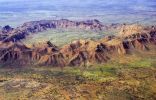
Earth_Impact_Craters_-_Gosses_Bluff_Crater_-_Australia.jpgGosses Bluff Crater (Australia)161 visiteSituato nel Northern Territory meridionale, l'imponente cratere meteorico Gosses Bluff ha un diametro di 5 km e un'altezza del bordo di 200 metri. Il sito e' noto come Tnorala agli aborigeni occidentali di Arrernte ed e' un luogo sacro.MareKromium
|
|
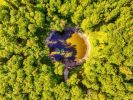
Earth_Impact_Craters_-_Kaali_Crater_-_Estonia.jpgKaali Crater (Eastland)160 visiteKaali e' il nome collettivo di un gruppo di nove laghi di crateri meteoritici nel villaggio di Kaali, sull'isola estone di Saaremaa. La formazione dell'ammasso e' datata poco dopo il 1530-1450 a.C.MareKromium
|
|
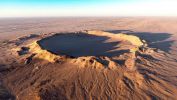
Earth_Impact_Craters_-_Tenoumer_Crater_-_Mauritaria.jpgTenoumer Crater (Mauritania - Western Sahara)217 visiteIl drammatico bordo quasi circolare del cratere Tenoumer e' una delle caratteristiche geologiche distintive del paesaggio desertico del Sahara occidentale della Mauritania. MareKromium
|
|
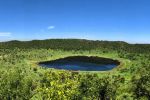
Earth_Impact_Craters_-_Tswaing_Crater_-_Sud_Africa.jpgTswaing Crater (South Africa)182 visiteIl pittoresco cratere Tswaing si trova a nord-ovest di Pretoria e si stima che abbia un'eta' compresa tra 220.000 e 52.000 anni. E' interessante notare che gli strumenti di pietra risalenti all'eta' della pietra media mostrano che il cratere era regolarmente visitato da persone fin da 100.000 anni faMareKromium
|
|
| 495 immagini su 42 pagina(e) |
 |
|
|
|
|
8 | |
|
|
|
|








