|
|

The_Moon_and_Venus.jpgCrescent Moon and Venus85 visiteCaption NASA, da "NASA - Picture of the Day" del giorno 6 Marzo 2009:"Last Friday (such as February, 27th, 2009), the Moon and Venus shared the early evening sky in a beautiful Conjunction.
Separated by only about 2°, they also were both in a crescent phase.
Just like our Moon, Venus can appear as a full disk or a thin crescent. Frequently the brightest object in the post-sunset or pre-sunrise sky, Venus is so small that it usually requires binoculars or a small telescope to clearly see its phase.
This telescopic image of Friday's Conjunction shows off the similar crescent phases, with the tiny crescent Venus at the upper right".MareKromium
|
|

The_Moon_and_Venus_2.jpgSetting Moon and Venus (Credits: Dott.ssa Tatiana Balbiani)131 visite“I dolori, le delusioni e la malinconia non sono fatti per renderci scontenti e toglierci valore e dignità, ma per maturarci”
Herman HesseMareKromium
|
|

The_Moon_and_Venus_3.jpgVenus and the Moon (Credits: Giorgia Hofer)117 visite“Beato chi non si aspetta nulla, perché non resterà mai deluso”
Alexander PopeMareKromium
|
|

The_Moon_and_the_Pleiades.jpgFragments of the Infinite80 visite"...E così Ti vedo, nascosta dietro i Veli di Orione,
E sorridente, come una Stella del Mattino,
Mi guardi, ma lasci che sia io a parlare,
Ti guardo, e lascio che la Notte si spenga,
Amore mio, sei ad un Passo dal mio Cuore,
Che sento pulsare e che potrei toccare,
Ma è un inganno: Tu sei persa nell'Infinito,
Trascorsa l'Alba, di Te non rimarrà più nulla..."
P.C. Floegers - "Poesie"
MareKromium
|
|
The_Moon~0.jpgThe Moon77 visitenessun commentoMareKromium
|
|
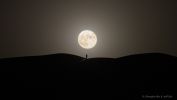
The_Moon~2.jpgFull Moonlight (Credits & Copyright: Zhengjie Wu and Jeff Dai - TWAN)122 visiteThe Full Moon is the brightest lunar phase, and tonight you can stand in the light of the first Full Moon of 2026. In fact, the Moon's full phase occurs on January 3 at 10:03 UTC, while only about 7 hours later planet Earth reaches its 2026 perihelion, the closest point in its elliptical orbit around the Sun, at 17:16 UTC. January's Full Moon was also not far from its own perigee, or closest approach to planet Earth. For this lunation the Moon's perigee was on January 1 at 21:44 UTC.MareKromium
|
|

The_Rising.jpgThe Rising (by Dr Gianluigi Barca)114 visitenessun commentoMareKromium
|
|

The_Sun.jpgPartial Eclipse82 visiteCaption NASA:"On Monday, March 19, 2007, shortly before the Equinox, locations in Asia and the Arctic were favoured by the New Moon's shadow during a partial Solar Eclipse. Although the view from Goa, India, found the eclipsed Sun near the horizon, photographer Joerg Schoppmeyer was still able to capture this lovely image, combining celestial with terrestrial silhouettes.
The next eclipse season will begin in late August this year, featuring a total Lunar Eclipse on August 28, and another partial solar eclipse on September 11. Compared to the March 19th eclipse, the September 11th eclipse will be seen on the other side of our fair planet, from parts of South America and Antarctica".
|
|

The_Sun_over_Stonehenge.jpgSunrise Solstice at Stonehenge 85 visitenessun commentoMareKromium
|
|

The_Sun~0.jpgNorouz...82 visiteCaption NASA:"Clouds covered the eastern horizon on Monday, when the Sun rose over the expansive Touran Wildlife Reserve in North-Eastern Iran. Of course, on that day the Moon rose with the Sun, creating a widely enjoyed partial solar eclipse. Along with a mountainous horizon, the cloud cover lent a dramatic aspect to this eclipse sunrise and made it possible for astronomer Babak Tafreshi to record these telephoto images without using a filter. Advancing north in planet Earth's sky, the Sun itself was also approaching the equinox, the astronomical marker for the first day of Northern Hemisphere Spring and the beginning of Norouz, the Persian New Year".
|
|

The_Sun~0.jpgPurple Sun (by Marco Faccin)77 visitenessun commentoMareKromium
|
|

The_Wall.jpgThe Wall and the Shell (by Roberto Tremolada)118 visitenessun commentoMareKromium
|
|
| 495 immagini su 42 pagina(e) |
 |
|
|
|
|
34 | |
|
|
|
|








