|
|

Sunrise.jpgCrepuscular Rays Over Utah83 visiteDa "NASA - Picture of the Day", del 31 Agosto 2005:"What could cause such rays of dark? Dark sky rays were caught in spectacular fashion earlier this month above Utah, USA. The cause is something surprisingly familiar: shadows. Clouds near the horizon can block sunlight from reflecting off air, making columns outward from the Sun appear unusually dark. Cloud shadows can be thought of the complement of the more commonly highlighted crepuscular rays, also visible above, where sunlight pours though cloud holes. Sometimes, on the opposite side of the sky, anticrepuscular rays can also be seen".
|
|

SunriseovertheParthenon.jpgDawn over the Land of Gods68 visiteDa "NASA - Picture of the Day", del giorno 21 Giugno 2009:"Today, the Sun will stay in the sky longer than any other day of the year, as seen from the Northern Hemisphere of Earth. Named the Summer Solstice, today's maximum daylight is indicative of the high amount of sunlight this time of year that is primarily responsible for the heat of the Summer season. At the North Pole and for all places above the arctic circle, there will be no night -- the entire day today will be lit by sunlight. The situation is reversed in Earth's Southern Hemisphere, where today has the least sunlight of any day. Today's solstice is commemorated above by a well-planned picture of our five billion year old Sun rising behind the 2500 year old Parthenon in Greece. Trees and birds occupy the foreground, while a modern crane is shown restoring parts of this historic symbol of a cultural civilization".MareKromium
|
|
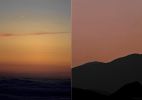
Sunrises.jpgPoints of View...127 visitenessun commentoMareKromium
|
|

Suns.jpgTwo Suns in the Sunset...264 visiteIn my rear view mirror, the Sun is going down
Sinking, behind bridges in the road...
And I think of all the good things
That we have left undone,
And I suffer premonitions,
Confirm suspicions,
Of the holocaust to come...
The rusty wire that holds the cork
That keeps the anger in,
Gives way,
And suddenly, it's day again!
The Sun is in the East,
Even though the day is done,
Two Suns in the sunset...
Hmmmmmmmmm....
Could be the Human Race is run?!?
Like the moment when your brakes lock
And you slide toward the big truck,
And stretch the frozen moments with your fear...
And you'll never hear their voices!
And you'll never see their faces!
You have no recourse to the law anymore!...
And as the windshield melts,
And my tears evaporate...
Leaving only charcoal to defend,
Finally I understand
The feelings of the few:
Ashes and Diamonds,
Foe and Friend,
We were all equal in the end...
(Pink Floyd - "Two Suns in the Sunset")MareKromium
|
|

Sunset-128564-1.jpgAfter Betelgeuse goes Supernova (Fantasy - Credits: Tatiana Balbiani)203 visite"...Those who aren't shocked when they first encounter quantum theory most likely haven't understood it.
And if quantum physics doesn't confuse them, then they certainly haven't understood it..."
(Traduzione)
"Coloro che non rimangono sconvolti quando si imbattono per la prima volta nella teoria quantistica molto probabilmemte non l'hanno capita.
E se la fisica quantistica non li confonde, allora sicuramente non l'hanno capita".
Niels BohrMareKromium
|
|

Sunset-128565.jpgReddish Clouds (Credits: Tatiana Balbiani)200 visite"...Do you think quantum physics has the answer?
Excuse me, but what good is it to me that time and space are exactly the same thing?
I mean, I ask someone what time it is and they say, "6 kilometers." What the hell is that?..."
Woody Allen, in Anything Else, 2003MareKromium
|
|

Sunset-PCF-00.jpgSunset from Legnano (Natural Colors; credits: Dr Paolo C. Fienga)210 visitenessun commento
|
|
Sunset-PCF-01.jpgSunset from Legnano (Absolute Natural Colors; credits: Dr Paolo C. Fienga)219 visitenessun commentoMareKromium
|
|

Sunset.jpgCrescent Moon and Mercury at Sunset71 visite"...Is anything too wonderful for the Lord?..."
Genesis - 18:14MareKromium
|
|

Sunset~1.jpgUntitled (by Brian Cameron)75 visitenessun commentoMareKromium
|
|

Super-Earths.jpgSuper-Earths?114 visiteda "NASA - Picture of the Day" del giorno 20 Marzo 2006:"Are Super-Earths common around other star systems? Quite possibly. Unexpected evidence for this came to light recently when a planet orbiting a distant star gravitationally magnified the light of an even more distant star. Assuming the planet's parent star is normal red dwarf, the brightening is best explained if the planet is about 13 times the mass of the Earth and orbiting at the distance of the asteroid belt in our own Solar System. Given the small number of objects observed and similar determinations already obtained for other star systems, these super-Earths might be relatively common. Astronomers speculate that the planet might have grown into a Jupiter-sized planet if its star system had more gas. Since the planet was not observed directly, significant uncertainty remains in its defining attributes and future research will be aimed at better understanding this intriguing system (...)".
|
|

Supernova.jpgSupernova (a Fantasy - by Dr Paolo C. Fienga - based on an Alex Cherney's picture)123 visiteChe cosa accadrebbe e, soprattutto, che cosa vedremmo se una stelle di grandi dimensioni esplodesse e, dal nostro punto di vista, si trovasse nei pressi del "Centro" della Via Lattea?
Probabilmente assisteremmo ad uno spettacolo quale è quello che vedete qui, in questo splendido frame di Alex Cherney (rappresentativo di una "Visione Galattica" ottenuta dall'Australia - Loch Ard Gorge), da me liberamente - ma solo in piccola parte - modificato.
Una sorta di "Piccolo Sole" illuminerebbe (in maniera maestosa!) la notte, forse per una settimana o poco più, ma senza trasformarla in giorno o in crepuscolo.
Si, sarebbe un Grande Spettacolo...Davvero.MareKromium
|
|
| 495 immagini su 42 pagina(e) |
 |
|
|
|
|
30 | |
|
|
|
|








