|
|
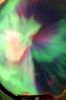
Aurora_Borealis-Coronal_Aurora-1.jpg"Auroral Corona" from l'Observatoire de la Découverte in Val Belair near Quebec - Canada84 visiteDa "NASA - Picture of the Day" del 9 Novembre 2004: "...This fisheye picture captures a particularly active and colorful 'Auroral Corona' that occurred on November 7, 2004 (...) The above aurora has an unusually high degree of detail, range of colors and breadth across the sky. The vivid green, red, and blue auroral colors are likely caused by high atmospheric oxygen and hydrogen reacting to incoming electrons. The trigger events were magnetically induced explosions on the Sun from sunspot region 696 over the past few days. Continued activity from this active solar region could mean more auroras visible to northern observers over the next few days. Early in the morning but far in the background, planets, stars and the Moon will be simultaneously putting on their own show".
Una piccola (nostra) nota di commento: dietro la vivace bellezza dell'immagine ed i "romantici" commenti, c'è un nuovo incremento dell'attività solare in un periodo in cui, invece, il nostro Sole è usualmente calmo.
|
|
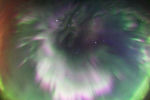
Aurora_Borealis-Coronal_Aurora-sep11aurora_moussette_f.jpgNorthern Lights over Canada75 visiteSo far, the Aurora Borealis - or "Northern Lights" - have made some remarkable visits to September's Skies. The reason, of course, is the not-so-quiet Sun. In particular, a large solar active region now crossing the Sun's disk has produced multiple, intense flares and a large Coronal Mass Ejection (CME) that triggered wide spread auroral activity just last weekend. This colorful example of spectacular curtains of aurora was captured with a fish-eye lens in skies over Quebec, Canada, on September 11, 2005.
Also featured is the planet Mars, the brightest object above and left center. Seen near Mars (just below and to the right) is the tightly knit Pleiades star cluster.
Although they can appear to be quite close, the Northern Lights actually originate at extreme altitudes, 100 Km or so above the Earth's surface.
|
|
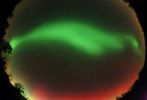
Aurora_Borealis-Coronal_Aurora.jpgCoronal Aurora near Warrensbourg - Missouri (USA)88 visiteIn relazione a quanto detto e scritto solo pochi giorni fa, ecco una nuova Aurora la quale, oltre ad essere stata particolarmente intensa (come potete ben vedere), è accaduta ad un latitudine che di Polare o presso-Polare non ha proprio nulla. La NASA dice che è un fenomeno inusuale ma "normale", vista l'attività solare di questi giorni. Permetteteci, a questo riguardo, una battuta: è proprio il fatto che sia la NASA a dire di non preoccuparci che ci fa preoccupare... EccoVi il commento originale da "NASA - Picture of the Day" del giorno 12.11.2004: "(...) Amazing! Unbelievable!, The best I've ever seen! ... They aren't talking about a movie, though. Instead, even casual sky critics are remarking on November's stunning auroral displays, visible with surprising intensities well beyond the confines of high latitudes where auroral activity is normally observed (...)". Vedete?!? Entusiasmo, eccitazione, linguaggio più da show che da Scienza e dintorni: è il nuovo corso della NASA...
|
|

Aurora_Borealis.jpgAurora Borealis over Chena Lakes68 visiteCaption NASA:"Sometimes, after your eyes adapt to the dark, a spectacular sky appears. In this case, a picturesque lake lies in front of you, beautiful green aurora flap high above you, brilliant stars shine far in the distance, and, for a brief moment, a bright meteor streaks by. This digitally fused breathtaking panorama was captured late last month across one of the Chena Lakes in North Pole, Alaska, USA, and includes the Pleiades open cluster of stars on the image right. The shot is unusual not only for the many wonders it has captured simultaneously, but because lakes this far north tend to freeze and become non-reflecting before a sky this dark can be photographed".MareKromium
|
|

Aurora_Borealis_-_00.jpgOn the shoulder of Giants...69 visitenessun commentoMareKromium
|
|

Aurora_Borealis_-_01.jpgRed Space-Waterfall77 visitenessun commentoMareKromium
|
|

Aurora_Borealis_-_02.jpgPeaceful Morning Sky87 visitenessun commentoMareKromium
|
|

Aurora_Borealis_-_03.jpgAurora in the Northern Skies83 visiteUn frame davvero molto bello ma che, a parere del nostro Esperto di Fotografia, è stato "taroccato" nelle colorazioni. In realtà la nostra non è una "conclusione scientifica" quanto, piuttosto, il frutto di una sensazione basata sia sull'esperienza (le Aurorae "rosse" sono rare, quelle "fucsia e rosa"...di fatto inesistenti...), sia sull'incoerenza cromatica dei particolari della fotografia una volta che essa è stata scomposta nei suoi canali principali.
Comunque sia...una bella immagine!MareKromium
|
|

Aurora_Borealis_-_04.jpgPurple (light's) Rain...71 visiteSi tratta della stessa fotografia mostratavi nel quadro precedente ma, questa volta, è in "colori autentici" (almeno a mio parere...).MareKromium
|
|

Aurora_Borealis_-_05.jpgAurora in the Northern Skies80 visitenessun commentoMareKromium
|
|

Aurora_Borealis~0.jpgAuroral Corona73 visiteCaption NASA, da "NASA - Picture of the Day" del giorno 28 Luglio 2009:"Few Auroras show this level of detail. Above, a standard digital camera captured a particularly active and colorful Auroral Corona that occurred last week above Alberta, Canada. With a shape reminiscent of a flower, the spectacular Aurora had an unusually high degree of detail. The vivid green and purple auroral colors are caused by high Atmospheric Oxygen and Hydrogen reacting to a burst of incoming electrons. Many photogenic Auroras have been triggered from a Solar Wind Stream that recently passed the Earth. The Auroras were unexpected because the initiating Sun has been unusually quiet lately".MareKromium
|
|

Autumn_s Moon.jpgLuna d'Autunno80 visitenessun commento
|
|
| 495 immagini su 42 pagina(e) |
 |
3 | |
|
|
|
|
|
|
|
|








