|
|

Solaris-4.pngSolaris222 visite"...Science? Nonsense!
In this situation, mediocrity and genius are equally useless!
I must tell you that we really have no desire to conquer any cosmos. We want to extend the Earth up to its borders. We don't know what to do with other worlds. We don't need other worlds. We need a mirror. We struggle to make contact, but we'll never achieve it. We are in a ridiculous predicament of man pursuing a goal that he fears and that he really does not need..."MareKromium
|
|
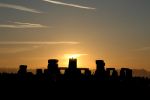
Solstice over Stonehenge.jpgSolstice on Stonehenge98 visiteDa "NASA - Picture of the Day" del 21 Giugno 2006:"Today the Sun reaches its northernmost point in the planet Earth's sky.
Called a "solstice", the date traditionally marks a change of seasons -- from Spring to Summer in Earth's Northern Hemisphere and from Fall to Winter in Earth's Southern Hemisphere. Pictured above is the 2005 Summer Solstice celebration at Stonehenge in England. The event was rare because Stonehenge was not always open to the public, and because recent Summer Solstices there had been annoyingly cloudy.
In 2005, however, thousands of people gathered at sunrise to see the sun rise through the 4000 year old solar monument.
Due to the precession of the Earth's orbital axis over the millennia, the Sun no longer rises over Stonehenge in an astronomically significant way, although the photographer was able to find a good spot where the rising Sun appeared over one of Stonehenge's massive standing stones".
|
|

South Polar Halo.jpgSouth Polar Halo87 visiteWhen Sunlight reflects and refracts off of tiny ice crystals in the atmosphere, the result can be ice crystal halos, which are related to rainbows (the latter being produced when Sunlight reflects and refracts from water droplets).
In Antarctica the temperatures are cold and the air is dry, so snow crystals grow very slowly. This slow growth tends to produce very clean hexagonal prisms, which are well suited for producing beautiful atmospheric displays. The example here is a South Pole halo, showing a rich variety of arcs and halos.
Halos arise from the way minute ice crystals in the atmosphere scatter Sunlight (or Moonlight!) into different angles.
The quality of a halo depends on the type and quality of the ice crystals that produce it.
|
|

South_African_Clouds.jpgRed Clouds (South Africa)252 visitenessun commentoMareKromium
|
|

South_Polar_Eclipse.jpgSouth Polar Eclipse176 visitenessun commentoMareKromium
|
|

Soviet-LTP-Map1.jpgThe Moon over Moscow...101 visiteI suoi occhi erano chiari e belli
Brillanti, come le notti di Luna piena
E le sue labbra, amaramente dolci
Come uno spicchio di arancio verde
Come una lacrima caduta nello zucchero ...
Le sue mani erano fresche e sicure
Mi stringevano, ma senza farmi male
E la sua pelle, così liscia e calda
Come la sabbia di un vicino deserto
Come le onde di un prossimo mare ...
Quante menzogne, per salvare i ricordi
La voglia di partire e di cercarla
Sapendo che è laggiù, da qualche parte
E lei non sa che io le penso ancora
Ed io non so che lei è andata via ...
Ed è bello pensare a quello che accade
Quando tutto sembra definito, ecco
Il Destino ci viene incontro
E ci prende per mano, leggermente
E ci accompagna, laggiù, dove vorremmo andare ...
Ed è bello pensare a quello che accade
Quando tutto sembra ormai deciso, ecco
Il Destino ci viene incontro
E ci prende per mano, leggermente
E ci porta via, laggiù, dove dobbiamo tornare...
Paolo C. Fienga – “Poesie”
|
|

Spacer.jpgHappy Easter 2008! (by Giorgio Picciau)77 visiteUn Saluto ed un Augurio "UFO-Roboticamente Spaziali" di Buona Pasqua 2008, a Tutti gli Amici di Lunar Explorer Italia, da parte del bravissimo ed immaginifico "Artista del Cosmo", Giorgio Picciau!
Un grande complimento a Lui, per questa bella e romantica "Visione" che - ne siamo certi - ci riporterà tutti indietro di qualche anno, "...quando le cose erano (forse) più semplici ed i cieli (di certo) erano più limpidi".
MareKromium
|
|

StairWaytoHaeven.jpgStairway to Haeven...65 visite"...Ciò che mi muove, in questa Vita, è la curiosità.
La curiosità di "vedere che cosa c'é oltre".
Oltre questa Terra, questo Mare, questo Cielo...Oltre questo Oggi ed oltre il Domani che verrà.
Oltre le nostre idee, le nostre paure, le nostre ipotesi e le nostre convinzioni.
Ti faccio un esempio: se, un giorno, mi capitasse di imbattermi in una scala che, poggiata sulla terra nuda, si alza verso l'Infinito, non credo che mi porrei troppe domande sulla sua Origine ed i suoi Scopi.
Penso che la guarderei, per qualche istante, e poi inizierei a salire, così, un gradino dopo l'altro, senza guardare giù...
Così: tanto per vedere sino a che punto sarei capace di arrivare, prima di sentire un brivido scorrere lungo la schiena ed il collo, e quindi rendermi conto che il mio Tempo, al pari del mio Cammino, è finito..."
P.C. Floegers - "Conversations"MareKromium
|
|

StarBirth-PIA12008.jpgStar-Birth84 visitenessun commentoMareKromium
|
|

Starfield.jpgStarfield...67 visitenessun commento
|
|

StillWaters1.JPGStill Waters n. 1 (by Roberto Tremolada)65 visitenessun commentoMareKromium
|
|

StillWaters2.JPGStill Waters n. 2 (by Roberto Tremolada)66 visitenessun commentoMareKromium
|
|
| 495 immagini su 42 pagina(e) |
 |
|
|
|
|
28 | |
|
|
|
|








