|
|
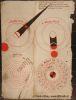
OldAgeAstronomy.jpgMedieval Astronomy from the "Melk Abbey"81 visiteDa "NASA - Picture of the Day" del giorno 17 Aprile 2009:"Discovered by accident, this manuscript page provides graphical insight to astronomy in medieval times, before the Renaissance and the influence of Nicolaus Copernicus, Tycho de Brahe, Johannes Kepler, and Galileo.
The intriguing page is from the lecture notes on astronomy compiled by the monk Magister Wolfgang de Styria before the year 1490 at Melk Abbey in Austria.
The top panels clearly illustrate the necessary geometry for a lunar (left) and solar eclipse in the Earth-centered Ptolemaic system.
At lower left is a diagram of the Ptolemaic view of the solar system and at the lower right is a chart to calculate the date of Easter Sunday in the Julian calendar.
Text at the upper right explains the movement of the planets according to the Ptolemaic system.
The actual manuscript page is on view at historic Melk Abbey as part of a special exhibition during the International Year of Astronomy".MareKromium
|
|

Olympus-Italia.jpgOlympus Mons and Italy: an interesting comparison80 visiteDal nostro Caro Amico e Partner, Lorenzo Leone, una simpatica comparazione fra la nostra Penisola ed il Monte Olympus: da osservare, per riflettere e per ricordarci quanto siamo piccoli...MareKromium
|
|

Once_upon_a_Time.jpgOnce Upon A Time... (by Roberto Tremolada)79 visite"...Fortuna immoderata est: in bono, atque in malo..."
(Laberio)
"...La Buona Sorte (al pari della Cattiva Sorte) non conosce misura: né nel bene, né nel male..."MareKromium
|
|

Orion.jpgPersian Orion...71 visitenessun commento
|
|

Orion_on_Barolo.jpg"The Great Hunter" over Barolo - Italy (by Dr Gianluigi Barca/Lunar Explorer Italia/Italian Planetary Foundation)120 visite"...Multiplicity is only apparent, in truth, there is only one mind..."
Erwin Schrödinger - "The Oneness of Mind", as translated in "Quantum Questions: Mystical Writings of the World's Great Physicists" - edited by Ken Wilber in 1984
MareKromium
|
|

Orion_s_Dawn.jpgOrion's Dawn71 visitenessun commentoMareKromium
|
|

Outpost1.JPGThe Outpost N. 1 (by Roberto Tremolada)80 visitenessun commentoMareKromium
|
|

Outpost2.JPGThe Outpost N. 2 (by Roberto Tremolada)69 visitenessun commentoMareKromium
|
|
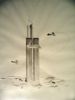
Over Clouds.jpgOver-Clouds365 visite"...Animus hominis quidquid sibi imperat, obtinet..."
(P. Siro)
|
|

Over Titan_s Clouds.jpgOver-clouds95 visitenessun commento
|
|

PIA09956.jpgCosmic "Merger"73 visiteThis artist's concept shows what the night sky might look like from a hypothetical planet around a star tossed out of an ongoing four-way collision between big galaxies (yellow blobs). NASA's SST spotted this "quadruple merger" of galaxies within a larger cluster of galaxies located nearly 5 BLY away.
Though the galaxies appear intact, gravitational disturbances have caused them to stretch and twist, flinging billions of stars into space -- nearly three times as many stars as are in our Milky Way galaxy. The tossed stars are visible in the large plume emanating from the central, largest galaxy. If any of these stars have planets, their night skies would be filled with the monstrous merger, along with other galaxies in the cluster (smaller, bluish blobs).
This cosmic smash-up is the largest known merger between galaxies of a similar size. While three of the galaxies are about the size of our Milky Way galaxy, the fourth (center of image) is three times as big.
All four of the galaxies, as well as most other galaxies in the huge cluster, are blob-shaped ellipticals instead of spirals like the Milky Way.
Ultimately, in about one hundred million years or so, the four galaxies will unite into one. About half of the stars kicked out during the merger will fall back and join the new galaxy, making it one of the biggest galaxies in the universe.MareKromium
|
|
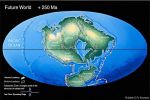
PangeaUltima_scotese_big.jpgA VERY far, distant and yet possible Future: Pangea Ultima76 visiteIs this what will become of the Earth's surface? The surface of the Earth is broken up into several large plates that are slowly shifting.
About 250 MY ago, the plates on which the present-day continents rest were positioned quite differently, so that all the landmasses were clustered together in one supercontinent now dubbed Pangea. About 250 MY from now, the plates are again projected to reposition themselves so that a single landmass dominates.
The above simulation from the PALEAOMAP Project shows this giant landmass: Pangea Ultima.
At that time, the Atlantic Ocean will be just a distant memory, and whatever beings inhabit Earth will be able to walk from North America to Africa.MareKromium
|
|
| 496 immagini su 42 pagina(e) |
 |
|
|
|
|
22 | |
|
|
|
|








