Walking on Mars with Spirit and Opportunity
|
|
|

OPP-SOL449-1P168067020ESF55DIP2682L5M1.jpgThe Stars that Llght-up the Martian Sky! (6) - Sol 44977 visiteSono le 19:17:33 MLT ed il cielo di Marte sta diventando davvero stellato ed affascinante ma...Noi, di oggetti MOLTO luminosi ed interessanti, ne vediamo almeno TRE!
Qual'è la Terra (se uno dei tre è la Terra...) e che cosa sono gli altri due?
Il filtro/colore usato è il n. 5.
|
|

OPP-SOL449-1P168067058ESF55DIP2682L6M1.jpgThe Stars that Llght-up the Martian Sky! (7) - Sol 44963 visiteAlle 19:18:10 MLT l'osservazione si fa interessantissima: guardate e giudicate Voi stessi!
Il filtro/colore usato adesso è il n. 6.
|
|

OPP-SOL449-1P168067205ESF55DIP2682L3M1.jpgThe Stars that Llght-up the Martian Sky! (8) - Sol 44963 visiteOre 19:20:33 MLT, ripresa ottenuta con il filtro/colore n. 3. A noi sembra ormai evidente che gli oggetti più brillanti che occupano l'obbiettivo della PanCam di Opportunity siano 2 (con un terzo, leggermente meno luminoso, visibile sulla parte alta del frame).
|
|

OPP-SOL449-1P168067382ESF55DIP2682L1M1.jpgThe Stars that Llght-up the Martian Sky! (9) - Sol 44963 visiteE chiudiamo la panoramica con l'ultimo frame (ufficialmente) ripreso dalla PanCam di Opportunity: sono le 19:23:26 MLT, il filtro/colore usato è il n. 1 e l'esposizione deve essere stata decisamente lunga (15/20"?) dato che uno dei tre corpi luminosi disegna una striscia nel cielo di Marte.
A nostro parere, quell'oggetto è effettivamente un Pianeta e, tutto sommato, potrebbe anche essere la Terra.
Ma ci resta il dubbio sugli altri 2 corpi luminosi puntiformi i quali, per altro, sembrano essersi sensibilmente spostati nel campo visivo della PanCam. Satelliti Artificiali? No, troppo lenti.
Deimos e/o Phobos? No, troppo piccoli e troppo poco luminosi.
Photoartifacts?
Questa è l'ipotesi che, oggettivamente, sembra più plausibile, ma ciò che la rende poco credibile è la persistenza di questi 'oggetti' in tutti i frames ed il loro (almeno in apparenza) movimento coerente che compiono nel cielo di Marte.
Purtroppo, in simili ambiti, ogni ipotesi ha una sua validità ed una sua debolezza. Giudicate Voi...
|
|

OPP-SOL449-PIA07228.jpgFading reddish Sky, shining Blue Planet!65 visiteCaption NASA originale:"On its 449th Sol (April 29, 2005), NASA's MER Opportunity woke up approximately an hour after sunset and took this picture of the fading twilight as the stars began to come out. Set against the fading red glow of the sky, the pale dot near the center of the picture is not a star, but a planet: Earth.
Earth appears elongated because it moved slightly during the 15" exposures. The faintly blue light from the Earth combines with the reddish sky glow to give the pale white appearance. The images were taken with Opportunity's PanCam, using 440, 530 and 750-nnmts color filters. In processing on the ground, the images were shifted slightly to compensate for Earth's motion between one image and the next".
|
|
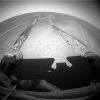
OPP-SOL453-1F168397692EFF55DIP1214L0M1.jpgStuck, in a Sea of Sand: will the "K-turn" help to save the day? (1)65 visiteDa "Mars Daily" del 4 Maggio 2005:"The Opportunity Team continues working with an engineering test rover on Earth to determine the safest way to attempt to drive the Rover out of the dune where it's currently parked on Mars. In the meantime, Opportunity is collecting science data with its instruments and cameras.
Opportunity used the PanCam to acquire images of the Rover's far tracks, where Opportunity had performed a successful "K-turn" at the start of the drive on Sol 446.
A "K-turn" is the technique engineers have figured out for safely turning the Rover 180° while the right front wheel is stuck in a position of 7° left of straight ahead.
To turn 180°, the Rover makes smaller arcing movements without cranking the wheels as much as a normal during a 180° turn. These movements create a "K" shape in the soil".
|
|

OPP-SOL453-1R168397767EFF55DIP1314R0M1.jpgStuck, in a Sea of Sand: will the "K-turn" help to save the day? (2)63 visiteDa "Mars Daily" del 4 Maggio 2005:"In addition, Opportunity acquired another PanCam image of the right track and a NavCam image covering 360° of the near deck of the Rover.
As of Sol 448 (ending on April 28, 2005), Opportunity's odometry total is 5.346 meters (such as approx. 3,32 miles)".
|
|

OPP-SOL455-1N168593417EFF55DIP1996L0M1.jpgLooking around and recharging, on Sol 45574 visiteOpportunity è ancora "prigioniero" della duna (che alla NASA invece definiscono 'sand-pit') che ha troppo disinvoltamente cercato di attraversare.
Nel Parco Simulazioni del Centro Controllo Missione i Tecnici NASA più "visionari" stanno provando e riprovando a trovare, usando uno dei gemelli di Opportunity, una via sicura per portare il Rover fuori dalla "trappola sabbiosa".
Nel frattempo, tanto per fare qualcosa di utile, Opportunity stende i suoi pannelli solari e si ricarica, come questo frame ci mostra chiaramente.
|
|
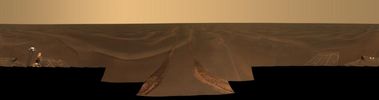
OPP-SOL456-464-Rub-al-Khali-PIA07216.jpgRub-al-Khalì: Opportunity's 360° Panorama (Soles 456 to 464)84 visiteCaption NASA:"This PanCam image, dubbed Rub al Khali, was acquired by NASA's MER Opportunity on the Plains of Meridiani during the period from the Rover's 456th to 464th Soles on Mars (May 6 to May 14, 2005). Opportunity was about 2 Km south of Endurance Crater at a place known informally as Purgatory Dune.
The Rover was stuck in the dune's deep fine sand for more than a month. Rub al Khali (Arabic translation: "the empty quarter") was chosen as the name for this panorama because it is the name of a similarly barren, desolate part of the Saudi Arabian desert on Earth.
The view spans 360° and it consists of images obtained in 97 individual pointings of the PanCam. The camera took images with 5 camera filters at each pointing. This 22.780-by-6.000-pixel mosaic is an approximately true-color rendering generated using the images acquired through filters admitting light wavelengths of 750, 530 and 480 nnmts".
|
|

OPP-SOL458-1.jpgPeaceful Horizon... - Sol 458 (possible True Colors; credits: Dr G. Barca)65 visitenessun commentoMareKromium
|
|

OPP-SOL458-1F168836646EFF55DIP1214R0M1.jpgStill in the sand... (1)67 visiteSiamo nel Sol 458 di Opportunity: sulla Terra si continua a simulare la situazione in cui il Rover è venuto a trovarsi ed a progettare delle possibili vie d'uscita.
Ci perdonate se esprimiamo la nostra sensazione e facciamo un piccolo "pronostico"?
Ok: secondo noi Opportunity uscirà dalla duna e proseguirà verso Erebus Crater e poi verso Victoria Crater. Ne siamo certi.
Così come siamo certi del fatto che alla NASA, specie in tempi recenti abbia preso piede la moda del "teatralizzare" gli eventi (questo fatto lo abbiamo constatato da parecchio tempo e da tanti dettagli, più o meno eclatanti, tra i quali sottolineiamo la tecnica narrativa adottata nella redazione dei loro 'summaries' - una tecnica estremamente "teatrale", appunto, ed irritante, non lo nascondiamo).
Dunque, se lo stile è "...Riusciranno i nostri Eroi a salvare il Rover insabbiato?...", allora la risposta è ovvia: certo che ci riusciranno!
|
|

OPP-SOL458-1P168841454EFF55DIP2263R2M1.jpgSide-Winders, on the way to Erebus (1)63 visiteNon sappiamo se si tratti di un effetto ottico causato dal tipo di filtro/colore impiegato per scattare le tre istantanee dell'orizzonte di Meridiani Planum che Vi proponiamo per oggi, ma la nostra impressione è che i Side-Winders che circondano Opportunity sìano decisamente più alti di quelli incontrati sino ad ora (provate a riguardare le immagini della traversata Eagle Crater-Anatolia-Endurance Crater per farVi un'idea di quello che intendiamo).
Forse non è stata una manovra azzardata quella che ha causato l'insabbiamento del Rover: forse è proprio cambiata la superficie su cui il Rover si muove, diventando più insidiosa.
Certo è che se così fosse, allora il viaggio verso Erebus e Victoria - che, onestamente, pensavamo fosse facile-facile - diventerebbe una vera sfida contro l'ostilità dell'ambiente.
Vedremo...
|
|
| 5458 immagini su 455 pagina(e) |
 |
|
|
|
|
76 | |
|
|
|
|








