Walking on Mars with Spirit and Opportunity
|
|
|
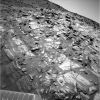
SOL746-2N192597764EFFAO55P0685R0M1.jpgStratifications... (1) - Sol 74662 visitenessun commento
|
|
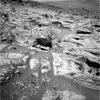
SOL746-2N192597856EFFAO55P0685R0M1.jpgStratifications... (2) - Sol 74662 visitenessun commento
|
|
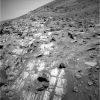
SOL746-2N192598054EFFAO55P0685R0M1.jpgStratifications... (3) - Sol 74662 visitenessun commento
|
|
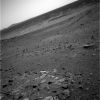
SOL746-2N192598815EFFAO55P1926L0M1.jpgDistant sandy waves... (1) - Sol 74662 visitenessun commento
|
|
SOL746-2N192598932EFFAO55P1926R0M1.jpgDistant sandy waves... (2) - Sol 74662 visitenessun commento
|
|
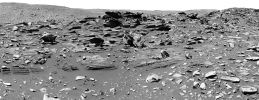
SOL746-PIA02187.jpgHome Plate Panorama - Sol 74673 visiteThis week, NASA's Spirit arrived at Home Plate, a feature that, when seen from orbit, looks like the home plate of a baseball diamond. Home Plate is a roughly circular feature about 80 mt (260 feet) in diameter that might be an old impact crater or a volcanic feature. The Spirit Team has been eager to get to Home Plate and has been enjoying distant views of the feature and a curious "bathtub ring" of light-colored materials along its edges. The Team has pushed the Rover hard to get here before the deep Martian winter sets in.
After scientists had identified Home Plate from orbit, they had many theories about what it could be and what they might see. But when Spirit's Pancam took this and other images, the Science Team was stunned. This PanCam image is of an outcrop nicknamed "Barnhill" and surrounding rocks on the north side of Home Plate, showing the most spectacular layering that Spirit has seen.
Pancam and MI views of the layers in the rocks reveal a range of grain sizes and textures that change from the lower to the upper part of the outcrop. This may help scientists figure out how the material was emplaced. Spirit is also conducting work with its arm instruments to figure out the chemistry and mineralogy of the rocks. Scientists have several hypotheses about what Home Plate could be, including features made by volcanoes and impact craters, and ways that water could have played a role. They are busy trying to figure out what the data from Spirit is really telling us.
As Spirit works at Home Plate during February, the science team is choosing informal names for rocks from the great players and managers of the Negro Leagues of baseball. This outcrop, "Barnhill," is informally named for David Barnhill, the ace of the New York Cubans' pitching staff during the early 1940s. He compiled an 18-3 record in 1941 and defeated Satchel Paige in the 1942 East-West all-star game. Other rocks in the area are informally named for Josh Gibson, "Bullet Joe" Rogan, and Cumberland Posey. Stay tuned this month, as the Baseball Hall of Fame elects more players from the Negro Leagues and Spirit continues to examine these spectacular rocks.
|
|
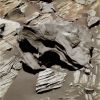
SOL747-1.jpgUnusually-looking Layered Rock - Sol 747 (False Colors; credits: Dr G. Barca)92 visitenessun commentoMareKromium
|
|
SOL747-2F192678390EFFAO55P1206R0M1.jpgNeedle Rock - Sol 74781 visitenessun commento
|
|
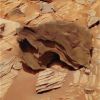
SOL747-MF-LXTT1.jpgUnusually-looking Layered Rock - Sol 747 (possible Natural Colors; credits: Drr Marco Faccin and Paolo C. Fienga - Lunexit Team)63 visitenessun commentoMareKromium
|
|
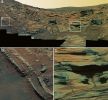
SOL748-00.jpgLayers at Home Plate (HR) - Sol 74863 visiteCaption NASA originale:"NASA's MER Spirit acquired this HR view of intricately layered exposures of rock while parked on the Northwestern edge of the bright, semi-circular feature known as "Home Plate". The Rover was perched at a 27-degree upward tilt while creating the panorama, resulting in the "U" shape of the mosaic.
(A) The northern edge of Home Plate,
(B) the coarse-grained lower unit,
(C) the fine-grained upper unit.
Spirit acquired 246 separate images of this scene using 6 different filters on the panoramic camera (Pancam) during the rover's Martian days, or Soles, 748 through 751 (such as from Feb. 9 through Feb. 12, 2006).
The field of view covers 160° of terrain around the Rover".MareKromium
|
|
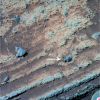
SOL748-01.jpgEvidence of Volcanic Explosion? - Sol 74864 visiteCaption NASA originale:"The lower coarse-grained unit shows granular textures toward the bottom of the image and massive textures.
Also shown (by the arrow) is a feature interpreted to be a "bomb sag" which is 4 cm across.
This false color image was obtained using Spirit's Panoramic Camera".MareKromium
|
|
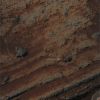
SOL748-02-PCF-LXTT.jpgEvidence of Volcanic Explosion? - Sol 748 (Enhanced Absolute Natural Colors; credits for the additional process. and color.: Dr Paolo C. Fienga - Lunexit Team)162 visiteCaption NASA originale:"The lower coarse-grained unit shows granular textures toward the bottom of the image and massive textures. Also shown (by the arrow) is a feature interpreted to be a "Bomb Sag" which is about 4 cm across".
Nota Lunexit: "Bomb Sag"---> (Geology) depressed and deranged Laminae mainly found in beds of fine-grained Ash or Tuff around an included Volcanic Bomb or Block which fell on and became buried in the deposit.MareKromium
|
|
| 5458 immagini su 455 pagina(e) |
 |
|
|
|
|
415 | |
|
|
|
|








