Walking on Mars with Spirit and Opportunity
|
|
|

SOL635-2P182748464EFFAF00P2386R1M1.jpgTime to go down... (2) - Sol 63562 visitenessun commento
|
|

SOL635-2P182749091EFFAF00P2386L7M1.jpgTime to go down... (3) - Sol 63562 visitenessun commento
|
|

SOL635-2P182749262EFFAF00P2386R1M1.jpgTime to go down... (4) - Sol 63572 visitenessun commento
|
|

SOL635-2P182749802EFFAF00P2386L7M1.jpgTime to go down... (5) - Sol 63568 visitenessun commento
|
|

SOL639-2F183091756EFFAH60P1201R0M1.jpgVarious views (1) - Sol 63962 visiteQualche frame che ci arriva dalla Front e dalla Rear-HazCam ci mostra la tessitura della superficie Marziana nell'area del Summit di Husband Hill: non ci sono (o, per lo meno, non abbiamo riscontrato) dei particolari da portare alla Vostra attenzione, ma ci sembra comunque importante dare ai nostri Lettori qualche elemento fotografico selezionato (fra le migliaia disponibili e quasi del tutto identici) per effettuare dei confronti tra il suolo del Summit ed il suolo della Pianura di Gusev, sulla quale Spirit è arrivato oltre un anno e mezzo fa.
Purtroppo la qualità di quasi tutte queste immagini non è assolutamente perfetta (anzi...), ma quello che riusciamo a vedere è pur sempre meglio di nulla.
|
|

SOL639-2R183091705EFFAH60P1301L0M1.jpgVarious views (2) - Sol 63962 visiteLa prima immagine era piuttosto anonima; decisamente meglio è questo secondo frame il quale ci propone - cerchiata in rosso - una roccia di forma piuttosto curiosa e che sembra avere qualcosa (poggiato?) nella (sulla) sua sezione centrale.
Tutte le elaborazioni che abbiamo effettuato, però, non sono decisive a causa della non buona risoluzione del frame.
|
|
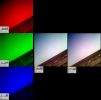
SOL639-MF.jpgGusev Landscape - Sol 639 (Color Algorithms; credits: Dr M. Faccin)91 visitenessun commentoMareKromium
|
|

SOL639-PIA03201.jpg"Phobal" eclypse (1) - Sol 63962 visiteNASA's MER Spirit continues to take advantage of favorable solar power conditions to conduct occasional nighttime astronomical observations from the Summit Region of Husband Hill. Spirit has been observing the martian moons Phobos and Deimos to learn more about their orbits and surface properties. This has included observing eclipses. On Earth, a solar eclipse occurs when the Moon's orbit takes it exactly between the Sun and Earth, casting parts of Earth into shadow. A lunar eclipse occurs when the Earth is exactly between the Sun and the Moon, casting the Moon into shadow and often giving it a ghostly orange-reddish color. This color is created by sunlight reflected through Earth's atmosphere into the shadowed region. The primary difference between terrestrial and martian eclipses is that Mars' moons are too small to completely block the Sun from view during solar eclipses.
Recently, Spirit observed a "lunar" eclipse on Mars. Phobos, the larger of the two martian moons, was photographed while slipping into the shadow of Mars.
|
|

SOL639-PIA03201_fig1.jpg"Phobal" eclypse (2) - Sol 63984 visiteJim Bell, the astronomer in charge of the rover's panoramic camera (Pancam), suggested calling it a "Phobal" eclipse rather than a lunar eclipse as a way of identifying which of the dozens of moons in our solar system was being cast into shadow.
With the help of the Jet Propulsion Laboratory's navigation team, the Pancam team planned instructions to Spirit for acquiring the views shown here of Phobos as it entered into a lunar eclipse on the evening of the rover's 639th martian day, or sol (Oct. 20, 2005) on Mars. This image is a time-lapse composite of eight Pancam images of Phobos moving across the martian sky. The entire eclipse lasted more than 26 minutes, but Spirit was able to observe only in the first 15 minutes. During the time closest to the shadow crossing, Spirit's cameras were programmed to take images every 10 seconds.
In the first three images, Phobos was in sunlight, moving toward the upper right. After a 100-second delay while Spirit's computer processed the first three images, the rover then took the fourth image, showing Phobos just starting to enter the darkness of the martian shadow. At that point, an observer sitting on Phobos and looking back toward the Sun would have seen a spectacular sunset! In the fifth image, Phobos appeared like a crescent, almost completely shrouded in darkness.
In the last three images, Phobos had slipped entirely into the shadow of Mars. However, as with our own Moon during lunar eclipses on Earth, it was not entirely dark. The small amount of light still visible from Phobos is a kind of "Mars-shine" -- sunlight reflected through Mars' atmosphere and into the shadowed region.
Rover scientists took some images later in the sequence to try to figure out if this "Mars-shine" made Phobos colorful while in eclipse, but they'll need more time to complete the analysis because the signal levels are so low. Meanwhile, they will use the information on the timing of the eclipse to refine the orbital path of Phobos. The precise position of Phobos will be important to any future spacecraft taking detailed pictures of the moon or landing on its surface. In the near future it might be possible for one of the rovers to take images of a "Deimal" eclipse to learn more about Mars' other enigmatic satellite, Deimos, as well.
|
|

SOL640-2N183180207EFFAI00P1755L0M1.jpgA new interesting outcrop - Sol 64062 visitenessun commento
|
|

SOL641-2P183259820EDNAI00P2630L4M1.jpgCosmic Rays, little cloud or UFO? - Sol 64162 visiteOriginal caption:"Left PanCam Non-linearized Downsampled EDR acquired on Sol 641 of Spirit's mission to Gusev Crater at approximately 09:13:43 MLT; camera commanded to use Filter 4 (601 nnmts)".
In questo frame, un nuovo esempio di importante Anomalia su cui la NASA non ha speso neanche una parola, neppure per inventarsi una qualche spiegazione scientifica e/o tecnologica per chiarire quello che vediamo (purtroppo non benissimo).
Alle 9:13 del mattino di Gusev il Sole non è alto sull'orizzonte, ma il cielo è già luminoso. Come la NASA stessa ha più volte evidenziato, la presenza di nubi su Gusev Crater costituisce fenomeno assolutamente raro, se non rarissimo. Ciò che vediamo, comunque, non sembra una nuvola. E non pare neppure lo "streak" tipico dei Raggi Cosmici. Ciò che vediamo "sembra" essere un oggetto luminoso ed in movimento rapido che attraversa il campo visivo della PanCam di Spirit proprio mentre essa scattava una delle 53 immagini del Cielo di Marte (tra le 08:55:45 e le 09:14:31 MLT).
|
|

SOL641-PCF-LXTT.jpgInteresting Outcrop - Sol 641 (Natural Colors; credits for the additional process. and color.: Dr Paolo C. Fienga - Lunar Explorer Italia)123 visitenessun commentoMareKromium
|
|
| 5458 immagini su 455 pagina(e) |
 |
|
|
|
|
372 | |
|
|
|
|








