Walking on Mars with Spirit and Opportunity
|
|
|
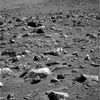
SOL591-2P178836474EFFAEC5P2280R1M1.jpgThe rocks of the Summit (1) - Sol 59173 visitenessun commento
|
|

SOL591-2P178836521EFFAEC5P2280L7M1.jpgThe rocks of the Summit (2) - Sol 59162 visitenessun commento
|
|

SOL594-1.jpgPanorama from Sol 594 (natural colors + MULTISPECTRUM; credits: Dr G. Barca & Lunexit)64 visitenessun commentoMareKromium
|
|
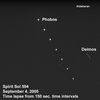
SOL594-P_D_Timelapse_594Atxt-A585R1.jpgDeimos and Phobos, from Husband's Hill Summit67 visiteTaking advantage of extra solar energy collected during the day, NASA's Mars Exloration Rover Spirit settled in for an evening of stargazing, photographing the two moons of Mars as they crossed the night sky. Spirit took this succession of images at 150-second intervals from a perch atop "Husband Hill" in Gusev Crater on martian day, or sol, 594 (Sept. 4, 2005), as the faster-moving martian moon Phobos was passing Deimos in the night sky. Phobos is the brighter object on the left and Deimos is the dimmer object on the right. The bright star Aldebaran and some other stars in the constellation Taurus are visible as star trails. Most of the other streaks in the image are the result of cosmic rays lighting up random groups of pixels in the camera.
Scientists will use images of the two moons to better map their orbital positions, learn more about their composition, and monitor the presence of nighttime clouds or haze. Spirit took the five images that make up this composite with its panoramic camera using the camera's broadband filter, which was designed specifically for acquiring images under low-light conditions.
|
|

SOL594-phobos_deimos_585-A585R1.jpgDeimos and Phobos62 visite"It is incredibly cool to be running an observatory on another planet" said planetary scientist Jim Bell of Cornell University, Ithaca, N.Y., lead scientist for the panoramic cameras on Spirit and Opportunity. In this picture, both Martian Moons, Deimos on the left and Phobos on the right, are well visible in the night sky in front of the constellation Sagittarius. Part of Sagittarius resembles an upside-down teapot. Phobos is the brighter object on the right; Deimos is on the left.
Spirit acquired these enhanced-brightness images with the PanCam on the night of Sol 585 (Aug. 26, 2005).
|
|

SOL594-phobos_deimos_585txt-A585R1.jpgMars Night-Sky64 visiteThe bright star Aldebaran and some of the stars in the constellation Taurus are visible on the right. Spirit acquired this image the evening of martian day, or sol, 590 (Aug. 30, 2005). The image on the right provides an enhanced-contrast view with annotation. Within the enhanced halo of light is an insert of an unsaturated view of Phobos taken a few images later in the same sequence.
On Mars, Phobos would be easily visible to the naked eye at night, but would be only about one-third as large as the full Moon appears from Earth. Astronauts staring at Phobos from the surface of Mars would notice its oblong, potato-like shape and that it moves quickly against the background stars. Phobos takes only 7 hours, 39 minutes to complete one orbit of Mars. That is so fast, relative to the 24-hour-and-39-minute sol on Mars (the length of time it takes for Mars to complete one rotation), that Phobos rises in the west and sets in the east. Earth's moon, by comparison, rises in the east and sets in the west. The smaller martian moon, Deimos, takes 30 hours, 12 minutes to complete one orbit of Mars. That orbital period is longer than a martian sol, and so Deimos rises, like most solar system moons, in the east and sets in the west.
|
|
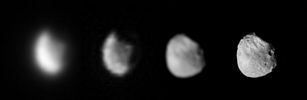
SOL594-phobos_stack_and_sim-A585R1_br.jpgPhobos from Spirit and Mars Express76 visiteTaking advantage of extra solar energy collected during the day, Spirit settled in for an evening of stargazing, photographing Deimos and Phobos. The first 2 images in this sequence show gradual enhancements in the surface detail of Mars' largest moon, Phobos, made possible through a combination technique known as stacking. In stacking scientists use a mathematical process known as Laplacian sharpening to reinforce features that appear consistently in repetitive images and minimize features that show up only intermittently. In this view of Phobos, the large crater named Stickney is just out of sight on the Moon's upper right limb.
Spirit acquired the first 2 images with the PanCam on the night of Sol 585 (Aug. 26, 2005). The far right image of Phobos, for comparison, was taken by the HR Stereo Camera on Mars Express. The third image in this sequence was derived from the far right image by making it blurrier for comparison with the panoramic camera images to the left. More information about the Mars Express image is available at http://www.esa.int/SPECIALS/Mars_Express/SEM21TVJD1E_1.html
|
|

SOL595-2-Sky-2.jpgNight Sky, Stars and (maybe) Phobos - Sol 595 (1 - credits: Dr G. Barca)88 visitenessun commentoMareKromium
|
|

SOL595-2-Sky-3.jpgNight Sky, Stars and (maybe) Phobos - Sol 595 (2 - credits: Dr G. Barca)92 visitenessun commentoMareKromium
|
|
SOL595-2-Sky-4.jpgNight Sky, Stars and (maybe) Phobos - Sol 595 (3 - credits: Dr G. Barca)98 visitenessun commentoMareKromium
|
|
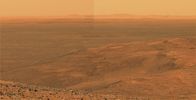
SOL595-MarsPanorama-PIA03252-2.jpgHorizon... - Sol 59567 visiteOriginal caption:(...) This is an approximately true-color rendering generated using the camera's 750-, 530- and 430-nanometer filters".
Note: un'ennesima visione di Marte, area Gusev Crater, ottenuta in colori approssimativamente veri che NON va d'accordo con altre "n" visioni di Marte ottenute (a detta della NASA) in colori approssimativamente veri.
Ok: diremmo che a questo punto dovrebbe essere chiaro proprio a tutti che qualcosa non va...negli occhi o nei sofisticati meccanismi dei Tecnici dell'Immagine.
|
|
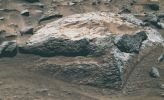
SOL596-1.jpgBuried Boulder - Sol 596 (True Colors + MULTISPECTRUM; credits: Dr G. Barca & Lunexit)73 visitenessun commentoMareKromium
|
|
| 5458 immagini su 455 pagina(e) |
 |
|
|
|
|
356 | |
|
|
|
|








