Walking on Mars with Spirit and Opportunity
|
|
|

OPP-SOL970-PIA09104-00.jpgVictoria Crater (1) - Sol 970 (natural colors)144 visiteCaption NASA:"NASA's Mars Exploration Rover Opportunity captured this vista of Victoria Crater from the viewpoint of Cape Verde, one of the promontories that are part of the scalloped rim of the crater.
Opportunity drove onto Cape Verde shortly after arriving at the rim of Victoria in September 2006. The view combines hundreds of exposures taken by the Rover's PanCam. The camera began taking the component images during Opportunity's 970th Martian day, or Sol, on Mars (Oct. 16, 2006).
Work on the panorama continued through the solar conjunction period, when Mars was nearly behind the Sun from Earth's perspective and communications were minimized.
Acquisition of images for this panorama was completed on Opportunity's 991st sol (Nov. 7, 2006)".MareKromium
|
|

OPP-SOL970-PIA09104-01.jpgVictoria Crater (2) - Sol 970 (natural colors)71 visiteCaption NASA:"The top of Cape Verde is in the immediate foreground at the center of the image.
To the left and right are two of the more gradually sloped bays that alternate with the cliff-faced capes or promontories around the rim of the crater. Duck Bay, where Opportunity first reached the rim, is to the right. Beyond Duck Bay counterclockwise around the rim, the next promontory is Cabo Frio, about 150 mt (500 feet) from the Rover.
On the left side of the panorama (frame 1) is Cape St. Mary, the next promontory clockwise from Cape Verde and about 40 mt (130 feet) from the Rover. The vantage point atop Cape Verde offered a good view of the rock layers in the cliff face of Cape St. Mary, which is about 15 mt or 50 feet tall. By about two weeks after the PanCam finished collecting the images for this panorama, Opportunity had driven to Cape St. Mary and was photographing Cape Verde's rock layers. The far side of the crater lies about 800 mt (half a mile) away, toward the South-East".MareKromium
|
|
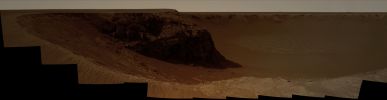
OPP-SOL970-VictoriaCrater-PIA09103-1.jpgVictoria's Panorama (1) - Sol 970 (Natural Colors; credits: Dr G. Barca)63 visiteNASA's Mars Exploration Rover Opportunity captured this vista of "Victoria Crater" from the viewpoint of "Cape Verde", one of the promontories that are part of the scalloped rim of the Crater. Opportunity drove onto Cape Verde shortly after arriving at the rim of Victoria in September 2006.
The view combines hundreds of exposures taken by the Rover's PanCam. The camera began taking the component images during Opportunity's 970th Martian day, or Sol, on Mars (such as Oct., 16, 2006). Work on the panorama continued through the Solar Conjunction Period, when Mars was nearly behind the Sun from Earth's perspective and communications were minimized. Acquisition of images for this panorama was completed on Opportunity's 991st Sol (such as Nov., 7, 2006).
The top of Cape Verde is in the immediate foreground at the center of the image. To the left and right are two of the more gradually sloped bays that alternate with the cliff-faced capes or promontories around the Rim of the crater.
"Duck Bay", where Opportunity first reached the rim, is to the right.
Beyond Duck Bay counterclockwise around the Rim, the next promontory is "Cabo Frio", about 150 meters (500 feet) from the rover. On the left side of the panorama is "Cape St. Mary", the next promontory clockwise from Cape Verde and about 40 meters (130 feet) from the Rover.
The vantage point atop Cape Verde offered a good view of the rock layers in the cliff face of Cape St. Mary, which is about 15 meters or 50 feet tall.
By about two weeks after the PanCam finished collecting the images for this panorama, Opportunity had driven to Cape St. Mary and was photographing Cape Verde's rock layers.
The far side of the Crater lies about 800 meters (half a mile) away, toward the South-East. MareKromium
|
|
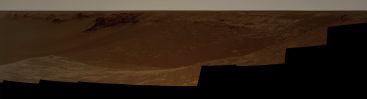
OPP-SOL970-VictoriaCrater-PIA09103-2.jpgVictoria's Panorama (2) - Sol 970 (Natural Colors; credits: Dr G. Barca)69 visiteNASA's Mars Exploration Rover Opportunity captured this vista of "Victoria Crater" from the viewpoint of "Cape Verde", one of the promontories that are part of the scalloped rim of the Crater. Opportunity drove onto Cape Verde shortly after arriving at the rim of Victoria in September 2006.
The view combines hundreds of exposures taken by the Rover's PanCam. The camera began taking the component images during Opportunity's 970th Martian day, or Sol, on Mars (such as Oct., 16, 2006). Work on the panorama continued through the Solar Conjunction Period, when Mars was nearly behind the Sun from Earth's perspective and communications were minimized. Acquisition of images for this panorama was completed on Opportunity's 991st Sol (such as Nov., 7, 2006).
The top of Cape Verde is in the immediate foreground at the center of the image. To the left and right are two of the more gradually sloped bays that alternate with the cliff-faced capes or promontories around the Rim of the crater.
"Duck Bay", where Opportunity first reached the rim, is to the right.
Beyond Duck Bay counterclockwise around the Rim, the next promontory is "Cabo Frio", about 150 meters (500 feet) from the rover. On the left side of the panorama is "Cape St. Mary", the next promontory clockwise from Cape Verde and about 40 meters (130 feet) from the Rover.
The vantage point atop Cape Verde offered a good view of the rock layers in the cliff face of Cape St. Mary, which is about 15 meters or 50 feet tall.
By about two weeks after the PanCam finished collecting the images for this panorama, Opportunity had driven to Cape St. Mary and was photographing Cape Verde's rock layers.
The far side of the Crater lies about 800 meters (half a mile) away, toward the South-East. MareKromium
|
|
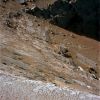
OPP-SOL975-1.jpgThe Inner Rim of Victoria Crater - Sol 975 (True Colors; credits: Dr G. Barca)72 visitenessun commentoMareKromium
|
|

OPP-SOL975-1P214745968EFF76POP2405L2M1-2.jpgSurface Anomaly n. 1 (extra-detail mgnf) - Sol 975152 visiteCari Amici, questo splendido detail mgnf del rilievo superficiale (fortemente) anomalo individuato dal Dr Barca e' veramente inesplicabile: l'oggetto in questione, infatti, pare proprio essere una sorta di "vaso a pianta poligonale".
Un "qualcosa" che, come potete vedere anche Voi, sembra "emergere" da un mucchio di detriti - di altra e totalmente differente natura rispetto ad esso - che lo avvolgono.
In una situazione come questa - e come dovremo ripetere anche discutendo della possibile Anomalia di Superficie n. 2 - le uniche conclusioni razionali e pragmatiche che possiamo trarre attengono la TOTALE ESTRANEITA' dell'oggetto in questione (in termini di colore, tessitura e caratteristiche esteriori) rispetto all'area che lo circonda ed a cui esso accede.
Un "oggetto", quindi - e, diremmo, "molto probabilmente" - NON SOLO NON indigeno di Victoria, MA ANCHE (per impiegare le parole spesso usate dal Dr Feltri in sede di commento di dettagli interni di crateri Marziani), un "oggetto" (rilievo) TOTALMENTE INCOMPATIBILE con le Meccaniche da Impatto dalle quali esso dovrebbe essere scaturito e che dovrebbero spiegare - SEMPRE ed in maniera ADEGUATA (according to Dr Schoemaker), le origini del 99,99% dei crateri visibili su tutti i corpi celesti conosciuti.
Per il resto...Giudicate Voi!
|
|

OPP-SOL975-1P214745968EFF76POP2405L2M1.jpgSurface Anomalies inside Victoria (context image) - Sol 975116 visiteGrazie ad un nuovo eccellente "colpo d'occhio" del Dr Gianluigi Barca, ecco 2 nuove possibili Anomalia di Superficie che fanno capolino dall'interno di Victoria Crater (una cerchiata in verde - Surface Anomaly n. 1 - ed una cerchiata in fucsia - Surface Anomaly n. 2).
Come potrete vedere nei successivi detail mgnf, si tratta di "rilievi" assolutamente enigmatici e, per tanti ordini di motivi, alquanto sconvolgenti.
Perche'? Perche', soprattutto, si tratta di "rilievi superficiali" che - geologicamente e razionalmente parlando - NON DOVREBBERO ESISTERE (e comunque non dove li vediamo).
Interessante, non credete?!? Peccato che la NASA (sic!) non abbia (almeno per ora) nulla da dire...
|
|
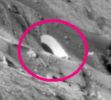
OPP-SOL975-1P214745968EFF76POP2405R2M1-2.jpgSurface Anomaly n. 2 (extra-detail mgnf) - Sol 97578 visiteL'ingrandimento proposto dal Dr Barca è, anche in questo caso, affascinante e ben curato, ma la risposta al quesito-base (e cioè: "che cosa stiamo guardando?") noi NON siamo in grado di darla.
L'unica considerazione che ci sentiamo di fare, in Buona Fede ed usando un'ampia dose di possibilismo, attiene la circostanza per cui sia il colore (bianco brillante), sia la "tessitura" (totalmente liscia) dell'oggetto che giace sul declivio che porta verso il fondo di Victoria NON APPAIONO ASSOLUTAMENTE CONGRUI rispetto al colore ed alla "tessitura" dell'area che circonda la possibile Anomalia.
Questo significa, in altre parole, che l'oggetto anomalo NON E' (rectius: potrebbe non essere) originario di Victoria.
Ora le possibili conseguenze (speculative) di una simile conclusione (ancorche' del tutto provvisoria ed interlocutoria) lasciamo che siate Voi a trarle...
|
|

OPP-SOL975-1P214745968EFF76POP2405R2M1.jpgSurface Anomaly n. 2 (context image) - Sol 97575 visiteL'oggetto (rectius: il rilievo superficiale) individuato dal Dr Barca e cerchiato in fucsia spicca, per svariati ordini di motivi, dal resto del paesaggio.
Di che cosa si tratta? E' un "manufatto" di un qualche tipo?
Potremmo gia' sbilanciarci ma, a nostro avviso, e' comunque meglio andar prima a controllare se, usando un elevato ingrandimento del particolare, si riesce a vedere (ed a capire) qualcosa di piu'...
|
|
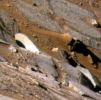
OPP-SOL975-2.jpgUnusual Surface Feature inside Victoria - Sol 975 (True Colors; credits: Dr G. Barca)77 visitenessun commentoMareKromium
|
|
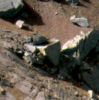
OPP-SOL975-3.jpgUnusual Surface Feature inside Victoria - Sol 975 (True Colors; credits: Dr G. Barca)65 visitenessun commentoMareKromium
|
|
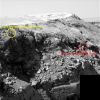
OPP-SOL976-1P214834746EFF76POP2406R2M1.jpgMore EXTREMELY "Unusual Inner Features" of Victoria - Sol 976173 visiteSpirit ha già raggiunto quota 1000 Soles, ma è fermo da un pò; Opportunity si sta rapidamente avvicinando anch'essa al fatidico traguardo ma, nel farlo, ci sta mettendo davanti ad un'enorme mole di particolari incredibili i quali caratterizzano lo splendido Cratere Victoria.
Certo, lo immaginavamo che le "sorprese", con Victoria, sarebbero state tante; quello che non potevamo immaginare, tuttavia, era il "quantitativo" di (probabili) Anomalìe che stiamo individuando, ogni giorno.
Anomalìe di Superficie, Singolarità , Pseudo-Rocce, Gusci, Uova e tante, tante altre Meraviglie Marziane. Delle Meraviglie che però, a quanto pare, interessano soltanto noi e pochi (anzi: pochissimi) altri Ricercatori.
Perchè diciamo questo? Beh, ci pare abbastanza ovvio: la NASA tace, l'ESA non sa che dire (e forse è molto meglio così...), le Istituzioni Scientifiche e para-Scientifiche non hanno argomenti ed i Ricercatori "quotati" (Italiani e non) preferiscono scrivere libri che parlano di "Facce, Piramidi e Teschi"...
|
|
| 5458 immagini su 455 pagina(e) |
 |
|
|
|
|
193 | |
|
|
|
|








