| |

|
|

ZZ-Mercury-Craters-Vyasa_and_Stravinsky_Crater-PIA12035_fig1.jpgLow-Sun over Mercury...54 visiteThis NAC image shows a close-up view of the craters Vyasa and Stravinsky (see PIA11360). Stravinsky is the smooth-floored crater partially seen on the right side of the image that overlies the rim of the larger, rougher crater Vyasa in the center and left. The low-Sun lighting angle casts distinctive shadows that show Mercury's rough surface, pockmarked by craters of all sizes. Small craters are visible on the smooth-floor of Stravinsky because of the high resolution of this image.
Date Acquired: October 6, 2008
Image Mission Elapsed Time (MET): 131771118
Instrument: Narrow Angle Camera (NAC) of the Mercury Dual Imaging System (MDIS)
Resolution: 140 meters/pixel (0,09 miles/pixel) near the bottom of the image
Scale: Stravinsky crater is about 190 Km in diameter (120 miles)MareKromium
|
|

ZZ-Mercury-Craters-Wang_Meng_Crater-PIA17239-PCF-LXTT-IPF-00.jpgWang Meng Crater, in context (Possible Absolute Natural Colors; credits for the additional process. and color.: Dr Paolo C. Fienga/Lunar Explorer Italia/Italian Planetary Foundation)58 visiteThe large Wang Meng Impact Basin (whose diameter is approx. 165 Km - such as about 102,465 miles) can clearly be see in the top right of this image, which is a mosaic made out of three frames taken by the NASA - MESSENGER Spacecraft on April, 20, 2013. This Absolute Natural Color view of the Impact Basin shows us, among many other extremely interesting things, the strong contrast between the dark Low Reflectance Material (or "LRM", for short) which is located on the Eastern Portion of Wang Meng's Peak Ring and the brighter Western Portion of the Peak Ring itself, as well as the bright white Rays that spread across the right side (---> West) of the picture.
While some of the Hollows existing on and near the Crater's Peak Ring and Outer Rim are, somehow, "associated" (here and there, and always unevenly) with Low Reflectance Material, as evidenced by their bright white halos, the Rays that are visible here (---> such as towards the Western and South/Western sides of the frame) are, in fact, coming from other Impact Craters located in Wang Meng's proximities - including the small, fresh Impact Crater visible towards the right corner of the picture, just in betwenn the Peak Ring and the Outer Rim of Wang Meng.
Date acquired: April, 20th, 2013
Images Mission Elapsed Time (MET): 8743264, 8743256, 8743260
Images ID: 3915336, 3915334, 3915335
Instrument: Wide Angle Camera (WAC) of the Mercury Dual Imaging System (MDIS)
Center Latitude: 6,33° North
Center Longitude: 254,10° East
Solar Incidence Angle: 41,6° (meaning that the Sun, at the time that the pictures were taken, was about 48,4° above the imaged Local Mercurian Horizon)
Emission Angle: 0,2°
Sun-Mercury-Messenger (or "Phase") Angle: 41,7°
This frame (which is an Original NASA - MESSENGER Spacecraft's false colors and Map-Projected image-mosaic published on the NASA - Planetary Photojournal with the ID n. PIA 17239) has been additionally processed, contrast enhanced, magnified to aid the visibility of the details, Gamma corrected and then re-colorized in Absolute Natural Colors (such as the colors that a human eye would actually perceive if someone were onboard the NASA - MESSENGER Spacecraft and then looked down, towards the Mercurian Impact Crater "Wang Meng"), by using an original technique created - and, in time, dramatically improved - by the Lunar Explorer Italia Team. Different colors, as well as different shades of the same color, mean, among other things, the existence of different Elements (Minerals) present on the Surface of Mercury, each having a different Albedo (---> Reflectivity) and Chemical Composition.MareKromium
|
|

ZZ-Mercury-Craters-Wang_Meng_Crater-PIA17239-PCF-LXTT-IPF-01.jpgWang Meng Crater, in detail (Possible Absolute Natural Colors; credits for the additional process. and color.: Dr Paolo C. Fienga/Lunar Explorer Italia/Italian Planetary Foundation)55 visiteThe large Wang Meng Impact Basin (whose diameter is approx. 165 Km - such as about 102,465 miles) can clearly be see in this Extra Detail Magnification which is a crop taken mosaic made out of three frames obtained by the NASA - MESSENGER Spacecraft on April, 20, 2013. This Absolute Natural Color view of the Impact Basin shows us, among many other extremely interesting things, the strong contrast between the dark Low Reflectance Material (or "LRM", for short) which is located on the Eastern Portion of Wang Meng's Peak Ring and the brighter Western Portion of the Peak Ring itself, as well as the bright white Rays that spread across the lower right side (---> West) of the picture.
While some of the Hollows existing on and near the Crater's Peak Ring and Outer Rim are, somehow, "associated" (here and there, and always unevenly) with Low Reflectance Material, as evidenced by their bright white halos, the Rays that are visible here (---> such as towards the Western and South/Western sides of the frame) are, in fact, coming from other Impact Craters located in Wang Meng's proximities - including the small, fresh Impact Crater visible towards the upper right corner of the picture, just in betwenn the Peak Ring and the Outer Rim of Wang Meng.
Date acquired: April, 20th, 2013
Images Mission Elapsed Time (MET): 8743264, 8743256, 8743260
Images ID: 3915336, 3915334, 3915335
Instrument: Wide Angle Camera (WAC) of the Mercury Dual Imaging System (MDIS)
Center Latitude: 6,33° North
Center Longitude: 254,10° East
Solar Incidence Angle: 41,6° (meaning that the Sun, at the time that the pictures were taken, was about 48,4° above the imaged Local Mercurian Horizon)
Emission Angle: 0,2°
Sun-Mercury-Messenger (or "Phase") Angle: 41,7°
This frame (which is a crop taken from an Original NASA - MESSENGER Spacecraft's false colors and Map-Projected image-mosaic published on the NASA - Planetary Photojournal with the ID n. PIA 17239) has been additionally processed, contrast enhanced, magnified to aid the visibility of the details, Gamma corrected and then re-colorized in Absolute Natural Colors (such as the colors that a human eye would actually perceive if someone were onboard the NASA - MESSENGER Spacecraft and then looked down, towards the Mercurian Impact Crater "Wang Meng"), by using an original technique created - and, in time, dramatically improved - by the Lunar Explorer Italia Team. Different colors, as well as different shades of the same color, mean, among other things, the existence of different Elements (Minerals) present on the Surface of Mercury, each having a different Albedo (---> Reflectivity) and Chemical Composition.MareKromium
|
|

ZZ-Mercury-Craters-Waters_Crater-PIA15389-PCF-LXTT-IPF.jpgWaters Crater, in context (Possible Absolute Natural Colors; credits for the additional process. and color.: Dr Paolo C. Fienga/Lunar Explorer Italia/Italian Planetary Foundation)65 visiteIn this High Resolution Image-Mosaic, obtained by putting together three frames taken by the NASA - MESSENGER Spacecraft on May, 16, 2011, we can see, once again, the approx. 15-Km (such as about 9,315 miles) diameter Impact Crater named Waters that, as you can easily understand just by looking at the picture, should be relatively young, as indicated by the Bright Rays that cross the neighboring (---> meaning located in its proximities) Surface Features. As we have already drawn to your attention in the past, an unusually-looking "Tongue-like Feature", most likely made of Impact Melt - and which shows a very dark gray color, when compared to the nearby Mercurian Surface - appears to have flowed out of the Crater itself, most likely at the time of - or just right after - its formation.
Date acquired: May, 16th, 2011
Images Mission Elapsed Time (MET): 214069807, 214069811, 214069815
Images ID: 261719, 261720, 261721
Instrument: Wide Angle Camera (WAC) of the Mercury Dual Imaging System (MDIS)
Center Latitude: 8,82° South
Center Longitude: 254,90° East
Solar Incidence Angle: 41,8° (meaning that the Sun, at the time that the picture was taken, was about 48,2° above the imaged Local Mercurian Horizon)
Emission Angle: 25,6°
Sun-Mercury-Messenger (or "Phase") Angle: 67,4°
This picture (which is an Original NASA - MESSENGER Spacecraft's false colors and Map-Projected image-mosaic published on the NASA - Planetary Photojournal with the ID n. PIA 15389) has been additionally processed, contrast enhanced, Gamma corrected, magnified to aid the visibility of the details and then re-colorized in Absolute Natural Colors (such as the colors that a human eye would actually perceive if someone were onboard the NASA - MESSENGER Spacecraft and then looked outside, towards the Surface of Mercury), by using an original technique created - and, in time, dramatically improved - by the Lunar Explorer Italia Team. Different colors, as well as different shades of the same color, mean, among other things, the existence of different Elements (Minerals) present on the Surface of Mercury, each having a different Albedo (---> Reflectivity) and Chemical Composition.
MareKromium
|
|

ZZ-Mercury-Craters-Waters_Crater-PIA18228-PCF-LXTT-IPF.jpgWaters Crater (EDM - Possible Absolute Natural Colors; credits for the additional process. and color.: Dr Paolo C. Fienga/Lunar Explorer Italia/Italian Planetary Foundation)104 visiteIn this beautiful image, obtained by the NASA - MESSENGER Spacecraft on September, 16, 2013, we can see the extremely unusually-looking Impact Crater known as Waters. The South-heading Dark Impact Melt Flow of Waters Crater (approx. 15 Km - such as about 9,315 miles - in diameter and so named, in the AD 2012, after the blues legend Muddy Waters - Mc Kinley Morganfield, born in Issaquena County - Mississippi - USA -, on April 4, 1913 and deceased in Westmont, Illinois, on April 30, 1983) has always been - we'd say, obviously - a Surface Feature of great interest for Planetary Scientists, and the Targeted Color Imaging Campaign carried out by the NASA - MESSENGER Spacecraft showed quite well, and more than once, the distinctive dark gray-greenish-bluish color of the aforementioned Impact Melt Flow.
As a consequence of such a great interest, during the late AD 2013, this High-Resolution Image was then acquired, and it revealed stunning new details (like the Wavy Texture) of the Impact Melt Flow - details which were (as far as their visual quality was and is concerned) way beyond the ones that had been photographed in other (previous) frames.
Date acquired: September, 16th, 2013
Image Mission Elapsed Time (MET): 21673915
Image ID: 4834878
Instrument: Narrow Angle Camera (NAC) of the Mercury Dual Imaging System (MDIS)
Center Latitude: 9,00° South
Center Longitude: 254,70° East
Solar Incidence Angle: 44,0° (meaning that the Sun, at the time that the picture was taken, was about 46,0° above the imaged Local Mercurian Horizon)
Emission Angle: 44,8°
Sun-Mercury-Messenger (or "Phase") Angle: 85,5°
This picture (which is an Original NASA - MESSENGER Spacecraft's b/w and NON-Map-Projected image published on the NASA - Planetary Photojournal with the ID n. PIA 18228) has been additionally processed, contrast enhanced, Gamma corrected, magnified to aid the visibility of the details and then colorized in Absolute Natural Colors (such as the colors that a human eye would actually perceive if someone were onboard the NASA - MESSENGER Spacecraft and then looked outside, towards the Surface of Mercury), by using an original technique created - and, in time, dramatically improved - by the Lunar Explorer Italia Team. Different colors, as well as different shades of the same color, mean, among other things, the existence of different Elements (Minerals) present on the Surface of Mercury, each having a different Albedo (---> Reflectivity) and Chemical Composition.MareKromium
|
|

ZZ-Mercury-Craters-Xiao_Zhao_Crater-PIA10668.jpgXiao Zhao's Rays paint Mercury's Surface54 visiteRecently named after the 12th century Chinese artist, Xiao Zhao crater on the central left side of this image is small in comparison with many other craters on Mercury and even with many other craters in this scene. However, Xiao Zhao's long bright rays make it a readily visible feature. The fresh, bright rays, which were created by material ejected outward during the impact event that formed the crater, indicate that Xiao Zhao is a relatively young crater on Mercury's surface.
Date Acquired: January 14, 2008
Image Mission Elapsed Time (MET): 108828473
Instrument: Narrow Angle Camera (NAC) of the Mercury Dual Imaging System (MDIS)
Resolution: 500 meter/pixel (0.3 miles/pixel)
Scale: Xiao Zhao crater is 23 kilometers (14 miles) in diameter
Spacecraft Altitude: 19,760 kilometers (12,280 miles)
MareKromium
|
|

ZZ-Mercury-Craters-Xiao_Zhao_Crater-PIA14495-PCF-LXTT.jpgXiao Zhao Crater (Absolute Natural Colors; credits for the additional process. and color.: Dr Paolo C. Fienga - Lunexit Team)124 visiteDate acquired: July, 11th, 2011
Image Mission Elapsed Time (MET): 218840609
Image ID: 489105
Instrument: Wide Angle Camera (WAC) of the Mercury Dual Imaging System (MDIS)
WAC filter: 9 (996 nanometers)
Center Latitude: 14,17° North
Center Longitude: 122,3° East
Resolution: 456 meters/pixel
Scale: the diameter of Xiao Zhao is 24,2 Km (approx. 15 miles)
Solar Incidence Angle: 22,1°
Emission Angle: 34,3°
Phase Angle: 56,4°MareKromium
|
|

ZZ-Mercury-Full_Disk-PIA16852-PCF-LXTT-IPF.jpgMercury (Possible Absolute Natural Colors; credits for the additional process. and color.: Dr Paolo C. Fienga/Lunar Explorer Italia/Italian Planetary Foundation)87 visiteThis extremely detailed and, in fact, really impressive view of the Planet Mercury was produced by using images from the Color Base Map Imaging Campaign that was carried out during the NASA - MESSENGER Spacecraft's Primary Mission. Young Rays, extending radially from (relatively) fresh Impact Craters, appear of a light gray or whitish color; the dark-gray and almost black-colored Regions and Areas are those Geologic Units of Mercury's Crust which are known as the "Low-Reflectance Material" (such as a Material that, according to the opinion of many Planetary Scientists, is thought to be rich in a dark and opaque Mineral). The brown and orange Regions are Plains that were formed, most likely, by the passage of Highly Fluid Lavas. The Impact Crater visible in the upper right of the image, at about one 'clock, and whose etremely well defined Rays' System stretches across the entire Planet, is Hokusai Crater.
We, as IPF, believe that the different colors of Mercury, as visible in this picture (which is an Ortographic Projection of the Innermost Planet in the Solar System), also can tell us something important about the age of the various Mercurian Regions and Areas. For instance, the almost black (or completely black) Areas and Spots, should be the ones which were more exposed to (and therefore that should have suffered for the longest time) the relentless action of the Charged Particles forming the Solar Wind and the Cosmic Rays. This means, in terms of age of these Areas and Spots, that the Surface Materials forming them should be the oldest ones that can be found on the Planet.
On the other hand, the Regions and Areas whose colors become less and less dark (and therefore we are talking about colors going from brown and dark orange, to yellow and, finally, to light gray or white) should be the ones that were less exposed to the so-called Cosmic Weathering, and this means, still in terms of age, that the Surface Materials that form them, should be the youngest ones present, today, on Mercury.
Instrument: Wide Angle Camera (WAC) of the Mercury Dual Imaging System (MDIS)
Center Latitude: 0°
Center Longitude: 320,00° East
This image (which is an Original NASA - MESSENGER Spacecraft false color image-mosaic published on the NASA - Planetary Photojournal with the ID n. PIA 16852) has been additionally processed and then re-colorized in Absolute Natural Colors (such as the colors that a human eye would actually perceive if someone were onboard the NASA - MESSENGER Spacecraft and then looked outside, towards the Planet Mercury), by using an original technique created - and, in time, dramatically improved - by the Lunar Explorer Italia Team. Different colors, as well as different shades of the same color, mean, among other things, the existence of different Elements (Minerals) present on the Surface of Mercury, each having a different Albedo (---> Reflectivity) and Chemical Composition.MareKromium
|
|

ZZ-Mercury-Full_Disk-PIA16853-PCF-LXTT-IPF.jpgMercury (Possible Absolute Natural Colors; credits for the additional process. and color.: Dr Paolo C. Fienga/Lunar Explorer Italia/Italian Planetary Foundation)87 visiteThis extremely detailed and, in fact, really impressive view of the Planet Mercury was produced by using images from the Color Base Map Imaging Campaign that was carried out during the NASA - MESSENGER Spacecraft's Primary Mission. Young Rays, extending radially from (relatively) fresh Impact Craters, appear of a light gray or whitish color; the dark-gray and almost black-colored Regions and Areas are those Geologic Units of Mercury's Crust which are known as the "Low-Reflectance Material" (such as a Material that, according to the opinion of many Planetary Scientists, is thought to be rich in a dark and opaque Mineral). The brown and orange Regions are Plains that were formed, most likely, by the passage of Highly Fluid Lavas. The giant Caloris Impact Basin is the large, and very well visible, circular yellow-orangish Surface Feature located just near the upper right of center of the image (such as at abour one 'o clock of Mercury's disk).
We, as IPF, believe that the different colors of Mercury, as visible in this picture (which is an Ortographic Projection of the Innermost Planet in the Solar System), also can tell us something important about the age of the various Mercurian Regions and Areas. For instance, the almost black (or completely black) Areas and Spots, should be the ones which were more exposed to (and therefore that should have suffered for the longest time) the relentless action of the Charged Particles forming the Solar Wind and the Cosmic Rays. This means, in terms of age of these Areas and Spots, that the Surface Materials forming them should be the oldest ones that can be found on the Planet.
On the other hand, the Regions and Areas whose colors become less and less dark (and therefore we are talking about colors going from brown and dark orange, to yellow and, finally, to light gray or white) should be the ones that were less exposed to the so-called Cosmic Weathering, and this means, still in terms of age, that the Surface Materials that form them, should be the youngest ones present, today, on Mercury.
Instrument: Wide Angle Camera (WAC) of the Mercury Dual Imaging System (MDIS)
Center Latitude: 0°
Center Longitude: 140,00° East
This image (which is an Original NASA - MESSENGER Spacecraft false color image-mosaic published on the NASA - Planetary Photojournal with the ID n. PIA 16853) has been additionally processed and then re-colorized in Absolute Natural Colors (such as the colors that a human eye would actually perceive if someone were onboard the NASA - MESSENGER Spacecraft and then looked outside, towards the Planet Mercury), by using an original technique created - and, in time, dramatically improved - by the Lunar Explorer Italia Team. Different colors, as well as different shades of the same color, mean, among other things, the existence of different Elements (Minerals) present on the Surface of Mercury, each having a different Albedo (---> Reflectivity) and Chemical Composition.MareKromium
|
|

ZZ-Mercury-Global_View_of_the_Surface-Cratered_Surface-209516.jpgHow many craters do you see?54 visiteOne of many investigations underway includes identifying and measuring the impact craters on Mercury's previously unseen Regions. The density of craters on the surface of a planet can be used to indicate the relative age of different places on the surface; the more craters the surface has accumulated, the older the surface.
By counting craters on different areas of Mercury's Surface, a relative geologic history of the Planet can be constructed, indicating which surfaces formed first and which formed later. However, this process is also time consuming; Mercury has a lot of craters!
This image shows just a portion (276 Km, or 172 miles, wide) of 1 frame taken with the Narrow Angle Camera (NAC) of the Mercury Dual Imaging System (MDIS). In this image alone, 763 craters have been identified and measured (shown in green) along with 189 hills (shown in yellow).
Altogether, 491 frames were taken by the NAC to create HR mosaics of Mercury's surface.
Of course, simply counting the craters is not enough. Each crater has to be measured and classified to fully interpret the differences in crater density.
Many small craters form as "secondaries," as clumps of material ejected from a "primary" crater re-impact the surface in the regions surrounding the primary.
In order to learn about the history of asteroid and comet impacts on Mercury, scientists have to distinguish between the primary and secondary craters. Once many more craters are measured, MESSENGER researchers will have new insights into the geological history of Mercury.
Image Mission Elapsed Time (MET): 108826672
MareKromium
|
|
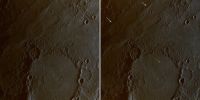
ZZ-Mercury-Global_View_of_the_Surface-PIA10601.jpgNew Lands on Mercury (Extremely Enhanced Natural Colors; credits for the additional process. and color.: Dr Paolo C. Fienga - Lunexit Team)54 visiteOn January 14, 2008, MESSENGER became the First Spacecraft in over three decades to visit Mercury, snapping images of a large portion of Mercury's Surface previously unseen by spacecraft. As the Spacecraft proceeds on its journey, the science team continues to study the 1213 images returned from the mission's historic first flyby. The probe's trajectory will bring it to a second Mercury flyby on October 6, 2008.
MESSENGER's Narrow Angle Camera (NAC) of the Mercury Dual Imaging System (MDIS) captured this image during the flyby of January 2008. The Sun is illuminating this Region at a low angle, accentuating the modest ridges and other low topography on these nearly flat plains. Low ridges trend from the top-center of the image to the left edge (white arrows). The ghostly remains of craters are visible, filled to their rims by what may have been volcanic lavas (red arrows). The faint remnant of an inner ring within the large crater in the bottom half of this picture can be seen (blue arrow); the area interior to this ring was also flooded, possibly by lava, nearly to the point of disappearance. Clusters of secondary craters on the floor of the large crater and elsewhere (yellow arrows) formed when clumps of material were ejected from large impacts beyond the view of this image, which is about 350 Km (approx. 220 miles) across.
Image Mission Elapsed Time (MET): 108826972MareKromium
|
|

ZZ-Mercury-Global_View_of_the_Surface-PIA10607.jpgMercurian Symphony (MULTISPECTRUM-2; credits: Lunexit)54 visiteCaption NASA:"When Mariner 10 flew by Mercury in 1974, morning sunlight was just striking Mozart Crater so that most of the feature was hidden in darkness near the Terminator. During MESSENGER's Mercury flyby on January 14, 2008, Mozart was in full sunlight, allowing the Crater to be seen in detail for the first time, as shown in this image snapped by the Narrow Angle Camera (NAC) of the Mercury Dual Imaging System (MDIS). Named in honor of the classical composer Wolfgang Amadeus Mozart, Mozart is the large crater near the center of the image. The Crater's diameter is about 225 Km (such as approx. 140 miles). The arc of dark hills visible on the Crater's floor probably represents remnants of a central peak ring, similar to that shown in the January 30 image release (PIA10378). Clues to the origin of the dark material on the peak ring and the curious dark streaks radiating outward from the Crater will be provided by 11-color image data collected by the Spacecraft's Wide Angle Camera (WAC).
A close inspection of the area around Mozart Crater shows many long chains of secondary craters, formed by impact of material thrown out during the formation of the main crater.
Mozart Crater is located just South of the Caloris Basin and can be identified in the false color image previously released (PIA10398).
Members of the MESSENGER Science Team are currently studying and characterizing the small craters on Mercury in order to provide new insight into the cratering process as it operates on the different planets in the Solar System.
Image Mission Elapsed Time (MET): 108830250
MareKromium
|
|
| 248 immagini su 21 pagina(e) |
|
|
|
|
|
15 | |
|
|
|
|
|
|





