| |

|
|

ZZ-Mercury-Craters-Mena_Crater-PIA17786-PCF-LXTT-IPF-01.jpgMena Crater, in detail (Possible Absolute Natural Colors; credits for the additional process. and color.: Dr Paolo C. Fienga/Lunar Explorer Italia/Italian Planetary Foundation)64 visiteIn this simple, and yet very interesting picture, taken by the NASA - MESSENGER Spacecraft on November, 13, 2013, we can get a relatively close look at the fresh, Bright-Rayed Impact Crater known as Mena (note: due to the distance between the Spacecraft and the Mercurian Surface, the Bright Rays of Mena Crater can just be barely seen in this image).
As you may want to notice, solidified Impact Melt formed some kind of a "Heart-shaped" and smooth Pond that is mostly concentrated on the South/Western Side of the Crater Floor; the quite obvious (---> very clear, easy to see) asymmetry existing between the aforementioned South/Western Side of the Floor and some (actually, a large) portion of its North/Eastern one, is due to the fact that Mena Crater did not form on a Flat Surface, but on the Sloping Rim of a much older Impact Crater (as it will be better seen tomorrow's contextual APOD).
Date acquired: November, 13th, 2013
Image Mission Elapsed Time (MET): 26657614
Image ID: 5189176
Instrument: Narrow Angle Camera (NAC) of the Mercury Dual Imaging System (MDIS)
Center Latitude: 0,24° South
Center Longitude: 235,30° East
Solar Incidence Angle: 54,7° (meaning that the Sun, at the time that the picture was taken, was about 35,3° above the imaged Local Mercurian Horizon)
Emission Angle: 23,4°
Sun-Mercury-Messenger (or "Phase") Angle: 71,0°
This frame (which is an Original NASA - MESSENGER Spacecraft's b/w and NON Map-Projected image published on the NASA - Planetary Photojournal with the ID n. PIA 17786) has been additionally processed, contrast enhanced, magnified to aid the visibility of the details, Gamma corrected and then colorized in Absolute Natural Colors (such as the colors that a human eye would actually perceive if someone were onboard the NASA - MESSENGER Spacecraft and then looked down, towards the Western Edge of the Mercurian Impact Crater "Mena"), by using an original technique created - and, in time, dramatically improved - by the Lunar Explorer Italia Team. Different colors, as well as different shades of the same color, mean, among other things, the existence of different Elements (Minerals) present on the Surface of Mercury, each having a different Albedo (---> Reflectivity) and Chemical Composition.MareKromium
|
|
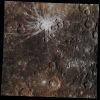
ZZ-Mercury-Craters-Mena_and_Cezanne_Crater-PIA16341-PCF-LXTT-IPF.jpgMena and Cezanne Crater (Absolute Natural Colors; credits for the additional process. and color.: Dr Paolo C. Fienga/Lunar Explorer Italia/Italian Planetary Foundation)68 visiteIn this Image-Mosaic, the Bright Rays of Mena Crater and the distinctive color difference of Cezanne Crater (with the surrounding area) are well highlighted. These two distinctive Impact Features provide beautiful contrast to this Absolute Natural Color image, giving the viewer more insight into reflectance variations (---> Albedoes) on Mercury's Surface. Also note the extremely old, degraded and larger, infilled Unnamed Crater visible on the center right of the frame, which is crossed by at least three major Crater Chains.
Date acquired: June 04, 2012
Image Mission Elapsed Time (MET): 247336883, 247336875, 247336879
Image ID: 1955368, 1955366, 1955367
Instrument: Wide Angle Camera (WAC) of the Mercury Dual Imaging System (MDIS)
WAC filters: 9, 7, 6 (996, 748, 433 nanometers) in red, green, and blue
Center Latitude: 3,78° South
Center Longitude: 235,8° East
Resolution: 552 meters/pixel
Scale: Cezanne Crater, such as the Crater in the bottom center, is about 67 km (approx. 41 miles) in diameter.
Solar Incidence Angle: 55,6° (meaning that the Sun was about 34,4° above the imaged Local Horizon at the time the pictures were taken)
Emission Angle: 0,0° (meaning that the MESSENGER Spacecraft, at the time that the pictures were taken, was absolutely perpendicular to the Mercurian Surface visible in the center of the frame)
Sun-Mercury-MESSENGER (or "Phase") Angle: 55,6°MareKromium
|
|

ZZ-Mercury-Craters-Moody_Crater-PIA12044_fig1.jpgMoody Crater54 visiteThe crater identified in this NAC image was named in November 2008 for Ronald Moody, a 20th century Jamaican sculptor and painter (see PIA11762). Moody features a Central Peak or Peak-Ring structure and an Annulus of dark material on its Outer Floor (green arrows). The area inward of the dark ring appears reddish in enhanced color WAC images (see PIA11219), indicating the presence of material different in composition from that of either the dark material or the Crater's immediate surroundings. Dark material has been found associated with other craters on Mercury, including Munch and Poe (see PIA12034). Moody is somewhat unusual for having its dark ring confined to the Crater Floor, rather than forming the crater rim as at Munch and Poe.
Date Acquired: January 14, 2008
Image Mission Elapsed Time (MET): 108829034
Instrument: Narrow Angle Camera (NAC) of the Mercury Dual Imaging System (MDIS)
Resolution: 590 meters/pixel (0,37 miles)
Scale: Moody is about 80 Km (approx. 50 miles) in diameter
Spacecraft Altitude: about 23.100 kilometers (approx. 14.300 miles)MareKromium
|
|

ZZ-Mercury-Craters-Munch_Crater_et_al_-PIA12034.jpgMunch, Sander and Poe Crater (Natural Colors; credits: Lunar Explorer Italia)54 visitenessun commentoMareKromium
|
|

ZZ-Mercury-Craters-Munch_Crater_et_al_-PIA12034_fig1.jpgMunch, Sander and Poe Crater56 visiteSander, Munch and Poe are a trio of impact craters within the Caloris Impact Basin (see PIA10359).
Munch and Poe were recently named (see PIA11762), while Sander received its name in the first set of feature names (see PIA10611) after MESSENGER’s first Mercury flyby. Munch is named for Edvard Munch (1863-1944), the Norwegian artist and painter of "The Scream".
The crater Poe takes its name from Edgar Allan Poe, the 19th century American writer and poet.
Sander is named for the German photographer August Sander (1876-1964).
Sander Crater exhibits very bright material within its Rim, while Munch and Poe each are surrounded by dark material. The presence of both bright and dark materials suggest that there is a diversity of rock types on and below Mercury's Surface, with different mineralogical compositions from those of the volcanic plains that comprise the majority of the floor of Caloris Basin.
The 3 Craters are located in the far northern part of the Caloris Basin. The basin Rim (see PIA10942), indicated by yellow arrows, can be seen in the upper left and extending across the top of this image, and many fractures within Caloris Basin (see PIA10606) are visible in the lower portion of this image.
Date Acquired: January 14, 2008
Image Mission Elapsed Time (MET): 108828587
Instrument: Narrow Angle Camera (NAC) of the Mercury Dual Imaging System (MDIS)
Resolution: 520 meters/pixel (0,32 miles/pixel)
Scale: This image is about 550 Km (approx. 340 miles) across
Spacecraft Altitude: about 20.400 Km (approx. 12.400 miles)MareKromium
|
|

ZZ-Mercury-Craters-Neruda_Crater-PIA17515-PCF-LXTT-IPF-0.jpgNeruda Crater (CTX Frame - Absolute Natural Colors; credits for the additional process. and color.: Dr Paolo C. Fienga/Lunar Explorer Italia/Italian Planetary Foundation)68 visiteThis frame features the Mercurian Impact Crater named "Neruda", after the Chilean poet Pablo Neruda (born on July, 12, 1904 in Parral - Chile - and died on September, 23, 1973 in the Chilean State's Capital, Santiago). As you can see, this Impact Crater (whose diameter is approx. 112 Km - such as about 69,55 miles) exhibits several Central Peaks punctuated by a few more recent, small Craters, resulting in a rugged Surface mostly made of ups and downs (and now think how difficult it would be if one hypothetical Astronaut decided - or just needed - to traverse the whole Crater's highly irregular Floor...). Similarly, the Crater's namesake Pablo Neruda experienced a number of ups and downs in his life, from success as a poet, through poverty, war and ultimately alleged poisoning.
Date acquired: July, 24th, 2012
Image Mission Elapsed Time (MET): 251577944
Image ID: 2256593
Instrument: Narrow Angle Camera (NAC) of the Mercury Dual Imaging System (MDIS)
Center Latitude: 52,20° South
Center Longitude: 125,30° East
Solar Incidence Angle: 80,4° (meaning that the Sun, at the time that the picture was taken, was about 9,6° above the imaged Local Mercurian Horizon)
Emission Angle: 2,4°
Sun-Mercury-Messenger (or "Phase") Angle: 78,0°
This picture (which is an Original NASA - MESSENGER Spacecraft's b/w and Map-Projected image published on the NASA - Planetary Photojournal with the ID n. PIA 17515) has been additionally processed, contrast enhanced, magnified and then colorized in Absolute Natural Colors (such as the colors that a human eye would actually perceive if someone were onboard the NASA - MESSENGER Spacecraft and then looked down, towards the Surface of Mercury), by using an original technique created - and, in time, dramatically improved - by the Lunar Explorer Italia Team. Different colors, as well as different shades of the same color, mean, among other things, the existence of different Elements (Minerals) present on the Surface of Mercury, each having a different Albedo (---> Reflectivity) and Chemical Composition.MareKromium
|
|

ZZ-Mercury-Craters-Neruda_Crater-PIA17515-PCF-LXTT-IPF-1.jpgNeruda Crater (EDM - Absolute Natural Colors; credits for the additional process. and color.: Dr Paolo C. Fienga/Lunar Explorer Italia/Italian Planetary Foundation)70 visiteThis frame is an Extra Detail Magnification (or "EDM", for short) featuring the Central Peaks' System of the Mercurian Impact Crater named "Neruda", after the Chilean poet Pablo Neruda (born on July, 12, 1904 in Parral - Chile - and died on September, 23, 1973 in the Chilean State's Capital, Santiago). As you can see, this Impact Crater (whose diameter is approx. 112 Km - such as about 69,55 miles) exhibits several Central Peaks punctuated by a few more recent, small Craters, resulting in a rugged Surface mostly made of ups and downs (and now think how difficult it would be if one hypothetical Astronaut decided - or just needed - to traverse the whole Crater's highly irregular Floor...). Similarly, the Crater's namesake Pablo Neruda experienced a number of ups and downs in his life, from success as a poet, through poverty, war and ultimately alleged poisoning.
Date acquired: July, 24th, 2012
Image Mission Elapsed Time (MET): 251577944
Image ID: 2256593
Instrument: Narrow Angle Camera (NAC) of the Mercury Dual Imaging System (MDIS)
Center Latitude: 52,20° South
Center Longitude: 125,30° East
Solar Incidence Angle: 80,4° (meaning that the Sun, at the time that the picture was taken, was about 9,6° above the imaged Local Mercurian Horizon)
Emission Angle: 2,4°
Sun-Mercury-Messenger (or "Phase") Angle: 78,0°
This picture (which is a crop taken from an Original NASA - MESSENGER Spacecraft's b/w and Map-Projected image published on the NASA - Planetary Photojournal with the ID n. PIA 17515) has been additionally processed, contrast enhanced, magnified to aid the visibility of the details and then colorized in Absolute Natural Colors (such as the colors that a human eye would actually perceive if someone were onboard the NASA - MESSENGER Spacecraft and then looked down, towards the Surface of Mercury), by using an original technique created - and, in time, dramatically improved - by the Lunar Explorer Italia Team. Different colors, as well as different shades of the same color, mean, among other things, the existence of different Elements (Minerals) present on the Surface of Mercury, each having a different Albedo (---> Reflectivity) and Chemical Composition.MareKromium
|
|

ZZ-Mercury-Craters-Pahinui_Crater-PIA16903-PCF-LXTT-IPF.jpgPahinui Crater (Absolute Natural Colors - Credits for the additional process. and color.: Dr Paolo C. Fienga/Lunar Explorer Italia/Italian Planetary Foundation)68 visiteOne of 9 (nine) newly named Mercurian Impact Craters, Pahinui, has intriguing Collapse-looking Pits surrounding its Central Peak. Pahinui Crater ha been so named after the Hawaiian musician Gabby Pahinui, a key figure in the 1970s Hawaiian Renaissance and master of the "slack-key guitar", a style that originated in Hawaii.
This image was acquired by the NASA - MESSENGER Spacecraft as part of the Mercury Dual Imaging System (MDIS)'s High-Resolution Surface Morphology Base Map. The Surface Morphology Base Map covers more than 99% of Mercury's Surface with an average resolution of 200 meters/pixel. Images acquired for the Surface Morphology Base Map typically are obtained at off-vertical Sun Angles (i.e.: high Solar Incidence Angles and therefore low Sun shining over the imaged Local Horizon) and have visible Shadows so as to reveal clearly the Topographic Form of many Geologic Features.
Date acquired: July, 31st, 2011
Image Mission Elapsed Time (MET): 220635824
Image ID: 575089
Instrument: Narrow Angle Camera (NAC) of the Mercury Dual Imaging System (MDIS)
Center Latitude: 28,30° South
Center Longitude: 146,90° East
Resolution: 139 meters/pixel
Solar Incidence Angle: 77,3° (meaning that the Sun, at the time that the picture was taken, was about 12,7° above the imaged Local Mercurian Horizon)
Emission Angle: 22,5°
Sun-Mercury-Messenger (or "Phase") Angle: 99,9°
This picture (which is an Original NASA - MESSENGER Spacecraft b/w frame published on the NASA - Planetary Photojournal with the ID n. PIA 16903) has been additionally processed and then colorized in Absolute Natural Colors (such as the colors that a human eye would actually perceive if someone were onboard the NASA - MESSENGER Spacecraft and then looked down, towards the Surface of Mercury), by using an original technique created - and, in time, dramatically improved - by the Lunar Explorer Italia Team. Different colors, as well as different shades of the same color, mean, among other things, the existence of different Elements (Minerals) present on the Surface of Mercury, each having a different Albedo (---> Reflectivity) and Chemical Composition.MareKromium
|
|

ZZ-Mercury-Craters-Poe_Crater-PIA16755-PCF-LXTT-IPF.jpgPoe Crater (Absolute Natural Colors; credits for the additional process. and color.: Dr Paolo C. Fienga/Lunar Explorer Italia/Italian Planetary Foundation)73 visiteThis picture is an image-mosaic made of 3 (three) frames taken by the NASA - MESSENGER Spacecraft in July 2011; it shows the huge and magnificent Mercurian Crater Poe (so named after the American writer, and whose diameter is approx. 77 Km - or about 48 miles), with its almost black colored Rim standing out from the reddish Volcanic Plains that surround it. Even in this case, a number of relatively small Hollows speckles the dark Rim of Poe Crater like stars, in the blackness of night.
Date acquired: July, 3rd, 2011
Images Mission Elapsed Time (MET): 218204194, 218204190, 218204186
Images ID: 458399, 458398, 458397
Instrument: Narrow Angle Camera (NAC) of the Mercury Dual Imaging System (MDIS)
Center Latitude: 42,83° North
Center Longitude: 158,9° East
Resolution: 213 meters/pixel
Solar Incidence Angle: 42,8° (meaning that the Sun, at the time that the pictures were taken, was about 47,2° above the imaged Local Mercurian Horizon)
Emission Angle: 35,9°
Sun-Mercury-Messenger (or "Phase") Angle: 78,7°
This picture (which is an Original NASA - MESSENGER Spacecraft b/w image mosaic published on the NASA - Planetary Photojournal with the ID n. PIA 16770) has been additionally processed and then colorized in Absolute Natural Colors (such as the colors that a human eye would actually perceive if someone were onboard the NASA - MESSENGER Spacecraft and then looked down, towards the Surface of Mercury), by using an original technique created - and, in time, dramatically improved - by the Lunar Explorer Italia Team. Different colors, as well as different shades of the same color, mean, among other things, the existence of different Elements (Minerals) present on the Surface of Mercury, each having a different Albedo (---> Reflectivity) and Chemical Composition.MareKromium
|
|

ZZ-Mercury-Craters-Praxiteles_Crater-PIA12052.jpgPraxiteles Crater (enhanced Natural Colors; credits: Lunar Explorer Italia)60 visiteMESSENGER's high-resolution images obtained during the mission's second Mercury flyby have revealed a number of irregularly shaped depressions on the floor of Praxiteles Crater. These depressions are intriguing indications of possible past volcanic activity within this Crater. View the previously released NAC image of Praxiteles for additional discussion.
The image shown here is similar to one recently published in the 1st of May issue of the "Science" magazine. This image was created by first mosaicking together the highest-resolution NAC images available of Praxiteles (one of which is shown in the previous web release), to produce complete coverage of the Crater. Independently, an enhanced-color image of Praxiteles was created by using images from all 11 WAC narrow-band color filters. (Visit last week's web release for more examples of enhanced-color images see PIA12051).
The WAC images provide important color information, but the WAC resolution is considerably less than that of the mosaicked NAC images. Thus, by overlaying a slightly transparent version of the WAC enhanced-color image on the high-resolution NAC mosaic, the high-resolution color view of Praxiteles crater shown here was produced. This overlay-color view helps associate the color features with the morphologic surface features. The fact that the irregularly shaped depressions on the floor of Praxiteles are associated with bright orange and yellow color features provides evidence that the depressions may be related to past volcanic activity in this area of Mercury.
Date Acquired: October 6, 2008
Instrument: Wide Angle Camera (WAC) and Narrow Angle Camera (NAC) of the Mercury Dual Imaging System (MDIS)
Resolution: 210 meters/pixel (0,13 miles/pixel)
Scale: Praxiteles Crater has a diameter of about 182 Km (approx. 113 miles) MareKromium
|
|

ZZ-Mercury-Craters-Prokofiev_Crater-PIA16857-PCF-LXTT-IPF.jpgIn the Everlasting Night of Prokofiev Crater (Absolute Natural Colors; credits for the additional process. and color.: Dr Paolo C. Fienga - Lunar Explorer Italia/Italian Planetary Foundation)71 visiteProkofiev Crater, so officially named in August 2012 after the Russian composer, is the largest Impact Crater (with a diameter of approx. 112 Km - such as about 69,5 miles) located in Mercury's North Polar Region which hosts Radar-Bright Surface Material. Furthermore, the NASA - MESSENGER Spacecraft has also found evidence that within the cold, dark, and permanently shadowed Inner Regions of Prokofiev, Water Ice is exposed on the Mercurian Surface, just like it seems to happen on the Floors of extremely deep and steep Impact Craters and Canyons located near and at the Poles of our own Moon.
Date acquired: January, 17th, 2013
Image Mission Elapsed Time (MET): 266090610
Image ID: 3288616
Instrument: Wide Angle Camera (WAC) of the Mercury Dual Imaging System (MDIS)
Center Latitude: 84,90° North
Center Longitude: 68,75° East
Resolution: 70 meters/pixel
Solar Incidence Angle: 84,9° (meaning that the Sun, at the time that the pictures were taken, was about 5,1° above the imaged Local Mercurian Horizon)
Emission Angle: 6,1°
Sun-Mercury-Messenger (or "Phase") Angle: 78,8°
This picture (which is an Original NASA - MESSENGER Spacecraft b/w frame published on the NASA - Planetary Photojournal with the ID n. PIA 16857) has been additionally processed and then colorized in Absolute Natural Colors (such as the colors that a human eye would actually perceive if someone were onboard the NASA - MESSENGER Spacecraft and then looked down, towards the Surface of Mercury), by using an original technique created - and, in time, dramatically improved - by the Lunar Explorer Italia Team. Different colors, as well as different shades of the same color, mean, among other things, the existence of different Elements (Minerals) present on the Surface of Mercury, each having a different Albedo (---> Reflectivity) and Chemical Composition.
MareKromium
|
|

ZZ-Mercury-Craters-Qi_Baishi_et_al_-PIA14398-PCF-LXTT.jpgTolstoj Basin (Enhanced Absolute Natural Colors; credits for the additional process. and color.: Dr Paolo C. Fienga - Lunexit Team)248 visiteThe various named features present in this color image, Qi Baishi, Hovnatanian, Kalidasa and Tolstoj, create a stunning depiction of Mercury's scarred and variable Surface. Tolstoj, the large basin in the bottom right of the image, represents the war and peace of its namesake's famous novel through its smooth, light-colored center and rough, dark blue exterior.
This image was acquired as part of MDIS's color base map. The color base map is composed of WAC images taken through eight different narrow-band color filters and will cover more than 90% of Mercury's Surface with an average resolution of 1 Km/pixel (0,6 miles/pixel). The highest-quality color images are obtained for Mercury's Surface when both the spacecraft and the Sun are overhead, so these images typically are taken with viewing conditions of low incidence and emission angles.
Date acquired: June, 27th, 2011
Image Mission Elapsed Time (MET): 217689462, 217689478, 217689458
Image ID: 433721, 433725, 433720
Instrument: Wide Angle Camera (WAC) of the Mercury Dual Imaging System (MDIS)
WAC filter: 9 (1000 nanometers), 7 (750 nanometers), 6 (430 nanometers) as red-green-blue
Center Latitude: 11,69° South
Center Longitude: 178,1° East
Resolution: 1387 meters/pixel
Scale: the Inner Ring of Tolstoj is roughly 365 Km
Incidence Angle: 13,4°
Emission Angle: 14,6°
Phase Angle: 28,0°MareKromium
|
|
| 248 immagini su 21 pagina(e) |
|
|
|
|
|
10 | |
|
|
|
|
|
|





