Artistic Views of the Solar System
|
|
|
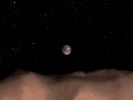
Toutatis.jpgEarth from the asteroid "Toutatis"109 visiteOn September 29, 2004, the Earth came within 1 million miles of the asteroid Toutatis - the closest predicted approach of our fair planet to a sizable asteroid or comet in this century. Coming within 1 million miles (or about 4 times the Earth-Moon distance), Earth would appear to be nearly the size of the full moon in the asteroid's sky, as suggested in this illustration. In Earth's sky, Toutatis appeared only as a faint object rapidly moving against a background of stars. Also known as Earth-Crossing Asteroid (ECA) 4179, Toutatis is in an eccentric 4 year orbit which moves it from the asteroid belt between Mars and Jupiter to just inside Earth's orbit. When the Earth passed near it in 1992 Toutatis was imaged by radar and seen to be 2 irregularly shaped lumps, perhaps joined by a narrow neck. This bizarre object is about 3 Km wide, 5,5 Km long and is tumbling through space. Studies of Toutatis and other ECA's help reveal connections between the Solar System's meteorites main-belt asteroids and comets.
|
|

UB-313.jpgUB 313: is this the "10th Planet"?82 visiteWhat do you call an outer Solar System object that is larger than Pluto? Nobody is yet sure, but the question arose recently when 2003 UB313, an object currently twice as far out as Pluto and not in the plane with the rest of the Planets, was verified recently to be 30% wider than Pluto. UB313's size was estimated (of course in a VERY approximate way!) by measuring how much infrared light this celestial body emits. Previous size estimates were based only on visible light and greatly affected by how reflective the object is.
Whether 2003 UB313 is officially declared a planet will be answered shortly by the International Astronomical Union (IAU).
In the above picture, a scientific artist has imagined UB313 in its distant orbit around the Sun, coupled with a hypothetical moon.
|
|

Unknown_Centaur.JPGUnknown Centaur82 visitenessun commentoMareKromium
|
|

Venus fly-by.jpgCassini-Huygens during the Venus fly-by82 visitenessun commento
|
|

Venus-Lightning.jpgVenusian Lightnings72 visiteCaption ESA:"This artist’s concept of Venus, dated 2006, suggests the presence of lightning in the atmosphere". MareKromium
|
|

Volcanoes-Olympus_and_Clouds.jpgOlympus, in a Sea of Clouds (Painting by Gordon Legg, based on Viking Orbiter mosaic P17444. From NASA SP-444, 1980) 137 visiteThis painting, based on a mosaic of black-and-white Viking Orbiter images of Olympus Mons, shows the volcano's flanks and complex caldera protruding above thin clouds of water ice. MareKromium
|
|

Voyagers-Heliosphere3b.jpgThe "Voyagers" at the Final Frontier107 visiteVoyager 1 and 2 are still going strong and are returning valuable science data. Each Voyagers' Cosmic Ray Detector, Magnetometer, Plasma Wave Detector and Low-Energy Charged Particle Detector all still operational. In addition, the Ultraviolet Spectrometer on Voyager 1 and the Plasma Science instrument on Voyager 2 continue to return data. Both spacecraft are expected to continue to operate and send back valuable data until at least the year 2020.
The mission currently employs the equivalent of about 10 full-time people at JPL, significantly less than the approximately 300 during the height of its famed "Grand Tour" of the planets through 1989. Only two veterans of the Voyager launches still work on the flight team. Some of the summer interns the team has employed were not even born when the spacecraft were launched. The project scientist, Dr. Ed Stone of the California Institute of Technology has been with the mission since inception and two original principal investigators - Dr. Stamatios Krimigis of the Applied Physics Laboratory and Dr. Norman Ness of the University of Delaware - remain.
During the journey, the Voyagers flew by Jupiter, Saturn, Uranus and Neptune and returned nearly 80 thousand images and more than 5 trillion bits of data. After traveling through space for more than 27 years, Voyager 1 is now more than 14 billion kilometers (94 AU) from the Sun, heading in a northerly direction toward interstellar space. Voyager 2, closer at about 11 billion kilometers (75 AU), is headed on a southerly path toward interstellar space. Voyager 1 is now the furthest human-made object from the Sun, having surpassed Pioneer 10 on February 17, 1998.
Since the beginning of the Interstellar Mission in 1990, the two spacecraft have returned well more than 65 billion bits of data, though at lower data rates than during the Grand Tour. The data continue to reveal new characteristics of the effects of the sun in the distant solar wind. As an example, a Coronal Mass Ejection (CME) shock wave from the October 2003 solar storms was detected at Voyager 2 in mid-April 2004. Some of the most powerful flares in recorded history hurled billion-ton clouds of gas, called coronal mass ejections (CMEs), into the solar system. By the time the resulting shocks reached Voyager 2, about 6 months later, they had combined into Merged Interaction Regions and had slowed considerably. Traveling at 600 km/sec, it had slowed considerably from the 1500-2000 km/sec detected last Fall as the storms left the Sun. Voyager 2 measured the speed of the shock, its composition, temperature and magnetism. When combined with measurements from SOHO, Mars Odyssey, Ulysses, Cassini and other spacecraft, the Voyager data show how far-ranging CMEs evolve and dissipate.
For the past two years or so, Voyager 1 has detected phenomena unlike any encountered before in all its years of exploration. These observations and what they may infer about the approach to the termination shock have been the subject of on-going scientific debates. While some of the scientist believed that the passage past the termination shock had already begun, some of the phenomena observed were not what would have been expected. So the debate continues while even more data are being returned and analyzed. However, it is certain that the spacecraft are in a new regime of space. The observed plasma wave oscillations and increased energetic particle activity may only be the long-awaited precursor to the termination shock. If we have indeed encountered the termination shock, Voyager 1 would be the first spacecraft to enter the solar system's final frontier, a vast expanse where wind from the Sun blows hot against thin gas between the stars: interstellar space.
|
|

Voyagers-Heliosphere4b.jpgThe Voyagers at the "Final Frontier"90 visiteOriginal caption:"In the summer of 1989, NASA's Voyager 2 became the first spacecraft to observe the planet Neptune, its final planetary target. Passing about 4.950 Km (about 3.000 miles) above Neptune's North Pole, Voyager 2 made its closest approach to any planet since leaving Earth 12 years before. Five hours later, Voyager 2 passed about 40.000 Km (about 25.000 miles) from Neptune's largest moon, Triton, the last solid body the spacecraft had an opportunity to study".
|
|

Voyagers-Heliosphere5b.JPGThe Voyagers at the "Final Frontier"93 visiteThe twin Voyager 1 and 2 spacecrafts continue exploring where nothing from Earth has flown before. In the 25th year after their 1977 launches, they each are much farther away from Earth and the Sun than Pluto is and approaching the boundary region - the heliopause - where the Sun's dominance of the environment ends and Interstellar Space begins. Voyager 1, more than twice as distant as Pluto, is farther from Earth than any other human-made object and speeding outward at more than 17 Km per second (38.000 miles per hour). Both spacecraft are still sending scientific information about their surroundings through the Deep Space Network (DSN).
The primary mission was the exploration of Jupiter and Saturn.
After making a string of discoveries there - such as active volcanoes on Jupiter's moon Io and intricacies of Saturn's rings - the mission was extended. Voyager 2 went on to explore Uranus and Neptune, and is still the only spacecraft to have visited those outer Planets. The adventurers' current mission, the Voyager Interstellar Mission (VIM), will explore the outermost edge of the Sun's domain. And beyond.
|
|

Voyagers-Heliosphere6b.JPGWhere are the "Pioneers"?98 visitePioneer 10 will continue into interstellar space, heading generally for the red star Aldebaran, which forms the eye of Taurus. Aldebaran is about 68 LY away and it will take Pioneer over 2 MY to reach it.
The Mission of Pioneer 11 has ended: the last communication from
Pioneer 11 was received in November 1995, shortly before the Earth's motion carried it out of view of the spacecraft antenna. The spacecraft is headed toward the constellation of Aquila, Northwest of the constellation of Sagittarius. Pioneer 11 will pass near one of the stars of Sagittarius in about 4 MY.
PIONEER SPACECRAFT CONDITIONS: very cold with most temperature readings at the bottom of their scale. Bus voltage about 26 volts (nominal is 28). Uplink received from DSS 14 at -131.7 dbm. Two commands received, both confirmed as executed. Geiger Tube Telescope Instrument on, and data received.
Project Phoenix has been observing Pioneer 10 at Arecibo in Puerto Rico through the auspices of the SETI Institute. The signal from Pioneer 10 was also picked up at Arecibo on 2 March 2002.
The last telemetered data from the University of Iowa cosmic ray instrument were as follows: 2 March 2002 (39 minutes of clean data) (r = 79.83 AU) 27 April 2002 (33 minutes of clean data) (r = 80.22 AU)
At GMT 17:27:30, Saturday, 4/28/01, the signal from Pioneer 10 was received at station 63 in Madrid, the first time since August 5/6 of 2000. So it appears that Pioneer 10 has life, albeit in another mode - i.e., only in a two-way coherent mode. We have been listening for the Pioneer 10 signal in a one-way downlink non-coherent transmission mode since last summer with no success. We therefore conclude that in order [for Pioneer 10] to talk to us, we need to talk to it. This means from now on, we need two-way round-trip light time (RTLT) passes to allow the Deep Space Network (DSN) to send up a strong stable signal to lock up with a coherent downlink signal.
|
|

Voyagers-Heliosphere7d.pngInterstellar Space for the "Voyagers"!217 visiteAffascinante. Notizia vecchiotta (quasi di due anni), ma sempre interessante da leggere ed osservare.MareKromium
|
|

Voyagers-InterstellarSpace8d.jpgThe Infinite and Beyond173 visitenessun commentoMareKromium
|
|
| 91 immagini su 8 pagina(e) |
 |
|
|
|
|
7 |
|








