Artistic Views of the Solar System
|
|
|

The_Rings-PIA10082.jpgMittens72 visiteCaption NASA:"This is an artist concept of the view from Cassini during the star occultation that detected "Mittens," the small object to the right of the star. As Cassini watched the star pass behind Saturn's F-Ring (foreground), the star blinked out when Mittens blocked it, indicating it may be a solid moonlet".MareKromium
|
|

Titan - artwork.jpgHuygens on Titan105 visiteThin methane clouds dot the horizon and a narrow methane spring or "methanefall" flows from the cliff at left and drifts mostly into vapor. Smooth ice features rise out of the methane/ethane lake, and crater walls can be seen far in the distance.
|
|

Titan by day.jpgA beautiful day on Titan144 visitenessun commento
|
|
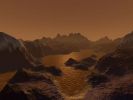
Titan-IMG000629-br500.jpgPools on Titan116 visiteUna piccolissima annotazione: quasi tutte le "Visioni Artistiche" di Titano sono caratterizzate da una sostanziale "luminosità" e "limpidezza" del paesaggio. A nostro modo di vedere - ed in accordo ai risultati che abbiamo ottenuto con un semplicissimo programma di simulazione - Titano, a differenza di quanto sino ad ora "artisticamente" ipotizzato, dovrebbe essere un mondo decisamente buio. E', inoltre, fortemente plausibile - anche se speriamo di sbagliarci - che la qualità delle immagini che verranno riprese e trasmesse dalla superficie del pianeta sia decisamente cattiva non solo per la scarsità di illuminazione, ma anche a causa della fitta nebbia che, a ben vedere, potrebbe essere presente anche sulla superficie di Titano (e non solo negli strati alti e medio-alti della sua spessa atmosfera).
|
|

Titan-IMG000630-br500.jpgTitan's descent (3D)97 visitenessun commento
|
|
Titan-IMG001293-br500.jpgHuygens is landed on Titan!103 visitenessun commento
|
|
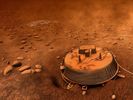
Titan-IMG001958-br500.jpgHuygens' Landing Site107 visiteThis is an artist's interpretation of the area surrounding the Huygens Landing Site, based on images and data returned on Jan. 14, 2005.
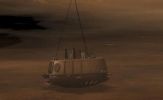
On January 14, 2005, the European Space Agency's (ESA) Huygens Probe reached the upper layer of Titan's atmosphere and landed on the surface after a parachute descent 2 hours and 28 minutes later.
As part of the joint NASA/ESA/ASI mission to Saturn and its Moons, the Huygens Probe was sent from the Cassini spacecraft to explore Titan, Saturn's largest moon. Titan's organic chemistry may be like that of the primitive Earth around 4000 MY ago, and it may hold clues about how life began on our Planet.
Nota: permetteteci un piccolo commento su questo "grande successo". Di dati significativi sull'ambiente di Titano (p.e.: temperature medie nel ciclo giorno/notte; presenza o meno di venti; presenza o meno di polveri in sospensione; componenti primari dell'atmosfera a varie altitudini etc.), ad oggi, non ci pare ne sìano emersi. A parte qualche "sembra" e qualche "si sta ancora studiando" non c'è ancora nulla di solido su cui lavorare (o almeno speculare). E questo per non dire delle fotografie di Titano al suolo: dovevano dirci tanto. Alla fine, quelle poche (ed orrende) immagini ricevute non ci hanno detto assolutamente niente.
La "Discesa dell'Europa su Titano" (come si scrisse in tono trionfalistico un anno fa - per poi dimenticare tutto in 24 ore...) fu dunque vera gloria?
Ai posteri l'ardua sentenza...
|
|

Titan-PIA11001.jpgEthane Lake on Titan113 visiteNASA scientists have concluded that at least one of the large lakes observed on Saturn's moon Titan contains liquid hydrocarbons, and have positively identified the presence of ethane. This makes Titan the only body in our solar system beyond Earth known to have liquid on its surface.
Scientists made the discovery using data from an instrument aboard the Cassini spacecraft. The instrument identified chemically different materials based on the way they absorb and reflect infrared light. Before Cassini, scientists thought Titan would have global oceans of methane, ethane and other light hydrocarbons. More than 40 close flybys of Titan by Cassini show no such global oceans exist, but hundreds of dark, lake-like features are present. Until now, it was not known whether these features were liquid or simply dark, solid material.
"This is the first observation that really pins down that Titan has a surface lake filled with liquid," said Bob Brown of the University of Arizona, Tucson. Brown is the team leader of Cassini's visual and mapping instrument. The results will be published in the July 31 issue of the journal Nature.
Ethane and several other simple hydrocarbons have been identified in Titan's atmosphere, which consists of 95 percent nitrogen, with methane making up the other fiver percent. Ethane and other hydrocarbons are products from atmospheric chemistry caused by the breakdown of methane by sunlight.
Some of the hydrocarbons react further and form fine aerosol particles. All of these things in Titan's atmosphere make detecting and identifying materials on the surface difficult, because these particles form a ubiquitous hydrocarbon haze that hinders the view. Liquid ethane was identified using a technique that removed the interference from the atmospheric hydrocarbons.
The visual and mapping instrument observed a lake, Ontario Lacus, in Titan's south polar region during a close Cassini flyby in December 2007. The lake is roughly 20,000 square kilometers (7,800 square miles) in area, slightly larger than North America's Lake Ontario.
"Detection of liquid ethane confirms a long-held idea that lakes and seas filled with methane and ethane exist on Titan," said Larry Soderblom, a Cassini interdisciplinary scientist with the U.S. Geological Survey in Flagstaff, Ariz. "The fact we could detect the ethane spectral signatures of the lake even when it was so dimly illuminated, and at a slanted viewing path through Titan's atmosphere, raises expectations for exciting future lake discoveries by our instrument."
The ethane is in a liquid solution with methane, other hydrocarbons and nitrogen. At Titan's surface temperatures, approximately 300 degrees Fahrenheit below zero, these substances can exist as both liquid and gas. Titan shows overwhelming evidence of evaporation, rain, and fluid-carved channels draining into what, in this case, is a liquid hydrocarbon lake.
Earth has a hydrological cycle based on water and Titan has a cycle based on methane. Scientists ruled out the presence of water ice, ammonia, ammonia hydrate and carbon dioxide in Ontario Lacus. The observations also suggest the lake is evaporating. It is ringed by a dark beach, where the black lake merges with the bright shoreline. Cassini also observed a shelf and beach being exposed as the lake evaporates. "During the next few years, the vast array of lakes and seas on Titan's north pole mapped with Cassini's radar instrument will emerge from polar darkness into sunlight, giving the infrared instrument rich opportunities to watch for seasonal changes of Titan's lakes," Soderblom said.
More information is available at: http://www.nasa.gov/cassini, http://saturn.jpl.nasa.gov and http://wwwvims.lpl.arizona.edu .
MareKromium
|
|

Titan.jpgLanding on Titan217 visiteWill the Huygens probe land or splash down? In the next few days, the Cassini spacecraft currently orbiting Saturn will release a probe that will descend toward Saturn's largest moon in mid-January. That moon, Titan, has a surface normally hidden from view by thick methane cloud decks. What the car-sized flying-saucer-shaped probe will find is unknown. Once reaching the surface, Huygens may survive for as long as 150 minutes and take as many as 1.100 images. These images will be beamed up to the passing Cassini mothership for subsequent transmission to a waiting Earth. The Huygens probe is depicted above entering Titan's atmosphere and deploying its parachute. Uncovering the most mysterious moon in the Solar System may reveal a surface so strange that images of it may not be immediately understood.
|
|

Titan_s Ocean - artistic view.jpgTitan's Ocean at night390 visitenessun commento
|
|

Titan_s Rain~0.jpgTitan's "Rain"...93 visiteDa "NASA - Picture of the Day" del 2 Agosto 2006:"Might it rain cold methane on Saturn's Titan? Recent analyses of measurements taken by the Huygen's probe that landed on Titan in 2005, January, indicate that the atmosphere is actually saturated with methane at a height of about 8 Km. Combined with observations of a damp surface and lakes near the Poles, some astrobiologists conclude that at least a methane drizzle is common on parts of Titan. Other astrobiologists reported computer models of the clouded moon that indicate that violent methane storms might even occur, complete with flash floods carving channels in the landscape. The later scenario is depicted in the above drawing of Titan. Lighting, as also depicted above, might well exist on Titan but has not been proven. The findings increase speculation that a wet Titanian surface might be hospitable to unusual forms of life".
Attenzione all'ultima frase: "Queste scoperte fanno crescere (la validità) di una ipotesi speculativa secondo cui la superficie di Titano, laddove effettivamente umida, potrebbe essere idonea ad ospitare "inusuali" forme di Vita".
Il significato e la portata di questa frase sono evidenti e di valore storico, ma c'è una domanda che ci incuriosisce e, in fondo, un pò ci turba: cosa intende la NASA quando parla di "unusual life forms"?...
|
|

TitanandHuygens_968A4_L.jpgTitan, Huygens and Saturn in the sky137 visiteUna "visione" davvero bellissima di Titano: forse la migliore.
|
|
| 91 immagini su 8 pagina(e) |
 |
|
|
|
6 | |
|








