|
|
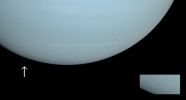
Z-Naiad.jpgNaiad transiting Neptune (Credits: NASA/JPL - Voyager 2 Mission; Credits for the additional process.: "zelario12" - https://creativecommons.org/licenses/by-sa/2.0/deed.en)112 visitenessun commentoMareKromium
|
|

Z-Thalassa.gifThalassa71 visiteThalassa appears to be about 80 Km (about 50 miles) in diameter.
It orbits Neptune in 7 hours and 30 minutes, about 25.200 Km (such as approx. 15.700 miles) above the cloud tops. It is irregularly shaped and shows no sign of any geological modification. Thalassa circles the Planet in the same direction as Neptune rotates. This image has been slightly smeared so that Thalassa appears highly elongated.
|
|
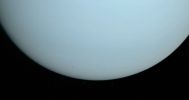
Z-Thalassa_and_Despina.jpgThalassa and Despina transiting (Credits: NASA/JPL - Voyager 2 Mission; Credits for the additional process.: "zelario12" - https://creativecommons.org/licenses/by-sa/2.0/deed.en)137 visitenessun commentoMareKromium
|
|

ZA-Neptune_s Rings-PIA01996_modest.jpgThe Rings of Neptune (closest approach)65 visiteCaption NASA originale:"The Voyager 2 spacecraft took this picture after closest approach to Neptune on Aug. 25 1989, using the clear filter of the wide-angle camera with an exposure time of 255 seconds. The view back towards Neptune at a phase angle of 135° found the 2 known rings to be 5 to 10 times brighter than seen in backscattering during Voyager approach at much lower phase angle. This brightness increase implies a large percentage of microscopic particles within the rings".
|
|

ZA-Neptune_s Rings-PIA01997_modest.jpgThe Rings of Neptune (full system) 170 visiteCaption NASA originale:"These two 591-second exposures of the rings of Neptune were taken with the clear filter by the Voyager 2 wide-angle camera on Aug. 26, 1989 from a distance of 280.000 Km (175.000 miles). The 2 main rings are clearly visible and appear complete over the region imaged. The time between exposures was 1 hour and 27 minutes. [During this period the bright ring arcs in the outer bright ring were not visible in either picture (they were unfortunately on the opposite side of the planet for each exposure).] Also visible in this image is the inner faint ring at about 42.000 km (25.000 miles) from the center of Neptune and the faint band which extends smoothly from the 53.000 Km (33.000 miles) ring to roughly halfway between the 2 bright rings".
|
|

ZA-Neptune_s Rings-PIA02202_modest.jpgThe Rings of Neptune (full system) 263 visiteCaption NASA originale:"This pair of Voyager 2 images (FDS 11446.21 and 11448.10), two 591-s exposures obtained through the clear filter of the wide angle camera, show the full ring system with the highest sensitivity. Visible in this figure are the bright, narrow N53 and N63 rings, the diffuse N42 ring, and (faintly) the plateau outside of the N53 ring (with its slight brightening near 57.500 Km)".
|
|

ZA-Triton-PIA02247_modest.jpgFarewell Triton...65 visiteCaption NASA originale:"Voyager 2 obtained this parting shot of Triton, Neptune's largest satellite, shortly after closest approach to the moon and passage through its shadow on the morning of Aug. 25, 1989. The distance to Triton was 90.000 Km and the phase angle was 155°, so that only a thin crescent of Triton's south polar region can be seen. Because of the high phase angle, and perhaps because of scattering sunlight in Triton's hazy atmosphere, few surface features are also easily discernible". Un piccolo commento: non sembra anche a Voi di intuire una sottile somiglianza fra Tritone e Titano?...
|
|

ZA-U-Triton.jpgFarewell Triton... (HR)74 visitenessun commento
|
|

ZB-Neptune_s Partial Rings-PIA02200_modest.jpgNeptune's "Partial Rings" (or "Ring Arcs")76 visiteCaption NASA originale:"One of two new ring arcs, or partial rings, discovered by NASA's Voyager 2 spacecraft, is faintly visible here just outside the orbit of the Neptunian moon 1989N4, also discovered by Voyager 2.
The 155 second exposure taken by Voyager's narrow-angle camera shows the glare of an overexposed Neptune to the right of the moon and ring arc.
The two bright streaks below the moon and ring arc are stars.
The ring arc is approximately 50.000 Km (or 30.000 miles) long".
|
|

ZC-Neptune_s Rings-PIA01493_modest.jpgThe Rings of Neptune66 visiteCaption NASA originale:"In Neptune's outermost ring, 39.000 miles out, material mysteriously clumps into 3 arcs.
Voyager 2 acquired this image as it encountered Neptune in August 1989".
|
|

s Rings-PIA02207_modest.jpgNeptune's Rings (and a crescent Neptune) from 1,1 MKM65 visiteCaption NASA originale:"This wide-angle Voyager 2 image, taken through the camera's clear filter, is the first to show Neptune's rings in detail. The 2 main rings, about 53.000 Km and 63.000 Km from Neptune, are 5 to 10 times brighter than in earlier images and the difference is due to lighting and viewing geometry. In approach images, the rings were seen in light scattered backward toward the spacecraft at a 15° phase angle. However, this image was taken at a 135° phase angle as Voyager 2 left the planet. That geometry is ideal for detecting microscopic particles that forward-scatter light preferentially. The fact that Neptune's Rings are so much brighter at that angle means the particle-size distribution is quite different from most of Uranus' and Saturn's rings, which contain fewer dust-size grains. However, a few components of the Saturnian and Uranian ring systems exhibit forward-scattering behavior: the F-Ring and the Encke Gap ringlet at Saturn, and 1986U1R at Uranus".
|
|

t Neptune Space.jpgNeptune's System62 visiteUn magnifico e realistico collage che ci mostra Nettuno e le sue Lune maggiori, insieme, per una "Foto Ricordo" di un viaggio indimenticabile...
|
|
| 96 immagini su 8 pagina(e) |
 |
|
|
|
|
8 |
|





