|
|

Triton-PIA02246-PCF-LXTT-IPF.jpgStill in the Abyss (Absolute Natural Colors; credits for the additional process. and color.: Dr Paolo C. Fienga - Lunar Explorer Italia/Italian Planetary Foundation)97 visiteFeatures as small as approx. 100 Km (such as a little more than 62 miles) across can be seen in this Absolut Color Image of Neptune's moon Triton, photographed by the NASA - Voyager 2 Spacecraft on August 20, 1989, while it was still approx. 5,4 Million KiloMeters (such as about 3,35 Million Miles) from Neptune. Triton's overall light pinkish color may be due to the heavy irradiation (---> the action of the Cosmic Rays and other Charged Particles, including the ones forming the Solar Wind) of the Ice (and, maybe, other Elements which were already) existing on the Surface of this distant Celestial Body.
The dark areas near the top of the image seem to be part of a belt of dark markings observed near Triton's Equator at different Longitudes. However - and generally speaking -, the darker areas visible on Triton appear to be somewhat redder in color than the brighter ones. The central Longitude in the image is 123° East. The South Pole of Triton is at about 6 o'clock of the disk, approximately 1/6th (one sixth) of the way up from its lower limb.
This frame (which is the Original NASA - Voyager 2 color frame published on the NASA - Planetary Photojournal with the ID n. PIA 02246) has been additionally processed and then re-colorized, according to an educated guess carried out by Dr Paolo C. Fienga (LXTT-IPF), in Absolute Natural Colors (such as the colors that a human eye would actually perceive if someone were onboard the NASA - Voyager 2 Spacecraft and then looked outside, towards the Neptunian moon Triton), by using an original technique created - and, in time, dramatically improved - by the Lunar Explorer Italia Team. Different colors, as well as different shades of the same color, mean, among others, the existence of different Elements present on the Surface of Triton, each having a different Albedo (---> Reflectivity) and Chemical Composition.MareKromium
|
|

Triton-PIA02246_modest.jpgTriton from Voyager 2 (real colors)63 visiteCaption NASA originale:"Features as small as 100 Km across can be seen in this color image of Neptune's satellite Triton, photographed by Voyager 2 on Aug. 20, 1989, while it was still 5.4 MKM (3.3 million miles) from Neptune. Triton's overall pinkish color may be due to reddish materials produced by irradiation of methane gas and ice on the satellite. The dark areas near the top of the image seem to be part of a belt of dark markings observed near Triton's equator at different longitudes. Generally, darker areas on Triton appear to be somewhat redder in color than brighter areas. The central longitude in the image is 123°. Here the south pole is at about 6 o'clock, approximately one sixth of the way up from the bottom. The color image was made from three black and white frames, taken through clear, violet and green filters".
|
|

Triton-PIA12184.jpgVolcanic Plains on Triton (possible Natural Colors; credits: Lunexit)64 visiteCaption NASA:"This view of the Volcanic Plains of Neptune's moon Triton was produced using topographic maps derived from images acquired by NASA's Voyager Spacecraft during its August 1989 flyby, 20 years ago this week (August 2009).
Triton, Neptune's largest moon, was the last solid object visited by the Voyager 2 Spacecraft on its epic 10-year tour of the Outer Solar System.
This regional view shows a variety of Terrains on Triton, including the smooth Volcanic Plains in the foreground, formed by icy lavas. Parts of this Surface have been eroded, forming mounds and depressions with relief of tens to a few hundred meters (several hundred feet). The round pits and mounds across the center of the scene are probably volcanic explosion or collapse craters, the largest of which (at bottom center) is approx. 250 meters deep (820 feet) and approx. 15 Km (about 9 miles) across.
Many of these pits are aligned in chains similar to those seen in basaltic volcanic areas on Earth, such as Craters of the Moon National Monument in Idaho, except the lavas on Triton are water and other ices that erupted onto the Surface.
In the distance is one of two large walled smooth plains of unknown origin. These plains are roughly 200 Km (about 124 miles) across.
The Surface of Triton is very rugged, scarred by rising blobs of ice (Diapirs), Faults and Volcanic Pits and Lava Flows composed of water and other ices. The Surface is also extremely young and sparsely cratered. It may even be younger than the Surface of Europa, one of the first objects visited by the Voyager Spacecraft and could be geologically active today.
Although locally very rugged, Triton has no large mountains or deep basins and regional relief is low, a consequence of its high internal heat and the low strength of most ices. This scene is on the order of 500 Km (about 310 miles) across and is taken from a new flyover movie across the Equatorial Regions of Triton commemorating the Voyager 20-year anniversary of this flyby.
Vertical relief has been exaggerated by a factor of 25 to aid interpretation".MareKromium
|
|

Triton-PIA12185.jpgVolcanic Plains on Triton65 visiteCaption NASA:"This view of the Volcanic Plains of Neptune's moon Triton was produced using topographic maps derived from images acquired by NASA's Voyager Spacecraft during its August 1989 flyby, 20 years ago this week (August 2009).
Triton, Neptune's largest natural moon, was the last solid object visited by the Voyager 2 Spacecraft on its epic 10-year tour of the Outer Solar System. This view shows a close-up of a prominent chain of Volcanic Features surrounded by smooth Volcanic Plains formed by lavas or ash deposits of water or other ices, such as Methane or Ammonia.
The smaller pits and domes are typically 10 Km (about 6 miles) across and have relief of no more than a few hundred meters (several hundred feet).
The large depressions at the far left and right of the chain are 50 to 80 Km (about 31 to 50 miles) across.
The Surface of Triton is very rugged, scarred by rising blobs of ice (diapirs), faults and volcanic pits and lava flows composed of water and other ices. The Surface is also extremely young and sparsely cratered and could be geologically active today.
This scene is on the order of 500 Km (about 310 miles) across and is taken from a new flyover movie across the Equatorial Regions of Triton commemorating the Voyager anniversary of the Triton flyby.
Vertical relief has been exaggerated by a factor of 25 to aid interpretation".MareKromium
|
|

Triton-PIA12187.jpgTritonian Terminator74 visitenessun commentoMareKromium
|
|

Triton-clouds-PIA02203.jpgClouds on the limb of Triton82 visiteCaption NASA originale:"Limb clouds over Triton's South Polar Cap. Image is stretched to enhance the limb clouds and surface features. The image shows the cloud on the west limb that extends about 100 Km along the limb and appears detached over much of its length".
Nuvole nel cielo di Tritone: non si tratta di un'ipotesi affascinante, bensì di un fatto. Ora la domanda non può che essere questa: qual'è la composizione delle nuvole di Tritone?
|
|

Triton-vg2_1138639.jpgTriton (HR)62 visitenessun commento
|
|

Triton-vg2_p34665.jpgTriton (in natural colors and HR)72 visitenessun commento
|
|

Triton.JPGNorthern Latitudes on Triton62 visiteVoyager 2 took this picture of Neptune's largest satellite, Triton, from less than 80.000 Km (about 50.000 miles). The image shows an area in Triton's Northern Hemisphere.
The Sun is just above the horizon, so features cast shadows that accentuate height differences. The large, smooth area in the right-hand side of the image shows a single, fresh, impact crater. Otherwise there is no evidence of impacts such as those that have pocked the faces of most of the satellites Voyager 2 has visited.
Many low cliffs in the area, bright where they face the Sun, and when they face away from it, suggest and intricate history for Triton. The cliffs might be due either to melting of surface materials or, possibly, caused by unusual fluid materials that flowed sometime in Triton's past.MareKromium
|
|

Triton3.jpgThin clouds on Triton148 visiteDeboli e sottilissime nuvole (strati) caratterizzano, saltuariamente, il cielo di Tritone. Un Mondo lontano e gelido che riceve, mediamente, poco più di 1/400mo della luce che la Terra riceve dal Sole, eppure...Eppure Tritone possiede un'atmosfera ed essa mostra (come risulta evidente da questa immagine) di essere "viva" e capace di esprimere "fenomeni" quali nuvole e venti. Probabilmente passerà un secolo (o anche di più) prima che qualche Governo finanzi una Missione ricognitiva del Sistema di Nettuno e - magari - simile, in termini di contenuti, alla Missione "Cassini-Saturno". Certamente, quando avremo avuto risposte significative alle domande che ci stiamo ponendo in questo momento, coloro che scrivono sulle pagine di Lunar Explorer non ci saranno più.
Ma è questo, forse, il fascino della Scienza: Essa non si ferma mai e, se c'è la Volontà, qualcuno riprende sempre il lavoro interrotto da altri e, prima o poi, lo conduce al termine...
Original caption:"This image of Triton shows a thin cloud layer along the limb of the moon. The image was obtained as Voyager 2 swept past Triton at a speed of 27 kilometers per second and passed within 39,800 kilometers. Voyager discovered that Triton possessed a thin atmosphere of 15 microbars or 0.000015 times the surface pressure on Earth at sea level. The limb of Triton also showed a thin haze about 13 kilometers from the surface of the planet and thin patches of clouds as shown by this image".
|
|

Triton_Mosaic.JPGTriton (photo-mosaic - credits: NASA)62 visiteCaption NASA:"This picture of Triton is a mosaic of the highest resolution images taken by Voyager 2 on Aug. 25, 1989 from a distance of about 40.000 Km (approx. 24.800 miles). The mosaic is superimposed on the lower resolution mapping images taken about 2 hours earlier in order to fill in gaps between high resolution images. The smallest features that can be seen on the images are about 0,8 Km (approx. 0,5 miles) across.
The Terminator (such as the line separating the day from the night) is at the top of the picture and is centered at about 30° North Lat. and 330° East Longitude.
These highest resolution images were targeted for the Terminator Region to show details of the topography by the shadows it casts. Near the center of the picture is a depression filled with smooth plains that are probably ices which were once erupted in a fluid state. The depth of the depression is about 300 meters (900 feet) and the prominent fresh impact crater on its floor is about 20 Km (approx. 12 miles) in diameter and about 1 Km (such as approx. 0,6 mile) deep. On the right is an elongate crater with adjacent dark deposits above it. This feature may be an explosive eruption vent formed by gaps within the ice.
The linear structure on the left is probably a fracture along which fresh ice has been extruded".MareKromium
|
|
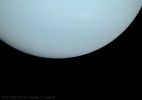
Z-Despina.jpgDespina transiting Neptune (Credits: NASA/JPL - Voyager 2 Mission; Credits for the additional process.: "zelario12" - https://creativecommons.org/licenses/by-sa/2.0/deed.en)132 visiteImmagine molto "datata", ma sempre molto bella ed ottimamente elaborata da tale "zelario12", al quale faccio i miei complimenti.MareKromium
|
|
| 96 immagini su 8 pagina(e) |
 |
|
|
|
|
7 |
|





