|
|

Neptune-bw-PIA02222.jpgNeptune and the "Great Dark Spot"101 visiteCaption NASA originale:"This photo was taken by Voyager 2's wide-angle camera. Light at methane wavelengths is mostly absorbed in the deeper atmosphere. The bright, white feature is a high-altitude cloud just south of the Great Dark Spot. Other, smaller clouds associated with the Great Dark Spot are white, and are also at high altitudes.
The Voyager Mission was conducted by JPL for NASA's Office of Space Science and Applications".
|
|

Neptune-clouds-PIA00047_modest.jpgThe clouds of Neptune (b/w) - 162 visiteCaption NASA originale:"The bright cirrus-like clouds of Neptune change rapidly, often forming and dissipating over periods of several to tens of hours. In this sequence Voyager 2 observed cloud evolution in the region around the Great Dark Spot (GDS). The surprisingly rapid changes which occur separating each panel shows that in this region Neptune's weather is perhaps as dynamic and variable as that of the Earth. However, the scale is immense by our standards - the Earth and the GDS are of similar size... - and in Neptune's frigid atmosphere, where temperatures are as low as 55 degrees Kelvin (-360 F), the cirrus clouds are composed of frozen methane rather than Earth's crystals of water ice".
|
|

Neptune-clouds-PIA01982_modest.jpgThe clouds of Neptune (b/w) - 261 visiteAncora i "cirri" di Nettuno, ripresi dalla Sonda Voyager 2, mentre si spostano rapidamente nei pressi - e lungo i bordi, in particolare- della Grande Macchia Scura (o GDS, come dicono alla NASA).
E' curioso pensare che i mutamenti del clima, su Nettuno, possano in qualche modo essere simili ai mutamenti di clima che possiamo riscontrare nel cielo della nostra Terra.
Già, ma in fondo - a pensarci bene - le nuvole ed il vento devono essere fenomeni assolutamente universali.
Certo, le nuvole di Nettuno non sono costituite da cristalli d'acqua, bensì da cristalli di metano ghiacciato ed i venti di Nettuno superano i 2000 Km orari. Ma le nuvole restano nuvole ed il vento - per quanto forte possa essere - rimane vento. Forse queste considerazioni sono banali, ma noi siamo convinti che, di tanto in tanto, sia una cosa giusta quella di pensare a quanto diversi, eppure quanto simili, possano essere i fenomeni della Natura qui, sulla Terra, o su Marte, o su Nettuno od ovunque - probabilmente - nell'Universo.
|
|

Neptune-crescent-PIA02204_modest.jpgNeptune's bright crescent66 visiteCaption NASA originale:"Neptune's bright crescent taken in six filters (from bottom to top: UV, violet, blue, clear, green, orange) on August, 31, 1989. The images were shuttered in temporal order: violet, blue, UV, clear, green, orange. These images how the bright core of D2, the South Polar feature, and the symmetric structure immediately surrounding the South Pole. The relatively high contrast of the features in these images indicates that they extend above most of the scattering haze and absorbing methane gas in Neptune's atmosphere. [Image processing by D.A. Alexander]"
|
|

Neptune-newmoons-PIA01991.jpgNew moons of Neptune67 visiteThis image captured by the Voyager 2 was used to confirm the discovery of 3 new moons orbiting Neptune. The 46" exposure was taken by Voyager 2's narrow angle camera through a clear filter on July 30, 1989, when the spacecraft was about 37,3 MKM (or 23,6 MMs) from Neptune. The large globe of the planet itself is severely overexposed and appears pure white. The image has been computer processed to accentuate the new moons, which otherwise would appear little stronger than background noise. The satellite 1989 N1, at right in this frame, was discovered by Voyager 2 in early July 1989. The new satellites are 1989 N2, 1989 N3 and 1989 N4. Each of the moons appears as a small streak: an effect caused by movement of the spacecraft during the long exposure. The new moons occupy nearly circular and equatorial orbits ranging from about 27.300 to 48.300 Km (such as 17.000 to 30.000 miles) from Neptune's cloud tops, and are estimated to range in diameter from about 100 to 200 Km (such as 60 to 125 miles).
|
|
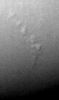
Neptune-shadows-PIA02220.jpg"Cloud shadows" on Neptune73 visiteCaption NASA originale:"This image of Neptune shows the discovery of shadows in Neptune's atmosphere, shadows cast onto a deep cloud band by small elevated clouds. They are the first cloud shadows ever seen by Voyager 2 on any planet. Estimates of the height of these discrete clouds above the underlying cloud bank can be obtained by careful analysis of this data".
|
|

Neptune_and_Despina-transit_combo_despinabrightened.jpgNeptune and Despina63 visiteDalla Rubrica "NASA - Picture of the Day", del giorno 3 Settembre 2009:"Despina is a tiny moon of Neptune. A mere 148 Km across, diminutive Despina was discovered in 1989, in images from the Voyager 2 Spacecraft taken during its encounter with the Solar System's most distant Gas Giant Planet. But looking through the Voyager 2 data 20 years later, amateur image processor (and philosophy professor) Ted Stryk discovered something no one had recognized before -- images that show the shadow of Despina in transit across Neptune's blue cloud tops.
His composite view of Despina and its shadow is composed of four archival frames taken on August 24, 1989, separated by 9 minutes. Despina itself has been artificially brightened to make it easier to see.
In ancient Greek mythology, Despina is a daughter of Poseidon (the Roman god Neptune)".MareKromium
|
|

Neptune_sEye-TheDarkSpot-V2-CJH.gifThe "Dark Spot" of Neptune69 visitenessun commento
|
|

NeptuneandTriton_vg2_big.jpgNeptune and Triton from Voyager 289 visiteNettuno possiede, così come Giove, Saturno ed Urano, un Sistema di lune estremamente complesso, dal quale spiccano Tritone (qui in foto accanto a Nettuno) e Nereide.
Si tratta, come testimoniano le immagini che possediamo, di corpi rocciosi sostanzialmente privi di atmosfera (anche se per Tritone quest'ultima asserzione sembra essere non veritiera) e pertanto soggetti - anche ai giorni nostri - ad un'elevata attività di bombardamento meteorico.
Le altre lune che fanno parte del Sistema di Nettuno (a parte Proteus, di cui possediamo qualche immagine) sono troppo piccole per essere esaminate nei particolari ma si presume che possa trattarsi di corpi (in origine) cometari o di altri corpi "erranti" sfuggiti, a seguito di impatti e/o di influenze mareali (o per altre cause a noi ignote), alla Fascia di Kuiper ed in seguito "catturati" dalla gravità del Pianeta.
|
|

Neq-Neptune-PIA00051.jpgNeptune in false colors64 visiteCaption NASA originale:"In this false color image of Neptune, objects that are deep in the atmosphere are blue, while those at higher altitudes are white. The image was taken by Voyager 2's wide-angle camera through an orange filter and two different methane filters. Light at methane wavelengths is mostly absorbed in the deeper atmosphere. The bright, white feature is a high altitude cloud just south of the Great Dark Spot. The hard, sharp inner boundary within the bright cloud is an artifact of computer processing on Earth. Other, smaller clouds associated with the Great Dark Spot are white or pink, and are also at high altitudes. Neptune's limb looks reddish because Voyager 2 is viewing it tangentially, and the sunlight is scattered back to space before it can be absorbed by the methane. A long, narrow band of high altitude clouds near the top of the image is located at 25° north latitude and faint hazes mark the equator and polar regions".
|
|

Neq-Neptune-PIA00057.jpgThe "haze" of Neptune (false colors)74 visiteCaption NASA originale:"This false color photograph of Neptune was made from Voyager 2 images taken through 3 filters: blue, green and a filter that passes light at a wavelength that is absorbed by methane gas. Thus, regions that appear white or bright red are those that reflect sunlight before it passes through a large quantity of methane. The image reveals the presence of a ubiquitous haze that covers Neptune in a semitransparent layer. Near the center of the disk, sunlight passes through the haze and deeper into the atmosphere, where some wavelengths are absorbed by methane gas, causing the center of the image to appear less red. Near the edge of the Planet, the haze scatters sunlight at higher altitude, above most of the methane, causing the bright red edge around the planet. By measuring haze brightness at several wavelengths, scientists are able to estimate the thickness of the haze and its ability to scatter sunlight. The image is among the last full disk photos that Voyager 2 took before beginning its endless journey into interstellar space".
|
|

Nereid-CJH.gifNereid61 visiteNereid was discovered in 1949 by astronomer Gerard Kuiper. Nereid is about 340 Km (210 miles) in diameter and is so far from Neptune that it requires 360 days to make one orbit. Voyager's best photos of Nereid were taken from about 4,7 MKM (about 2,9 MMs). The photos show that the moon's surface reflects about 14% of the sunlight that strikes it, making it somewhat more reflective than Earth's Moon and more than twice as reflective as Proteus. Nereid's orbit is the most eccentric in the Solar System. Its distance to Neptune ranges from about 1.353.600 Km (about 841.100 miles) to 9.623.700 Km (such as about 5.980.200 miles).
|
|
| 96 immagini su 8 pagina(e) |
 |
|
4 | |
|
|
|





