|
|

Miranda-PIA01354_modest.jpgMiranda (close-up of the Verona Rupes Region) - HR105 visiteCaption NASA originale:"Miranda, innermost of Uranus' large satellites, is seen at close range in this Voyager 2 image, taken Jan. 24, 1986, as part of a HR mosaicing sequence. Voyager was some 36.000 Km (22.000 miles) away from Miranda. This clear-filter, narrow-angle image shows an area about 250 Km (150 mi) across, at a resolution of about 800 meters (2.600 feet). Two distinct terrain types are visible: a rugged, higher-elevation terrain (right) and a lower, striated terrain. Numerous craters on the rugged, higher terrain indicate that it is older than the lower terrain. Several scarps, probably faults, cut the different terrains.
The impact crater in the lower part of this image is about 25 Km (15 mi) across".
|
|

Miranda-PIA02217.jpgMiranda87 visiteCaption NASA originale:"Mosaic of HR images of Miranda. One wide-angle and eight narrow-angle camera images of Miranda were combined in this view. The controlled mosaic was transformed to an orthographic view centered on the South Pole. The trapezoidal region (about 200 Km on a side) occurs near the South Pole and is located near the center of the mosaic. The trapezoid's outer boundary and its internal patterns of ridges and band of contrasting albedo display numerous sharp corners".
|
|

Miranda-PIA02218.jpgNot only Verona Rupes: more deep scarps on Miranda (HR)85 visiteCaption NASA originale:"View of Miranda showing light and dark banded scarps near the boundary of the banded ovoid and a deep graben that bounds the ovoid in this region".
|
|

Miranda-V2-PIA00141_modest.jpgMiranda's limb from Voyager 2 - January 24, 1986113 visiteEd ecco ora Miranda, la Luna più interna di Urano. Essa ha una forma decisamente irregolare ed evidenzia molto chiaramente - come in questo frame - delle profonde "cicatrici" superficiali le quali rivelano, come dicono alla NASA, una "complessa storia geologica". EccoVi parte della caption originale NASA per questa foto:"...At least 3 terrain types of different age and geologic style are evident at this resolution of about 700 (2.300 feet) meters. Visible in this clear-filter, narrow-angle image are, from left: (1) an apparently ancient, cratered terrain consisting of rolling, subdued hills and degraded medium-sized craters (2) a grooved terrain with linear valleys and ridges developed at the expense of, or replacing, the first terrain type and (3) a complex terrain seen along the terminator, in which intersecting curvilinear ridges and troughs are abruptly truncated by the linear, grooved terrain. Voyager scientists believe this third terrain type is intermediate in age between the first two".
|
|

Miranda-V2-PIA01980_modest.jpgMiranda: a funny shaped Moon99 visiteIn questa seconda immagine di Miranda risulta ben visibile una vastissima depressione situata in prossimità del suo Polo Nord la quale potrebbe aver avuto origine a seguito di un impatto con un altro corpo celeste di notevoli dimensioni.
Una luna che ha "sofferto", dunque, e la cui storia risale - molto probabilmente - alle stesse origini del nostro Sistema Solare, quando gli impatti - specie nella sua "periferia" - avvenivano con una frequenza di gran lunga maggiore rispetto a quanto accade ai giorni nostri.
|
|

Miranda-Verona_Rupes.jpgVerona Rupes163 visiteCaption NASA:"Could you survive a jump off the tallest cliff in the Solar System?
Quite possibly. Verona Rupes on Uranus' moon Miranda is estimated to be 20 kilometers deep - ten times the depth of the Earth's Grand Canyon. Given Miranda's low gravity, it would take about 12 minutes for a thrill-seeking adventurer to fall from the top, reaching the bottom at the speed of a racecar -- about 200 Km-per- hour.
Even so, the fall might be survivable given proper airbag protection. The featured image of Verona Rupes was captured by the passing Voyager 2 Robotic Spacecraft in 1986.
How the giant cliff was created remains unknown, but is possibly related to a large impact or tectonic surface motion". MareKromium
|
|

Miranda-vg2_2684617-A.jpgThe beautiful "Verona Rupes" from a different angle (context image)100 visitenessun commento
|
|

Miranda-vg2_2684617-B.jpgThe beautiful "Verona Rupes" from a different angle (detail mgnf)116 visiteUn detail mgnf dedicato ad un frame raro e stupendo che ci rammenta (ancora una volta) una delle Meraviglie del Sistema Solare: le Verona Rupes.
|
|

Miranda-vg2_2684626.jpgThe "limb" of Miranda79 visitenessun commento
|
|

Miranda-vg2_p29524.jpgThe tormented surface of Miranda (false colors - elab. NASA)76 visitenessun commento
|
|

Miranda.jpgExtremely anomalous surface features on Miranda (HR)78 visitenessun commento
|
|
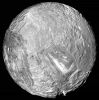
Miranda.jpgMiranda (full disk)135 visiteLe "Verona Rupes" sono in basso, leggermente alla Dx dell'Osservatore.MareKromium
|
|
| 109 immagini su 10 pagina(e) |
 |
3 | |
|
|
|
|
|
|





