|
|
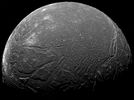
Ariel.jpgAriel (HR)87 visiteLa tormentata superficie di Ariel si rivela in tutto il suo (comunque grande) fascino.
Una serie di impressionanti fratture tettoniche (forse un raffreddamento troppo rapido?) caratterizza l'Est e l'Ovest di questo mondo lontano; svariati mega-canyons, lunghi e profondi, passano attraverso l'equatore di Ariel, frammentandosi e ramificandosi poi in centinaia di crepacci minori; distese simili ai "mari" della Luna contraddistinguono una buona parte della sua superficie la quale, inoltre, sembra avere delle aree (alla Vostra Sx - Eastern limb) la cui albedo (alta) appare molto diversa rispetto al resto del Pianeta.
Da notare che, a differenza di quanto accade per le altre lune di Urano (come per la maggior parte delle lune dei quattro Giganti Gassosi), non riusciamo a distinguere che un modesto numero di crateri da impatto e questa circostanza è sicuramente strana: che Ariel sia passata, magari, attraverso una parziale e "recente" (in senso geologico) ridefinizione della sua superficie?
|
|

MIRANDA.jpgMiranda from Voyager 2137 visiteIn questo nuovo frame potete apprezzare il fatto che Miranda ha più la forma di un uovo che quella di una sfera. Le fotografie che possediamo di questo corpo celeste ci fanno vedere un mondo profondamente segnato da impatti: impatti che hanno provocato profondissime "cicatrici" le quali, come si diceva in sede di commento all'immagine precedente, sono ancora ben visibili.
La enorme depressione a cui avevamo già accennato è ora visibile con maggiore chiarezza, sulla Vostra Sn. A giudicare dalle sue fattezze possiamo supporre che si sia (forse) trattato di un "urto radente", ossìa il corpo celeste che ha impattato Miranda avrebbe dovuto avere, al momento del contatto, un angolo di incidenza, rispetto al piano dell'orizzonte di Miranda stessa, molto basso (inferiore ai 35°?). Ed è forse per questo motivo che, nonostante la catastrofica collisione, Miranda è, si, rimasta profondamente segnata, ma NON si è completamente disintegrata...
|
|

Miranda-A86-7026_a.jpgMiranda (possible natural colors; credits: Lunexit)81 visitenessun commentoMareKromium
|
|

Miranda-B.JPGThe "Chevron Grooves" of Miranda (perspective view)79 visitenessun commentoMareKromium
|
|

Miranda-PIA00038_modest.jpg"Chevron grooves" on Miranda - HR113 visiteCaption NASA originale:"This image of Miranda, obtained by Voyager 2 on approach, shows an unusual 'chevron' figure and regions of distinctly differing terrain on the Uranian moon. Voyager was 42.000 Km (26.000 miles) away when its narrow-angle camera acquired this clear-filter view. Grooved areas baring light and dark bands, distinct from other areas of mottled terrain, are visible at this resolution of about 600 meters (2.000 feet). The bright V-shaped feature in the grooved areas is the 'chevron' observed in earlier, lower-resolution images. Cutting across the bands are sinuous scarps, probably faults. Superimposed on both types of terrain are many bowl-shaped impact craters less than 5 Km (3 mi) wide. The entire picture spans an area about 220 Km (140 mi) across".
|
|

Miranda-PIA00042-PCF-LXTT-IPF.jpgMiranda's Southern Hemisphere (Possible Absolute Natural Colors; credits for the additional process. and color.: Dr Paolo C. Fienga/Lunar Explorer Italia/Italian Planetary Foundation)112 visiteThis image-mosaic of the Uranian moon Miranda was taken by the NASA - Voyager 2 Spacecraft on January 24, 1986, from a distance of approx. 147.000 Km (such as about 91.287 miles). This image-mosaic was constructed from images taken through the Spacecraft's Narrow-Angle Camera's Green, Violet and UltraViolet Filters.
Miranda, just about 480 Km (such as approx. 299 miles) across, is the smallest of Uranus' five Major natural satellites. Miranda's Regional Geologic Provinces are shown very well in this view of its Southern Hemisphere, imaged at a resolution of roughly 2,7 Km (such as 1,67 miles) per pixel. The dark- and bright-Banded Region with its curvilinear traces, covers about half of the frame. Higher-resolution pictures taken some time later showed many Fault Valleys and Ridges, all parallel to these "Bands". Near the Terminator Line (on the right - Dx), another system of Ridges and Valleys abuts the Banded Terrain; furthermore, many Impact Craters pockmark the Surface of Miranda all over this Region. The largest of these Craters are about 30 Km (approx. 18,63 miles) in diameter and many more of them lie in the range of 5 to 10 Km (such as from 3,1 to 6,2 miles) in diameter.
This frame (which is an Original NASA - Voyager 2 Spacecraft Natural Color image-mosaic published on the NASA - Planetary Photojournal with the ID n. PIA 00042) has been additionally processed, contrast enhanced, magnified to aid visibility of the Surface details and then re-colorized, according to an educated guess carried out by Dr Paolo C. Fienga/LXTT/IPF, in what they should be its Absolute Natural Colors (such as the colors that a human eye would actually perceive if someone were onboard the NASA - Voyager 2 Spacecraft and then looked outside, towards the Uranian moon Miranda), by using an original technique created - and, in time, dramatically improved - by the Lunar Explorer Italia Team. Different colors, as well as different shades of the same color, mean, among others, the existence of different Elements present on the Surface of Miranda, each having a different Albedo (---> Reflectivity) and Chemical Composition.
Note: it is possible (but we, as IPF, have no way to be one-hundred-percent sure of such a circumstance), that the actual luminosity of Miranda - as it is in this frame - would appear, to an average human eye, a little bit lower than it has been shown (or, better yet: interpreted) here.MareKromium
|
|

Miranda-PIA00042-PCF-LXTT.jpgMiranda (Absolute Natural Colors; credits for the additional process. and color.: Dr Paolo C. Fienga - Lunexit Team)234 visitenessun commentoMareKromium
|
|

Miranda-PIA00042_modest.jpgMiranda in natural colors (elab. NASA)108 visiteCaption NASA originale:"This color composite of the Uranian satellite Miranda was taken by Voyager 2 on Jan. 24, 1986, from a distance of 147.000 Km (91.000 miles). This picture was constructed from images taken through the narrow-angle camera's green, violet and ultraviolet filters. It is the best color view of Miranda returned by Voyager. Miranda, just 480 Km (300 mi) across, is the smallest of Uranus' 5 major satellites. Miranda's regional geologic provinces show very well in this view of the Southern Hemisphere, imaged at a resolution of 2,7 km (1,7 mi). The dark and bright-banded region with its curvilinear traces covers about half of the image. HR pictures taken later show many fault valleys and ridges parallel to these bands. Near the terminator (at right), another system of ridges and valleys abuts the banded terrain; many impact craters pockmark the surface in this region. The largest of these are about 30 Km in diameter; many more lie in the range of 5 to 10 Km in diameter".
|
|

Miranda-PIA00044-Verona_Rupes-PCF-LXTT.jpgVerona Rupes (Super Close-Up - Absolute Natural Colors; credits for the additional process. and color.: Dr Paolo C. Fienga - Lunexit Team)224 visitenessun commentoMareKromium
|
|

Miranda-PIA00044_modest.jpgMiranda (super close-up of "Verona Rupes") - HR122 visiteCaption NASA originale:"This HR image of Miranda was acquired by Voyager 2 on Jan. 24, 1986, when the spacecraft was 36.250 Km (22.500 miles) from the Uranian moon. In this clear-filter, narrow-angle image, Miranda displays a dramatically varied surface. Well shown at this resolution of 660 meters (2.160 feet) are numerous ridges and valleys - a topography that was probably produced by compressional tectonics. Cutting across the ridges and valleys are many faults. The largest fault scarp, or cliff, is seen below and right of center; it shows grooves probably made by the contact of the fault blocks as they rubbed against each other (leaving what are known as slickensides). Movement of the down-dropped block is shown by the offset of the ridges. The fault may be 5 Km (3 mi) high, or higher than the walls of the Grand Canyon on Earth. NASA's Voyager 2 probe encountered the planet Uranus and its collection of moons in 1986. The small moon Miranda, with a diameter of 472 km, has a surface made up of a jumble of bizarre geological features. One of the most prominent of these features is an enormous cliff with a vertical relief of about 20 km (12 miles). This cliff, named Verona Rupes, is 10 times higher than the walls of the Grand Canyon on Earth. That this towering cliff is so huge is made even more remarkable by the small size of Miranda itself. The white material exposed in the cliff face is probably mostly water ice".
|
|

Miranda-PIA00140.jpgMiranda, from approx. 31.000 Km108 visiteCaption NASA originale:"This Voyager 2 image of Miranda was taken Jan 24, 1986, from a distance of about 31.000 Km (19.000 miles), shortly before the spacecraft's closest approach to the Uranian moon. The HR of 600 meters (2.000 feet) reveals a bewildering variety of fractures, grooves and craters, as well as features of different albedos (reflectancea). This clear-filter, narrow-angle view encompasses areas of older, heavily cratered terrain with a wide variety of forms. The grooves and troughs reach depths of a few Km (or miles) and expose materials of different albedos. The great variety of directions of fractures and troughs, and the different densities of impact craters on them, signify a long, complex geologic evolution of this satellite".
|
|

Miranda-PIA01354-PCF-LXTT.jpgVerona Rupes (Absolute Natural Colors; credits for the additional process. and color.: Dr Paolo C. Fienga - Lunexit Team)241 visitenessun commentoMareKromium
|
|
| 109 immagini su 10 pagina(e) |
2 |  |
|
|
|
|
|
|
|





