| |

Jupiter: the "King" and His Moons
|
|
|

Io-Tohill-Scarp-01.jpgThe mysterious Tohill Mons and Patera (2) - natural colors65 visitenessun commento
|
|

Io-TohillMons-PIA03600_1.jpgTohill Mons (MULTISPECTRUM-2; credits: Lunexit)75 visiteCaption NASA:"Dramatic shadows across a mountainous landscape on Jupiter's moon Io reveal details of the topography around a peak named Tohil Mons in this mosaic created from images taken by NASA's Galileo Spacecraft in October 2001.
Tohil Mons rises 5,4 Km (18.000 feet) above Io's Surface, according to analysis of stereo imaging from earlier Galileo flybys of Io. The new images, with a resolution of 327 mt (1070 feet) per picture element, were taken when the Sun was low in the sky, producing informative shadows. North is to the top and the Sun illuminates the Surface from the upper right. The topographic features revealed include a very straight ridge extending South-West from the peak, 500- to 850-meter-high (1640- to 2790-foot-high) cliffs to the North-West and a curious pit immediately East of the peak.
Major questions remain about how Io's mountains form and how they are related to Io's ubiquitous volcanoes. Although Io is extremely active volcanically, few of its mountains appear to be volcanoes. However, two volcanic craters do lie directly to the North-East of Tohil's peak, a smaller dark-floored one and a larger one at the very edge of the mosaic. Furthermore, the shape of the pit directly East of the peak suggests a volcanic origin.
Galileo scientists will use these images to investigate the geologic history of Tohil Mons and its relationship to the neighboring volcanic features.
The image is centered at 28° South Latitude and 161° West Longitude".
MareKromium
|
|

Io-Tupan Patera-fullcolor-PIA02599_modest.jpgIo: Tupan Patera82 visiteWonderful colors in a volcanic crater named Tupan Patera on Jupiter's moon Io, as seen in this image from NASA's Galileo spacecraft, show varied results of lava interacting with sulfur-rich materials.
The colorfulness of the image is only slightly enhanced from what the human eye would see on the scene. The red in the image includes a small amount of infrared energy. Tupan Patera, named after a Brazilian thunder god, was seen as an active hot spot in earlier Galileo observations, but those low-resolution views did not show details of volcanic activity. This image taken in October 2001 at a resolution of 135 meters (443 feet) per picture element reveals the complex nature of the crater.
Tupan is now clearly shown to be a volcanic depression, about 75 kilometers (47 miles) across, surrounded by cliffs about 900 meters (3000 feet) tall. In the center is a large area that must be higher than the rest of the crater floor because it has not been covered by the dark lavas. Much of the area is coated with a diffuse red deposit that Galileo scientists believe has condensed from sulfur gas escaping from volcanic vents. The floor of Tupan is covered with a surreal pattern of dark black, green, red, and yellow materials. The black material is recent, still-warm lava. The yellow is presumed to be a mix of sulfurous compounds, and the green appears to form where red sulfur has interacted with the dark lavas. While Galileo scientists have found previous evidence for both molten sulfur and molten rock on Io, this image shows the best evidence to date of chemical reactions taking place between the two.
The intermingled patches of sulfur and lava are difficult to explain. The yellowish sulfur may be melting from within the crater walls over solidified but warm lava. The sulfur may boil away from the areas too hot for liquid sulfur to sit on, leaving patches where the dark lava is still visible.
North is to the top of the image and the Sun illuminates the surface from the upper right.
|
|

Io-Volcanic Plumes and Flares-PIA00703.jpgVolcanic activity on Io ("Plumes" and "Flares")66 visitenessun commento
|
|
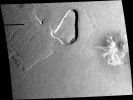
Io-Volcanic_Depression-PIA03532_modest1.jpgVolcanic Depression near the Equator (Original NASA/Galileo b/w Frame)69 visiteThis image taken by NASA's Galileo spacecraft on Oct. 16, 2001, near the equator of Jupiter's moon Io shows the contrast in volcanism styles found on Io.
The central feature is a large patera, or volcanic depression, almost 100 kilometers (60 miles) long. It may have formed after eruptions of lava emptied a subsurface magma chamber and left an empty space into which the crust collapsed. Evidence of lava flows associated with this patera, however, is difficult to find. Either the flows have been buried, or perhaps they never erupted and simply drained back deep into the crust.
On the right of the image is a small shield volcano, similar to volcanoes in Hawaii. It is rare for lavas on Io to be thick enough to pile up into shields around vents. They usually run out in thin, long flows instead. This shield abuts some very pale lava flows that emerged from a small vent to the west. These flows could be made of sulfur, like flows at Io's Emakong Patera. The vent is also surrounded by dark, diffuse material, which may be the result of lava erupted in an explosive, gas-rich eruption, similar to the 1980 eruption of Mount Saint Helens in Washington.
North is to the top of the image and the illumination is from the right. The image has a resolution of 330 meters (1,080 feet) per picture element and is 340 (211 miles) kilometers across.
|
|
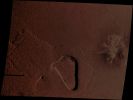
Io-Volcanic_Depression-PIA03532_modest2.jpgVolcanic Depression near the Equator (Absolute Natural Colors; credits for the additional process. and color.: Dr Paolo C. Fienga - Lunexit Team)142 visitenessun commentoMareKromium
|
|
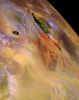
Io-Zal Patera-PIA02527.jpgZal Patera (False Colors; credits: NASA/JPL)66 visitenessun commento
|
|
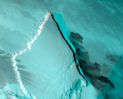
Io-Zal Patera-PIA02553.jpgThe "Zal" Patera93 visiteThis stereo image of Jupiter's moon Io shows the topography of a region on Io that includes the Zal Patera feature and a mountain or plateau that borders it to the west. It was created by combining two different views taken by NASA's Galileo spacecraft on November 25, 1999 (shown in red) and February 22, 2000 (shown in blue).
A mountain 120 kilometers (75 miles) wide rises to the west of the patera, a dark volcanic depression. By measuring the shadow, scientists were able to determine that the eastern margin of this mountain is about 1.5 kilometers (5000 feet) high. To the west and northwest, the mountain's margins are scalloped, which may indicate that a process called sapping is eroding them. Sapping occurs when fluid escapes from the base of a cliff, causing the material above it to collapse. Along the northwestern margin, the rough material at the base of the cliff maybe debris left over from the sapping process. Dark lava flows can be seen coming from a fissure to the east of the mountain.
Galileo scientists are in the process of generating topographic maps from these images. Such maps will reveal the heights and slopes of different landforms in this region, which will help scientists determine the strength and other properties of Io's surface materials. They will also be useful in understanding the processes of uplift and erosion on Io.
The picture is centered at 42.3 degrees north latitude and 76.9 degrees west longitude. North is to the top of the picture. The observations used to make the stereo image were made at ranges of 26,000 and 33,500 kilometers (16,200 and 20,900 miles) from Io. The resolution of the stereo image is about 335 meters (370 yards) per picture element.
|
|

Io-Zal Region-PIA02554.jpgZal Region on Io66 visiteThis image shows one of many intriguing mountains on Jupiter's moon Io. The image was made by combining a recent high-resolution, black and white image with earlier low-resolution color data to provide a high-resolution, color view. NASA's Galileo spacecraft took both images.
The 240-kilometer (150-mile) long mountain in the image is south of the volcanic hot spot named Zal. The black and white version of this image was useful for showing the shape of the mountain and the small fans of debris piled against the base of its tall, steep cliffs. However, when colorized the relationship between different types of materials becomes apparent. For example, the bright, red material is believed to contain a compound of sulfur that forms when sulfur is boiled at a high temperature. Active eruptions of molten rock (lava) are the most likely source for the heat. Thus we see red sulfur where lava reaches the surface. Other sulfur compounds cover the yellow areas, and the black areas are fresh silicate lava that has not yet been coated by the yellow sulfurous materials. The green patches are still somewhat mysterious; they appear to form when red sulfur lands on warm lava and the two react in a manner that is still unknown.
In this image, it is clear that the red material has blown out of a long crack along the western side of the mountain. Lava has flowed from this crack and filled a depression (caldera). Some of the red sulfur close to the dark caldera appears to have been converted into green material. The fact that lava comes up along the faults that define the sides of the mountains provides important clues to how the mountains form and the state of the interior of Io. Scientists at the University of Arizona speculate that the formation of the mountains on Io may be related to plumes of hot material rising inside the fiery body of Io.
North is to the top and the setting sun is shining from the west. The image is centered at about 33 degrees north, 72 degrees west. The high-resolution image was taken on February 22, 2000 by NASA's Galileo spacecraft. The image was taken by the Galileo's onboard camera from a range of 33,500 kilometers (20,800 miles) and has a resolution of 335 meters (1,100 feet) per picture element. The color images were taken on July 3, 1999. They have resolutions of 1.3 kilometers (0.81 miles) per picture element and are illuminated from almost directly behind the spacecraft. They were taken at a distance of about 130,000 kilometers(81,000 miles) from Io.
|
|
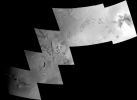
Io-Zamama Plume-PIA03531_modest.jpgThe "Zamama" flow field64 visiteThe source area of what had been a towering volcanic plume two months earlier lies in the far-right frame of this mosaic of images taken of Jupiter's moon Io by NASA's Galileo spacecraft on Oct. 16, 2001.
The region in the images includes the Zamama lava flow in Jupiter's northern hemisphere. The Zamama flow field emanates from the northernmost of two small volcanoes in the far left frame. These lava flows were not present in Voyager images of Io, so they formed some time between the Voyager 1 flyby in 1979 and the first Galileo observations of Io in 1996. Galileo also observed Zamama during Io encounters in 1999, and scientists identified narrow, long, dark lava flows thought to be similar to lava flows in Hawaii.
Moving northeast, the second and third frames of this mosaic contain lava flow fields and several unnamed volcanic depressions, called "paterae." It is unclear whether the broad, shield-like features or plateaus on which the paterae rest were created by eruptions from the paterae, or if they were preexisting features. Some fractures and dark lines suggest that the crust here is breaking up, creating cracks that magma can use to rise to the surface.
The far-right frame of this mosaic shows dark lava flows and bright spots. The bright spots are probably sulfur-bearing plume deposits, which are thought to be associated with the source of a plume eruption 500 kilometers (310 miles) high that was observed by the Galileo spacecraft in August, 2001. It was the largest plume eruption ever observed on Io.
|
|
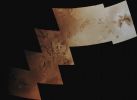
Io-Zamama_Patera-PIA03531-PCF-LXTT-IPF.jpgZamama (Absolute Natural Colors; credits for the additional process. and color.: Dr Paolo C. Fienga/Lunar Explorer Italia/Italian Planetary Foundation)113 visiteThe source area of what had been a towering Volcanic Plume in the middle of August of the AD 2001, lies in the far-right frame of this Image-Mosaic (of pictures taken by the NASA - Galileo Spacecraft on October, 16th, 2001) which shows us a portion of the Northern Latitudes of the Jovian "Volcanic" moon, Io. The Region showed in this Image-Mosaic includes the Zamama Lava Flow-Field, which emanates from the Northernmost of 2 (two) small Volcanoes visible in the far left frame. These Lava Flows were not present in any of the NASA - Voyager 1 Probe's images of Io, so it is logic to assume that they must have formed sometime between the NASA - Voyager 1 Fly-By (that occurred in the AD 1979) and the early observations of Io made by the NASA - Galileo Spacecraft and which took place in the AD 1996 (in addition to that, it has to be said that the NASA - Galileo Spacecraft also observed the Zamama Lava Flow-Field during the Io encounters that occurred in the AD 1999: a time when some NASA scientists identified narrow, long, dark Lava Flows which they thought to be relatively similar to other Lava Flows found on Planet Earth and, to be precise, in the Hawaii Islands).
Moving North/East, the second and third frames of this mosaic show a number of Lava Flow-Fields and several Unnamed Volcanic Depressions, known as "Paterae". It is still unclear whether the broad, shield-like features (or "Plateaux") on which the Paterae rest were created by Eruptions from the Paterae themselves, or if they were just preexisting Volcanic Features. Furthermore, some Fractures and Dark Lines suggest that the Crust of Io, in a few places of this Region, is breaking up, thus creating Cracks that Magma can use to rise up to the Surface. Finally, the far-right frame of this mosaic shows dark Lava Flows and bright "Spots". The bright "Spots" are probably Sulphur-bearing Plume Deposits, which are thought to be associated with the source of a Plume Eruption approx. 500 Km (such as about 310 miles) high, that was observed by the Galileo Spacecraft in August, 2001 (a Plume Eruption that actually was the largest one ever observed on Io).
This Image-Mosaic (which is an NASA - Original Galileo Spacecraft b/w Image-Mosaic published on May, 28th, 2002, on the NASA - Planetary Photojournal and identified by the serial n. PIA 03531) has been additionally processed and then colorized in Absolute Natural Colors (such as the colors that a human eye would actually perceive if someone were onboard the NASA - Galileo Spacecraft and then looked ahead, towards the Jovian moon Io), by using an original technique created - and, in time, dramatically improved - by the Lunar Explorer Italia Team.MareKromium
|
|
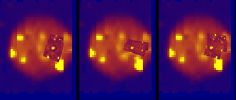
Io-active volcanoes-PIA02558_modest.jpgActive volcanoes on Io in 3 different months70 visiteCaption NASA originale:Changes in the volcanoes on Io can be seen in these 3 views, taken by NASA's Galileo spacecraft during its 3 flybys of Io in October and November 1999 and February 2000. All the images show the active volcanoes as bright yellow, corresponding to hot lava flows that appear glowing in infrared wavelengths. The 3 views were taken by the spacecraft's near-infrared mapping spectrometer and show the comparison of a typical low-resolution observation to the high-resolution views. The Prometheus volcano is seen near the middle of all three images. Before the recent flybys, only Prometheus and three other volcanoes were known to be active in this region. After these and other high-resolution observations, scientists were able to detect 14 volcanoes in the same area. The fainter volcanoes (hot spots) show some significant changes over intervals of 1 to 3 months. The area shown by all three observations put together is about 2 million square kilometers (about 770,000 square miles)".
|
|
| 328 immagini su 28 pagina(e) |
|
|
|
|
|
16 | |
|
|
|
|
|
|








