| |

Jupiter: the "King" and His Moons
|
|
|

Io-PIA03530-Loki-PCF-LXTT.jpgThe Loki Region of Io (Enhanced and Darkened Natural Colors; credits for the additional process. and color.: Dr Paolo C. Fienga - Lunar Explorer Italia)224 visitenessun commentoMareKromium
|
|

Io-PIA10249.jpgTvashtar Eruption from New Horizons132 visiteCaption NASA:"This New Horizons image of Jupiter's volcanic moon Io was taken at 13:05 Universal Time during the Spacecraft's Jupiter flyby on February 28, 2007. It shows the reddish color of the deposits from the giant volcanic eruption at the volcano Tvashtar, near the top of the sunlit crescent, as well as the bluish plume itself and the orange glow of the hot lava at its source. The relatively unprocessed image on the left provides the best view of the volcanic glow and the plume deposits, while the version on the right has been brightened to show the much fainter plume, and the Jupiter-lit night side of Io.
New Horizons' color imaging of Io's sunlit side was generally overexposed because the Spacecraft's color camera, the super-sensitive Multispectral Visible Imaging Camera (MVIC), was designed for the much dimmer illumination at Pluto. However, two of MVIC's four color filters, the blue and "Methane" filter (a special filter designed to map Methane frost on the Surface of Pluto at an infrared wavelength of 0.89 microns), are less sensitive than the others, and thus obtained some well-exposed views of the surface when illumination conditions were favorable. Because only two color filters are used, rather than the usual three, and because one filter uses infrared light, the color is only a rough approximation to what the human eye would see.
The red color of the Tvashtar plume fallout is typical of Io's largest volcanic plumes, including the previous eruption of Tvashtar seen by the Galileo and Cassini Spacecrafts in 2000, and the long-lived Pele plume on the opposite side of Io. The color likely results from the creation of reddish three-atom and four-atom Sulfur molecules (S3 and S4) from plume gases rich in two-atom Sulfur molecules (S2 After a few months or years, the S3 and S4 molecules recombine into the more stable and familiar yellowish form of Sulfur consisting of eight-atom molecules (S8), so these red deposits are only seen around recently-active Io volcanos.
Though the plume deposits are red, the plume itself is blue, because it is composed of very tiny particles that preferentially scatter blue light, like smoke. Also faintly visible in the left image is the pale-colored Prometheus plume, almost on the edge of the disk on the Equator at the 9 o'clock position.
Io was 2,4 MKM from the Spacecraft when the picture was taken, and the center of Io's disk is at 77° West Longitude, 5° South Latitude. The Solar Phase Angle (such as the angle formed by the Sun, Io and New Horizons) was 107°".MareKromium
|
|
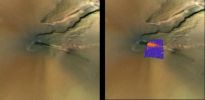
Io-Pele Volcano-PIA02560_modest.jpgThe "Pele" Volcano88 visitePele, one of Io's best-known volcanoes, was observed by the infrared spectrometer, an instrument onboard NASA's Galileo spacecraft, during the flyby of Jupiter's moon Io on February 22, 2000. The temperature map is shown here on the left in false color, superimposed on a visible color image of the Pele region obtained by the Voyager spacecraft in 1979. The red color represents the hottest lava flows. The purple colors are cooler materials. Preliminary results show that the temperatures of the hottest lava flows are at least 1,400 Kelvin (about 2,000 Fahrenheit), consistent with the temperatures of basaltic lava seen on the Kilauea volcano in Hawaii. It is possible that the eruption temperatures at Pele are even higher, as lava cools quickly once it starts to spread over the surface. The Voyager context image is 200 kilometers (124 miles) across.
|
|

Io-Pele plume-PIA02546_modest.jpgThe "sulphuric plume" of Pele73 visiteThis image depicts the discovery of sulfur gas in the plume of the Pele volcano on Jupiter's moon Io, as seen by the Hubble Space Telescope in October 1999, during a flyby of Io by NASA's Galileo spacecraft. The main image shows Io passing in front of Jupiter as seen by Hubble's Wide-Field Planetary Camera (WFPC2) in near-ultraviolet light. The small inset shows that when a WFPC2 image at shorter ultraviolet wavelengths is included in a color composite with the near-ultraviolet image, Io's Pele plume appears as a dark smudge off the edge of Io's disk, silhouetted against Jupiter. The larger inset shows data from Hubble's Space Telescope Imaging Spectrograph, which mapped the composition of Pele's plume by analyzing the ultraviolet light from Jupiter which had passed through the plume. The regions shown in yellow were rich in sulfur gas, which was precisely centered over the Pele volcano, whose position is shown along with the edge of Io's disk.
|
|
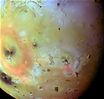
Io-Pele-PIA01112.jpgPele's deposits on Io69 visiteThe varied effects of Ionian volcanism can be seen in this false color infrared composite image of Io's Trailing Hemisphere. LR color data from Galileo's first orbit (June, 1996) have been combined with a HR clear filter picture taken on the third orbit (November, 1996) of the spacecraft around Jupiter. A diffuse ring of bright red material encircles Pele, the site of an ongoing, high velocity volcanic eruption. Pele's plume is nearly invisible, except in back-lit photographs, but its deposits indicate energetic ejection of sulfurous materials out to distances more than 600 Km from the central vent. Another bright red deposit lies adjacent to Marduk, also a currently active ediface. High temperature hot spots have been detected at both these locations, due to the eruption of molten material in lava flows or lava lakes. Bright red deposits on Io darken and disappear within years or decades of deposition, so the presence of bright red materials marks the sites of recent volcanism.
|
|
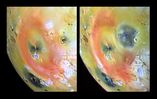
Io-PillanPatera-PIA00744.jpgPillan Patera65 visiteThese images of Jupiter's volcanic moon, Io, show the results of a dramatic event that occurred on the fiery satellite during a five-month period. The changes, captured by the solid state imaging (CCD) system on NASA's Galileo spacecraft, occurred between the time Galileo acquired the left frame, during its seventh orbit of Jupiter, and the right frame, during its tenth orbit. A new dark spot, 400 kilometers (249 miles) in diameter, which is roughly the size of Arizona, surrounds a volcanic center named Pillan Patera. Galileo imaged a 120 kilometer (75 mile) high plume erupting from this location during its ninth orbit. Pele, which produced the larger plume deposit southwest of Pillan, also appears different than it did during the seventh orbit, perhaps due to interaction between the two large plumes. Pillan's plume deposits appear dark at all wavelengths. This color differs from the very red color associated with Pele, but is similar to the deposits of Babbar Patera, the dark feature southwest of Pele. Some apparent differences between the images are not caused by changes on Io's surface, but rather are due to differences in illumination, emission and phase angles. This is particularly apparent at Babbar Patera.
North is to the top of the images. The left frame was acquired on April 4th, 1997, while the right frame was taken on Sept. 19th, 1997. The images were obtained at ranges of 563,000 kilometers (350,000 miles) for the left image, and 505,600 kilometers (314,165 miles) for the right.
|
|
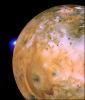
Io-Plumes from Loki-V1-PIA00010_modest.jpgLoki's eruption on Io (the "Plume")77 visiteUn'informazione importante per chi volesse provare a calcolare le dimensioni effettive della "piuma vulcanica" (conoscendo, ovviamente, le dimensioni di Io): l'immagine è stata scattata da (circa) 490.000 Km.
Original caption:"Voyager 1 image of Io showing active plume of Loki on limb. Heart-shaped feature southeast of Loki consists of fallout deposits from active plume Pele. The images that make up this mosaic were taken from an average distance of approximately 490.000 Km (about 340.000 miles)".
|
|

Io-Plumes-PIA01081.jpgMore "Plumes" on Io65 visitenessun commento
|
|

Io-Sodium cloud-2-PIA01109.jpgA sodium cloud from Io (1)93 visiteUna "Nube di Sodio da Io", intitola questa serie di 4 immagini. Ma di che cosa si tratta realmente?
Ebbene, in questo specifico frangente si tratta della ripresa di una "ondata" (letteralmente) di vapori di sodio provenienti da Io a seguito di una delle (tante) eruzioni che lo caratterizzano. Nulla di speciale, insomma.
Ma c'è una curiosità, a proposito dei "vapori di Sodio", che ci farebbe piacere raccontare: solo pochi Appassionati e Cultori della Materia, infatti, conoscono e sanno che cosa significa, in termini di navigazione interplanetaria, "rilasciare una nube di Sodio". Ebbene si tratta di un esperimento relativo alla verifica empirica circa la correttezza della traiettoria assunta da una qualsiasi Sonda interplanetaria durante il suo percorso (un check, insomma, che i campi gravitazionali degli astri accanto ai quali essa deve passare, passa o è passata, non abbiano, in qualche modo, determinato delle "deviazioni" impreviste).
|
|

Io-Sodium cloud-3-PIA00593.jpgA sodium cloud from Io (2)71 visiteE' una tecnica davvero molto antica, a quanto ne sappiamo, risalente addirittura ai tempi delle Sonde Sovietiche "Lunik" (nei loro viaggi del 2 gennaio 1959 e del 12 dicembre dello stesso anno). Queste due Sonde, infatti, furono programmate per emettere, dopo aver percorso all'incirca 100.000 Km, una "nube di vapori di Sodio" così densa da far si che gli Scienziati potessero, individuandola nel cielo, stabilire anche visivamente (oltre che grazie ai segnali radio) se la traiettoria effettivamente percorsa coincideva con quella stimata e progettata a tavolino.
|
|

Io-Sodium cloud-PIA01110.jpgA sodium cloud from Io (3)67 visiteEd infatti la nuvola di Sodio emessa dalla Sonda Lunik-2, in particolare, venne realmente vista, identificata e fotografata dall'Osservatorio Francese di Haute-Provence, in quanto essa si "staccava", debolmente, del fondo del cielo. Per il Lunik-1, invece, il momento del rilascio della nube non fu altrettanto propizio, in quanto la Luna NON era visibile dall'Europa. Tuttavia - a quanto oggi ne sappiamo - anche questa prima nube venne vista, identificata e ripresa da alcuni Osservatori situati nell'URSS meridionale.
|
|
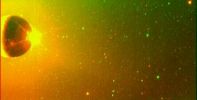
Io-Sodium cloud-PIA01111.jpgA sodium cloud from Io (4)68 visiteForse tutto questo processo potrà sembrare, ad alcuni giovani Ricercatori, come un tantino "naif" (se non addirittura ridicolo), ma occorre ricordare che le tecniche - oggi diventate di uso familiare - di "controllo a distanza" erano, in quegli anni, pura fantascienza e quindi, nel programmare gli eventi, ci si doveva anche affidare, oltre che alla cara, vecchia matematica (e a dei calcoli che, sebbene fatti solo "a mano" o con l'aiuto di un buon "regolo calcolatore", erano tendenzialmente perfetti), anche ad una eccellente dose di "intraprendenza, fantasia e buona sorte".
Non si finisce davvero mai di conoscere ed imparare, vero?!?
|
|
| 328 immagini su 28 pagina(e) |
|
|
|
|
|
14 | |
|
|
|
|
|
|








