Jupiter: the "King" and His Moons
|
|
|

Io-PIA00740.jpgThe "face" of Io65 visitenessun commento
|
|

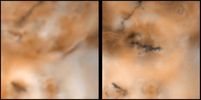
Io-PIA01070.jpgAs Time Goes By...On Io! (1)69 visiteDetail of changes on Jupiter's moon Io in the Region around Volund as seen by the Voyager 1 spacecraft in April 1979 (left frame) and NASA's Galileo spacecraft in September 1996 (right frame). North is to the top of both frames which are approx. 600 by 600 Km. Note the new linear feature, which may be a volcanic fissure, trending east from the southern end of Volund. Dark diffuse material lies to the west and a ring of bright material which may be SO2- rich plume deposits appears to be centered near the middle of the new linear feature.
|
|
Io-PIA01071.jpgAs Time Goes By...On Io! (2)65 visitenessun commento
|
|
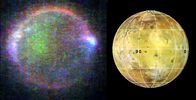
Io-PIA01637.jpgIo's "aurorae"74 visiteThis eerie view of Jupiter's moon Io in eclipse (left) was acquired by NASA's Galileo spacecraft while the moon was in Jupiter's shadow. Gases above the satellite's surface produced a ghostly glow that could be seen at visible wavelengths (red, green and violet). The vivid colors, caused by collisions between Io's atmospheric gases and energetic charged particles trapped in Jupiter's magnetic field, had not previously been observed. The green and red emissions are probably produced by mechanisms similar to those in Earth's polar regions that produce the aurora, or northern and southern lights. Bright blue glows mark the sites of dense plumes of volcanic vapor, and may be places where Io is electrically connected to Jupiter. The viewing geometry is shown in the image on the right. North is to the top of the picture and Jupiter is on the right. The resolution is 13,5 Km (about 8 miles) per picture element. The images were taken on May 31, 1998 at a range of 1,3 MKM (such as about 800.000 miles) by Galileo's onboard solid state imaging camera system during the spacecraft's 15th orbit of Jupiter.
|
|
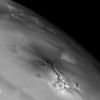
Io-PIA02232-1.jpgIo's Limb (RAW b/w NASA-Galileo Spacecraft Original Frame)68 visiteCaption NASA:"This picture of Io was taken on the morning of March 5 at a range of 75.445 Km. The area shown is at approx. 15° South Latitude and 244° East Longitude. Many depressions and elevations are shown. The light is coming from the left, so a depression has a bright right wall and shadow on the left wall. The depressions are complex in shape and do not resemble impact craters. Two of the depressions are joined by a shallow trough. The elevations are irregular and comical. They are cut by linear and irregular troughs. The surface is smooth and plain-like, that is, the surface is not pockmarked by abundant impact craters so are probably geologically young.
|
|
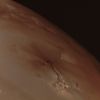
Io-PIA02232-PCF-LXTT.jpgIo's Limb (Absolute Natural Colors; credits for the additional process. and color.: Dr Paolo C. Fienga - Lunar Explorer Italia)199 visitenessun commentoMareKromium
|
|
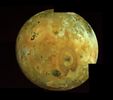
Io-PIA02294.jpgIo: full disk, from about 400.000 Km65 visitePerhaps the most spectacular of all the Voyager photos of Io is this mosaic obtained by Voyager 1 on March 5, 1979, at a range of 400.000 Km (approx.). A great variety of color and albedo is seen on the surface, now thought to be the result of surface deposits of various forms of Sulfur and Sulfur Dioxide. The two great volcanoes Pele and Loki (upper left) are prominent.
|
|

Io-PIA02520.jpgMountains on Io (MULTISPECTRUM; credits: Lunexit)80 visiteCaption NASA:"This image taken by NASA's Galileo Spacecraft during its close flyby of Jupiter's moon Io on November 25, 1999 shows some of the curious mountains found there. The Sun is illuminating the scene from the left, and because it is setting, the Sun exaggerates the shadows cast by the mountains. By measuring the lengths of these shadows, Galileo scientists can estimate the height of the mountains. The mountain just left of the middle of the picture is 4 Km (13.000 feet) high and the small peak to the lower left is 1,6 Km (5000 feet) high.
These mountains, like others imaged during a previous Galileo flyby of Io in October '99, seem to be in the process of collapsing. Huge landslides have left piles of debris at the bases of the mountains. The ridges that parallel their margins are also indicative of material moving down the mountainsides due to gravity.
North is to the upper left of the picture. The image, centered at 8,1° South Latitude and 78,7° East Longitude, covers an area approx. 210-by-110 Km (such as about 130-by-70 miles). The resolution is 267 meters (880 feet) per picture element.
The image was taken at a range of approx. 25.000 Km (about 16.000 miles) by Galileo's onboard camera".
MareKromium
|
|
Io-PIA02540.jpgRifting at Hi'iaka Patera (MULTISPECTRUM-2; credits: Lunexit)82 visiteCaption NASA:"NASA's Galileo Spacecraft acquired the images in this mosaic of Hi-iaka Patera (the irregularly shaped, dark depression at the center of the image) and two nearby mountains on November 25, 1999 during its 25th orbit. The sharp peak at the top of the image is about 11 Km (about 36.300 feet) high, and the two elongated plateaus to the West and South of the caldera are both about 3,5 Km (11.500 feet) high.
The ridges on the North-Western mountain are often seen on Ionian mountains and are thought to be formed as surface material slides downslope due to gravity.
At low resolution, many of the dark features, called pateras, appear to be calderas -- depressions formed by collapse into an empty magma chamber. However, higher resolution images such as this one suggest a different origin. In the case of Hi-iaka, the Northern and Southern Margins of the pateras have very similar shapes which appear to fit together. This may indicate that the crust has been pulled apart here and the resulting depression has subsequently been covered by dark lava flows. Furthermore, the two mountains bordering Hi-iaka Patera also appear to fit together. However, the similar shapes and heights of the pateras margins and mountains could be coincidental. Galileo scientists are currently investigating whether mountains and pateras are related to each other and what could cause the surface of Io to rift apart in such a manner.
North is to the top of the mosaic and the sun is illuminating the surface from the left. The resolution is 260 meters (about 280 yards) per picture element. Galileo took the images at a distance of 26.000 Km (approx. 16.000 miles) from Io".MareKromium
|
|
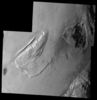
Io-PIA02555.jpgShamshu Mons and Patera from 34.500 Km76 visiteThis mosaic of images taken by NASA's Galileo spacecraft on February 22, 2000 shows 3 mountains and two lava-filled depressions in the Shamshu Region of Io. The dark oval feature on the left side is a depression that has been resurfaced by lava flows. The rough terrain North-East of the depression is Shamshu Mons. A 10-Km (6-mile) wide canyon oriented in North-East to South-West direction cuts this mountain. The northwestern edge of the mountain has been scalloped by erosion and it appears that the material has flowed along the canyon floor. Portions of 2 more mountains can be seen on the right side. The depression between these mountains is Shamshu Patera, a volcanic hotspot. The dark patches within it are recent and active lava flows. The northernmost edge of Shamshu Patera appears to be cutting into the mountain to its northeast. North is to the top of the picture and the Sun illuminates the surface from the West. This mosaic has a resolution of about 345 mt/pixel and covers an area of about 390x380 Km.
|
|
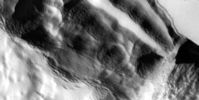
Io-PIA02597.jpgTelegonus Mensa in HR68 visiteA cliff slumps outward in these HR view that NASA's Galileo spacecraft captured of the edge of a mountain named Telegonus Mensa on Jupiter's moon Io. When Galileo flew near the South Pole of Io in October 2001, scientist's targeted this cliff to study the process of erosion. Water and wind cause most erosion on Earth, but Io has neither surface water nor atmosphere. The cliff is slumping due to gravity (?). The picture has a resolution of about 10 mt (33 feet) per picture element. Galileo's camera took it from a distance of about 1000 Km (about 620 miles). North is to the top and the Sun illuminates the surface from the upper right.
|
|
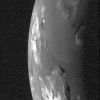
Io-PIA03530-1.jpgIo: the Loki Volcano from Galileo (RAW-HR and b/w Original NASA-Galileo Spacecraft Frame)73 visiteCaption NASA:"Light from the setting Sun falls across the Loki Volcanic Region on Jupiter's moon Io in this image taken by NASA's Galileo Spacecraft taken on October, 16, 2001.
The image was taken to examine the relative depths and heights of the major Surface Features existing in the Region. The Sun illuminates the surface from the right. Galileo's camera caught the large Volcanic Crater, or "Patera" of Loki near the Terminator (such as the boundary line between night and day). The image also shows several smaller craters plus shadows cast by the high peaks of several mountains.
Shadows cast by the low Sun should reveal any topography associated with Loki, such as a plateau in the center of the Patera or high Patera Walls. The near absence of shadows in this Region surprised Galileo scientists, as they had expected much more pronounced topography near Loki.
Another surprising aspect of this image is that features that have been black in previous Voyager and Galileo images of Loki, such as the dark Lava Flows visible inside the Patera, are here brighter than their surroundings. The best explanation is that the shiny, glassy surfaces of chilled Lava Flows look extremely dark when the Sun is directly overhead, but they reflect the Sun's light comparatively well when it shines at a low angle, in a similar manner to the reflective surfaces of bodies of water.
Other Volcanic Paterae in this image show the same unusual reflectance as seen at Loki. Some of them are being viewed at such an angle that these reflections from Lava Flows are the brightest features in the image. This image tells us that Lava Flows on Io chill quickly and form glassy surfaces, not unlike recently cooled lava flows in Hawaii.
The image has a resolution of about 1,1 Km (approx. 0,7 miles) per picture element. North is to the top of the picture".
|
|
| 328 immagini su 28 pagina(e) |
 |
|
|
|
|
13 | |
|
|
|
|








