Saturn: the "Ringed Beauty" and His Moons
|
|
|

Phoebe-PIA06075.jpgPhoebe's SkyLine55 visiteImages like this one, showing bright wispy streaks thought to be ice revealed by subsidence of crater walls, are leading to the view that Phoebe is an ice-rich body overlain with a thin layer of dark material. Obvious down slope motion of material occurring along the walls of the major craters in this image is the cause for the bright streaks, which are over-exposed here. Significant slumping has occurred along the crater wall at top left.
The slumping of material might have occurred by a small projectile punching into the steep slope of the wall of a pre-existing larger crater. Another possibility is that the material collapsed when triggered by another impact elsewhere on Phoebe. Note that the bright, exposed areas of ice are not very uniform along the wall. Small craters are exposing bright material on the hummocky floor of the larger crater.
Elsewhere on this image, there are local areas of outcropping along the larger crater wall where denser, more resistant material is located. Whether these outcrops are large blocks being exhumed by landslides or actual 'bedrock' is not currently understood.
The crater on the left, with most of the bright streamers, is about 45 kilometers (28 miles) in diameter, front to back as viewed. The larger depression in which the crater sits is on the order of 100 kilometers (62 miles) across. The slopes from the rim down to the hummocky floor are approximately 20 kilometers (12 miles) long; many of the bright streamers on the crater wall are on the order of 10 kilometers (6 miles) long. A future project for Cassini image scientists will be to work out the chronology of slumping events in this scene.
This image was obtained at a phase, or Sun-Phoebe-spacecraft, angle of 78 degrees, and from a distance of 11,918 kilometers (7,407 miles). The image scale is approximately 70 meters (230 feet) per pixel. No enhancement was performed on this image.
|
|
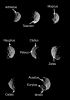
Phoebe-PIA06118.jpgThe Craters of Phoebe: names55 visitenessun commento
|
|
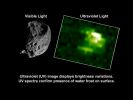
Phoebe-PIA06401.jpgFrozen water on Phoebe54 visiteCaption NASA originale:"On the right, the ultraviolet image of Saturn's moon Phoebe, taken from a distance of approx. 31.000 Km (such as about 19.263 miles) shows an irregular surface and bright crater region (white area). The bright areas indicate water frost on Phoebe's surface.
The image was taken by Cassini's UltraViolet Imaging Spectrograph during the spacecraft's closest approach to Phoebe, on June 11, 2004.
The large crater shows clearly in the image on the left".
|
|

Phoebe-PIA07775.jpgPhoebe's Global Digital Map128 visiteCaption NASA:"This Global Digital Map of Saturn's moon Phoebe was created using data taken during the Cassini Spacecraft's close Fly-By of the small moon that occurred in June 2004. The Map is an "Equidistant Projection" and has a scale of 233 meters (764 feet) per pixel.
The Mean Radius of Phoebe used for projection of this Map is approx. 107 Km (such as 66,447 miles). The resolution of the Map is 8 pixels per degree".MareKromium
|
|

Phoebe-PIA07795.jpgPhoebe: Cartographic Projections (Mercator Projection)140 visiteCaption NASA:"This Map is part of a group release of Mercator and Polar Stereographic Projections of Saturn's moon Phoebe.
A "Mercator Projection" is a map that preserves directions on a body, but distorts sizes, especially near the Poles. This Global Digital Map of Phoebe was created using data taken during Cassini's close Fly-By of the small moon that occurred in June 2004.
The mosaic is projected into the Mercator Projection within the Latitude range from 57° South to 57° North; the Stereographic Projections represent Latitudes greater and lower than + or - 55°. Thus, this map meets the standard scale of 1:1.000.000, as recommended by the U.S.G.S.
The projections are conformal, the quadrangles overlap and the scale of the Poles was chosen such that the circumference of the Stereographic Projection is identical to the width of the Mercator Projection.
The nomenclature was proposed by the Cassini imaging team and has yet to be validated by the International Astronomical Union. Resolution of the digital mosaic is 233 meters (764 feet) per pixel, although the highest resolution images have resolutions of 70 meters (230 feet) per pixel. The Mean Radius of Phoebe is approx. 107 Km (such as 66,447 miles)".MareKromium
|
|
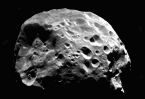
Phoebe.jpgPhoebe (Original NASA/JPL/ASU b/w Image-Mosaic)54 visiteWas Saturn's moon Phoebe once a comet? Images from the Cassini spacecraft taken two years ago (early 2004) when entering the neighborhood of Saturn, indicate that Phoebe may have originated in the outer Solar System.
Phoebe's irregular surface, retrograde orbit, unusually dark surface, assortment of large and small craters, and low average density appear consistent with the hypothesis that Phoebe was once part of the Kuiper Belt of icy comets beyond Neptune before being captured by Saturn. Visible in the above image of Phoebe are craters, streaks, and layered deposits of light and dark material. The image was taken from around 30.000 Km out from this 200-Km diameter moon.
Two weeks after taking the above image, Cassini fired its engines to decelerate into orbit around Saturn.
|
|
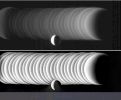
Polydeuces-EB.jpgPolydeuces? (an Image-Mosaic by Elisabetta Bonora and Marco Faccin - Lunexit Team)58 visitenessun commentoMareKromium
|
|
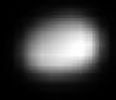
Polydeuces-PIA08209.jpgPolydeuces (extra detail mgnf)55 visiteThis magnified view shows tiny Polydeuces, a moon that was discovered by the Cassini spacecraft and is a mere 3 Km (a little less than 2 miles) across. Along with much larger Helene (32 Km, or 20 miles across), Polydeuces orbits Saturn at the same distance as large, icy Dione (which is 1.126 Km, or 700 miles across).
Because this body was only recently discovered and is so small, scientists presently know precious little about it. Further observations by Cassini may yield additional insights about its nature and composition.
The image was taken with the Cassini spacecraft narrow-angle camera on May 22, 2006 at a distance of approx. 73.000 Km (about 45.000 miles) from Polydeuces and at a phase angle of 41°. The image was obtained using a spectral filter sensitive to wavelengths of infrared light centered at 752 nanometers. Scale in the original image was about 434 mt (appx. 1423 feet) per pixel. The image has been magnified by a factor of 4 and contrast-enhanced to aid visibility.
|
|

Prometheus & Pandora form Voyager 1.jpgPrometheus & Pandora from Voyager 156 visiteUn'immagine "datata", ma la prima - in assoluto! - che riuscì a mostrarci i primi due (e forse i più famosi) Ring-Master di Saturno: Pandora e Prometeo.
Simili, per i compiti da essi svolti, ai cani che i pastori impiegano per impedire alle pecore raccolte in gregge di disperdersi (ed anche per tale motivo chiamati "Shepherd Moons"), essi "vegliano" sui detriti che formano il più sottile ed irregolare degli Anelli di Saturno ( l'Anello "F") e lo mantengono "in situ"!
Da non dimenticare, tuttavia, che Prometeo - anche a seguito di alcune immagini ottenute da Cassini (una delle quali Vi proponiamo più avanti - PIA06143), sembra essere "collegato" all'Anello "F" da un "cordone di polveri e detriti" e qualche Scienziato ha anche ipotizzato che questo Ring-Master non solo concorre a mantenere l'Anello "F" stabile, ma anche - ed in qualche modo - lo "priva" di parte del materiale che lo forma.
|
|

Prometheus & Pandora from Cassini-Huygens.jpgPrometeus & Pandora from Cassini-Huygens54 visitevedi il commento al frame che precede
|
|

Prometheus & Pandora near the F-Ring.jpgPrometheus & Pandora near the "F"-Ring54 visitenessun commento
|
|

Prometheus&Pandora-PIA07612.jpgCosmic race: Prometheus and Pandora72 visiteSaturn's moon Prometheus (Sx) chases Pandora (Dx) in this Cassini view, but the outcome of their race has already been decided by gravity. Prometheus orbits closer to Saturn and thus moves faster than does Pandora. This view is from a third of a degree (1/3°) beneath the Ringplane. Familiar Ring features that are visible from higher angles above the Rings are foreshortened here. The Planet's dark shadow stretches across the Ringplane at center.
The image was taken in visible light with the Cassini spacecraft narrow-angle camera on Sept. 8, 2005, at a distance of approx. 1,8 MKM (such as about 1,1 MMs) from Saturn. The image scale is 10 Km (about 6 miles) per pixel on Prometheus and Pandora.
|
|
| 2245 immagini su 188 pagina(e) |
 |
|
|
|
|
92 | |
|
|
|
|





