Saturn: the "Ringed Beauty" and His Moons
|
|
|

PIA07966-112203-1.wavAudio Signals from the the Space of Saturn (by Dr M. Faccin)55 visitenessun commentoMareKromium
|
|
PIA07966-112203.wavAudio Signals from the the Space of Saturn (by Dr M. Faccin)55 visitenessun commentoMareKromium
|
|
PIA07966-112203xx.mp3Audio Signals from the the Space of Saturn (by Dr M. Faccin)55 visitenessun commentoMareKromium
|
|
PIA07967-072504.wavAudio Signals from the the Space of Saturn (by Dr M. Faccin)55 visitenessun commentoMareKromium
|
|
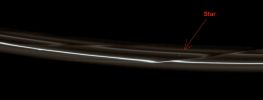
PIA10587.jpgThe "Fragile" F-Ring54 visiteCaption NASA:"Set starkly against the blackness of space are the F-Ring's delicate strands which are periodically gored by its shepherding moon, Prometheus.
Prometheus (approx. 86 Km, or about 53 miles across) and Pandora (approx. 81 Km, or about 50 miles across) both interact with the F-Ring but neither is visible here. Prometheus has the larger effect (see, for instance, PIA08397 for a movie of Prometheus creating a Streamer-Channel in the ring).
A star can be seen through the ring on the right side (Dx) of the image.
This view looks toward the unilluminated side of the Rings from about 33° above the Ring-Plane. The image was taken in visible light with the Cassini Spacecraft narrow-angle camera on Jan. 11, 2009.
The view was acquired at a distance of approx. 1 MKM (such as about 620,000 miles) from Saturn and at a Sun-Saturn-Spacecraft, or Phase, Angle of 37°.
Image scale is roughly 6 Km (about 4 miles) per pixel".MareKromium
|
|

Pallene-N00119642.jpgPallene54 visitePallene è un satellite naturale minore del pianeta Saturno, la cui orbita è situata fra quelle di Mimas ed Encelado. Pallene è stata scoperta nel 2004 da Sébastien Charnoz del Cassini Imaging Team, il gruppo scientifico responsabile dell'analisi delle immagini scattate dalla Sonda Cassini, guidato da Carolyn Porco.
Dopo aver ricevuto la designazione provvisoria S/2004 S 2, il satellite fu successivamente battezzato dall'Unione Astronomica Internazionale con il nome di Pallene, una Ninfa della mitologia greca. Si rilevò inoltre che il satellite coincideva con un oggetto avvistato il 23 agosto 1981 in una singola fotografia scattata dalla sonda spaziale Voyager 2, con una distanza stimata da Saturno di circa 200.000 km; al satellite, di cui non fu possibile stabilire l'orbita esatta, venne allora attribuita la designazione S/1981 J 14.
L'orbita di Pallene è visibilmente influenzata da una Risonanza Orbitale con Encelado, molto più grande, anche se l'effetto è meno intenso rispetto alle perturbazioni esercitate da Mimas sulla vicina Metone. Il fenomeno è all'origine delle oscillazioni periodiche nel semiasse maggiore di circa 4 Km, e della longitudine del Nodo Ascendente di 0,02° (pari a circa 75 Km). Anche l'Eccentricità Orbitale di Pallene varia (fra 0,002 a 0,006), mentre la sua Inclinazione oscilla fra 0,178° e 0,184°.MareKromium
|
|

Pan from Voyager 1.jpgPan from Voyager 183 visiteIl "Flautista" Pan: una Luna Minore e, nel contempo, uno dei Ring-Master di Saturno. Difficilissimo da vedere ma non per questo meno affascinante.
Provate ad immaginarVi, per esempio, a ciò che potreste vedere alzando gli occhi se Vi trovaste a "passeggiare" - anche solo per pochi istanti, su questo piccolo mondo di pietra...
|
|

Pan-N00060357.jpgSinking in the Rings: Pan, from 438.000 Km53 visiteCaption NASA:"N00060357.jpg was taken on April 29, 2006 and received on Earth April 29, 2006. The camera was pointing toward Pan that, at the time, was approximately 438.027 Km away.
The image was taken using the CL1 and CL2 filters. This image has not been validated or calibrated"
|
|

Pan-N00068548.jpgPan: just "in-between"..53 visitenessun commento
|
|

Pan-PIA07587.jpgPan running in his "lane"53 visiteSaturn's moon Pan occupies the Encke Gap at the center of this image, which also displays some of the A-Ring's intricate wave structure. Pan is 26 Km (about 16 miles) across.
The two most prominent bright banded features seen on the left side of the image are Spiral Density Waves, which propagate outward through Saturn's Rings. The bright crests represent areas with higher ring particle densities.
The image was taken in visible green light with the Cassini spacecraft narrow-angle camera on Aug. 1, 2005, at a distance of approx. 794.000 Km (about 493.000 miles) from Pan. The image scale is 5 Km (such as 3 miles) per pixel.
|
|

Pan-PIA08230.jpgInside "Encke"...53 visiteCaption NASA originale:"Hiding within the Encke Gap is the small moon Pan, partly in shadow and party cut off by the outer A-Ring in this view. Similar to Atlas, Pan appears to have a slight ridge around its middle; and like Atlas, Pan's orbit also coincides with a faint ringlet. Pan is 26 Km(about 16 miles) across.
The image was taken in visible light with the Cassini spacecraft narrow-angle camera on June 30, 2006 at a distance of approximately 269.000 Km (such as about 167.000 miles) from Pan. Image scale is roughly 2 Km(approx. 5.259 feet) per pixel".
|
|

Pan-PIA08317.jpgA "Bright Pearl" in the Darkness: Pan in the Gap53 visiteCaption NASA originale:"This Cassini spacecraft view of Pan in the Encke Gap shows hints of detail on the moon's dark side, which is lit by Saturnshine -- sunlight reflected off Saturn.
Pan (26 Km, or 16 miles across) cruises the Encke Gap (325 Km, or 200 miles wide) with several faint ringlets.
This view looks toward the lit side of the Rings from about 52° below the Ring-Plane. The sunlit portion of Pan is partly overexposed.
The image was taken in visible light with the Cassini spacecraft narrow-angle camera on Oct. 27, 2006 at a distance of approx. 385.000 Km (about 239.000 miles) from Pan and at a Sun-Pan-spacecraft, or phase, angle of 86°. Image scale is roughly 2 Km (1,4 miles) per pixel".
|
|
| 2245 immagini su 188 pagina(e) |
 |
|
|
|
|
88 | |
|
|
|
|





