Saturn: the "Ringed Beauty" and His Moons
|
|
|

Mimas___Prometheus-PIA10523.jpgThe "Ring-Masters" of Saturn62 visiteCaption NASA:"Two moons that have profound impacts on the Rings of Saturn, Mimas and Prometheus, are seen here with the F-Ring.
Mimas (approx, 396 Km, or about 246 miles across), the larger and much more distant of the moons, creates the Cassini Division: between the A and B-Rings.
Prometheus (approx. 86 Km, or about 53 miles across), although much smaller than Mimas, is half of a duo responsible for maintaining the narrow FRing".MareKromium
|
|

Mimas_and_the_Rings-PIA12543.jpgIn-Between (Natural Colors; credits: NASA/JPL/Space Science Institute)65 visiteCaption NASA:"Two of Saturn's moons straddle the Planet's Rings in this view. Mimas is closest to the Cassini Spacecraft here. Epimetheus, instead, is on the far side of the Rings.
Saturn's shadow cuts across the middle of the Rings. This view looks toward the sunlit side of the Rings from just above the Ring-Plane.
Images taken using red, green and blue spectral filters were combined to create this Natural Color view. The images were obtained with the Cassini Spacecraft narrow-angle camera on Oct. 24, 2009 at a distance of approx. 2,7 MKM (such as about 1,7 MMs) from Epimetheus and approx. 2,4 MKM (about 1,5 MMs) from Mimas.
Scale on Mimas is roughly 14 Km (a little less than 9 miles) per pixel".MareKromium
|
|

MimasandPrometheus-N00121924-N00121943.gif"Space Runners" (GIF-Movie; credits: Dr G. Barca)70 visitenessun commentoMareKromium
|
|

MimasandPrometheus-N00121933.jpgSpace Encounter: Mimas and Prometheus (1)87 visiteCaption NASA:"N00121933.jpg was taken on October 20, 2008 and received on Earth October 21, 2008.
The camera was pointing toward MIMAS that, at the time, was approx. 1.052.776 Km away.
This image was taken using the CL1 and CL2 filters and it has not been validated or calibrated." MareKromium
|
|

MimasandPrometheus-N00121936.jpgSpace Encounter: Mimas and Prometheus (2)76 visiteCaption NASA:"N00121933.jpg was taken on October 20, 2008 and received on Earth October 21, 2008.
The camera was pointing toward MIMAS that, at the time, was approx. 1.054.003 Km away.
This image was taken using the CL1 and CL2 filters and it has not been validated or calibrated." MareKromium
|
|

MimasandPrometheus-N00121942.jpgSpace Encounter: Mimas and Prometheus (3)87 visiteCaption NASA:"N00121933.jpg was taken on October 20, 2008 and received on Earth October 21, 2008.
The camera was pointing toward MIMAS that, at the time, was approx. 1.056.495 Km away.
This image was taken using the CL1 and CL2 filters and it has not been validated or calibrated." MareKromium
|
|

Moonlet-PIA11148-1.jpgTiny Moonlet within a G-Ring Arc75 visiteCaption NASA:"This sequence of three images, obtained by NASA's Cassini Spacecraft over the course of about 10 minutes, shows the path of a newly found moonlet in a bright arc of Saturn's faint G-Ring.
In each image, a small streak of light within the Ring is visible. Unlike the streaks in the background, which are distant stars smeared by the camera's long exposure time of 46", this streak is aligned with the G-Ring and moves along the ring as expected for an object embedded in the Ring.
Cassini scientists interpret the moving streak to be reflected light from a tiny moon half a kilometer (a third of mile) wide that is likely a major source of material in the arc and the rest of the G-Ring.
Debris knocked off this moon forms a relatively bright arc of material near the inner edge of the G-Ring, the most visible part of the Ring in these images. That arc, in turn, leaks material to form the entire Ring.
These images were captured by Cassini's narrow-angle camera on Oct. 27, 2008.
The first image (left) was taken in Visible Light, the second image (middle) was taken in Red Light, and the third image (right) in Near-InfraRed Light centered at a wavelength of 750 nanometers.
Image scale for the first image is roughly 7 Km (a little more than 4 miles) per pixel while the second and third were taken at reduced resolution.
These spatially compressed images were captured at 14 Km (about 9 miles) per pixel and then displayed at a size equal to the first image. This view looks toward the un-illuminated side of the Rings from about 5° above the Ring-Plane.
The view was acquired at a distance of approx. 1,2 MKM (such as about 751.000 miles) from Saturn and at a sun-Saturn-Spacecraft, or Phase, Angle of 23°".MareKromium
|
|

Moons-EB.gifKnown and Unknown Saturnian Moons' Carousel... (GIF-Movie; credits: Elisabetta Bonora - Lunexit Team)84 visitenessun commentoMareKromium
|
|

MysteriousMoons-N00027751.jpgTwo "Mysterious Moons"...67 visiteIl frame è bellissimo e, a nostro parere, di grande suggestione; le due Lune Saturniane appaiono marcate da debolissimi dettagli, forse sufficienti per identificarle e forse no.
Dunque: quali sono le due Lune che vedete raffigurate in questa spettacolare immagine?
|
|

New_Moon-PIA08369_full_movie.gifA "New Moon" for Saturn96 visiteCaption NASA:"The 60th moon of Saturn reveals itself in a sequence of images. The discovery suggests that the new moon, along with its neighbors Methone and Pallene (discovered by the Cassini imaging team in 2004), may form part of a larger group of moons in this region. The movie spans 6 hours.
Initial calculations show the moon to have a width of approx. 2 Km (1,2 miles), with an orbit that lies between those of the moons Methone and Pallene. The moon's orbit is in resonance with another moon, Mimas, also seen in this sequence as a very bright, moving object. The new moon's location is indicated by a red box.
The (narrow) ring visible in the images is the G-Ring, and the G-Ring arc passes through the field of view during the course of the movie. Calypso, a Trojan moon of Tethys, is also visible in the sequence. Trojan moons are found near gravitationally stable points ahead or behind a larger moon.
This view looks toward the non-illuminated side of the Rings from about 3° above the Ring-Plane.
The series of images was taken in visible light with the Cassini spacecraft wide-angle camera on May 30, 2007, at a distance of approximately 1.76 million kilometers (1.09 million miles) from Saturn. Image scale is about 105 kilometers (65 miles) per pixel. The ghostly shape that stretches across the scene results from scattered light within the camera optics".MareKromium
|
|
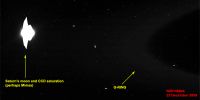
OverSaturation-N00148644.jpgOversaturation (by Elisabetta Bonora)66 visiteNon sempre la sovrasaturazione (o "sovraesposizione") - che è produttiva di una serie di image-artifacts tipici (su tutti, la cosiddetta "Light-Drop") - è il frutto di un errore: gli "oggetti a debole o debolissima luminosità", infatti, per essere evidenziati richiedono - come ben sapete - dei tempi di esposizione più lunghi del solito.
E quando poi, nel campo di ripresa, assieme all'"oggetto debole", vi è pure un "oggetto ad albedo elevata" - come in questo caso accade, rispettivamente, per l'Anello-G di Saturno e la sua luna Mimas -, ecco che l'immagine finale "sembra" venir fuori "sbagliata". Brutta e mossa, di regola (come vedete anche le stelle sono divenute, in questo frame, delle piccole "star-trails").
Ma la verità è che non si è trattato di un errore, ma di è una - oggettiva - necessità (come ben dimostra questa chiara elaborazione della nostra Elisabetta Bonora).MareKromium
|
|

PHOEBE-PIA06064_modest.jpgPhoebe from Cassini-Huygens103 visiteUn'immagine spettacolare che ci mostra questa Luna martoriata da impatti occorsi - forse - milioni o miliardi di anni fa. La sua forma vagamente ovoidale, unita alle sue caratteristiche superficiali, fanno assomigliare questa Luna Maggiore - secondo noi - a Phobos. La grande depressione che vedete sulla parte superiore di Phoebe, infine, ci ricorda proprio lo "Stickney Crater" di Phobos
|
|
| 2245 immagini su 188 pagina(e) |
 |
|
|
|
|
86 | |
|
|
|
|





