Saturn: the "Ringed Beauty" and His Moons
|
|
|

Japetus-W00012022.jpgIs this Japetus?!?64 visiteOriginal caption:"W00012022.jpg was taken on November 03, 2005 and received on Earth November 05, 2005. The camera was pointing toward IAPETUS at approximately 1.624.627 Km away, and the image was taken using the CL1 and CL2 filters. This image has not been validated or calibrated".
|
|
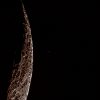
Japetus-W00035137.jpgJapetus (possible natural colors - elab. Lunexit)64 visiteCaption NASA:"W00035137.jpg was taken on September 10, 2007 and received on Earth September 10, 2007. The camera was pointing toward Japetus that, at the time, was approx. 5.983 Km away, and the image was taken using the CL1 and CL2 filters. This image has not been validated or calibrated".MareKromium
|
|

Japetus-W00035193-PCF-LXTT.jpgOver the "Equatorial Ridge" (Absolute Natural Colors; credits for the additional process. and color.: Dr Paolo C. Fienga - Lunexit Team)259 visiteCaption NASA:"W00035193.jpg was taken on September 10, 2007 and received on Earth September 11, 2007. The camera was pointing toward Japetus that, at the time, was approximately 2084 Km away, and the image was taken using the CL1 and CL2 filters. This image has not been validated or calibrated". MareKromium
|
|

Japetus-W00035206.jpgThe "White-Side" of Japetus (possible natural colors; elab. Lunexit)124 visiteCaption NASA:"W00035206.jpg was taken on September 10, 2007 and received on Earth September 11, 2007. The camera was pointing toward Japetus that, at the time, was approximately 5.317 Km away, and the image was taken using the CL1 and CL2 filters. This image has not been validated or calibrated".MareKromium
|
|

Japetus-W00035220.jpgJapetus (possible natural colors - elab. Lunexit)63 visiteCaption NASA:"W00035220.jpg was taken on September 10, 2007 and received on Earth September 12, 2007. The camera was pointing toward Japetus that, at the time, was approximately 24.665 Km away, and the image was taken using the CL1 and CL2 filters. This image has not been validated or calibratedMareKromium
|
|
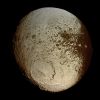
Japetus-big.jpgJapetus (Natural Colors; credits: Lunexit)65 visiteDa "NASA - Picture of the Day", del giorno 9 Agosto 2009:"What has happened to Saturn's moon Japetus? Vast sections of this strange world are dark as coal, while others are as bright as ice. The composition of the dark material is unknown, but InfraRed Spectra indicate that it possibly contains some dark form of carbon.
Japetus also has an unusual equatorial ridge that makes it appear like a walnut. To help better understand this seemingly painted moon, NASA directed the robotic Cassini Spacecraft orbiting Saturn to swoop within 2000 Km in 2007.
Pictured above, from about 75.000 Km out, Cassini's trajectory allowed unprecedented imaging of the hemisphere of Japetus that is always trailing.
A huge impact crater seen in the South spans a tremendous 450 Km and appears superposed on an older crater of similar size. The dark material is seen increasingly coating the easternmost part of Japetus, darkening craters and highlands alike.
Close inspection indicates that the dark coating typically faces the moon's Equator and is less than a meter thick. A leading hypothesis is that the dark material is mostly dirt leftover when relatively warm but dirty ice sublimates. An initial coating of dark material may have been effectively painted on by the accretion of meteor-liberated debris from other moons.
This and other images from Cassini's Japetus flyby are being studied for even greater clues".MareKromium
|
|

Japetus-cassini-big.jpgJapetus: the most misterious Saturnian moon62 visiteCaption NASA originale:"What has happened to Saturn's moon Japetus? A strange ridge crosses the moon near the equator, visible near the bottom of the above image, making Japetus appear similar to the pit of a peach. Half of Japetus is so dark that it can nearly disappear when viewed from Earth. Recent observations show that the degree of darkness of the terrain is strangely uniform, like a dark coating was somehow recently applied to an ancient and highly cratered surface. The other half of Japetus is relatively bright but oddly covered with long and thin streaks of dark. A 400-Km wide impact basin is visible near the image center, delineated by deep scarps that drop sharply to the crater floor. The above image was taken by the Saturn-orbiting Cassini spacecraft during a flyby of Japetus at the end of last year".
|
|

Japetus-temp.1-PIA07006_modest.jpgJapetus Temperature Variation Map63 visiteCaption NASA originale:"This plot shows how daytime temp.s at low latitudes on the Dark Material on Japetus vary with time of day from about 130 Kelvin (-226 F) at noon to about 70 Kelvin (-334 F) at sunset. The observations are compared to a "forecast" model (green line) which predicts temperatures based on an assumed value of a parameter called the "thermal inertia. Rock or solid ice has a high thermal inertia (approx. 2.000.000 as measured in the obscure units used for thermal inertia), meaning that it is good at storing heat and cools down or heats up relatively slowly. On Japetus, in contrast, temperatures drop precipitously in the afternoon as the Sun sinks towards the horizon and a very small value of the thermal inertia (30.000 units) is needed in the model to match the data. This means that Japetus's surface is extremely bad at storing heat and is thus extremely fluffy, probably due to the pulverizing effect of billions of years of meteorite impacts (...)".
|
|
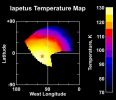
Japetus-temp.2-PIA07005_modest.jpgJapetus Temperature Map60 visiteCaption NASA originale:"Temperatures reach nearly 130 Kelvin (-226 F) at noon on the equator on the dark material that covers most of this side of Japetus, making high noon on Japetus's dark side probably the warmest place in the Saturn System. This is much warmer than temperatures on the moon Phoebe - as measured by the composite infrared spectrometer in June 2004 - which peaked near 112 Kelvin (-258 F). That's because, although Phoebe is almost as dark as Japetus's dark material and absorbs nearly as much sunlight, Phoebe rotates much more quickly (once every 9 hours, compared to 79 days for Japetus). That means the surface has less time to heat up during the day. Temperatures on Japetus' bright material are much colder, peaking near 100 Kelvin (-280 F), both because the bright material absorbs less sunlight and because it is further from the equator on this side of Japetus".
|
|
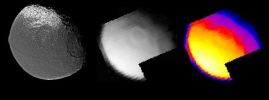
Japetus-temp.3-PIA07004_modest.jpgJapetus Thermal Radiation Image60 visiteCaption NASA originale:"This image of the infrared heat radiation from Saturn's moon Japetus was obtained by the Cassini composite infrared spectrometer instrument 16 hours before Cassini's closest approach to this mysterious moon, on December 31, 2004. The thermal radiation is shown as both a grayscale image, equivalent to what we would see if our eyes were sensitive to infrared wavelengths near 15 microns and as a color-coded temperature map. A previously-released mosaic obtained by Cassini's imaging camera shortly before the composite infrared spectrometer observation, with similar scale and orientation, is also shown for comparison. Temperatures in the large crater near the center of the disc are slightly different from those in surrounding areas, because sloping surfaces within the crater are warmer where they are tilted towards the Sun and cooler when tilted away from the Sun".
|
|

Japetus.jpgThe "Great - and anomalous - Walls" of Japetus63 visiteUn nuovo lavoro del Dr Feltri sulle raw images di Cassini. Ma sentiamo che cosa Lui stesso racconta:"...fermo restando che i Thunderbolts hanno indovinato parte della Verità, le cose sono alquanto più complicate di quanto pensano. Dal punto di vista 'architettonico' è interessante il "muro" sinaptico verticale semicircolare che divide il cratere più grande da quello intermedio. Come già visto in Endurance, la parete verticale si è leggermente distaccata dalla superficie orizzontale superiore, il che costituisce un indizio consistente sulla formazione indipendente delle 2 superfici perpendicolari (e addio alla teoria dei Crateri da Impatto...) le quali si sono prima connesse e poi distaccate (un po' come piastrelle posizionate su un gradino). Tale circostanza porta ad una coesistenza di matrici biogeniche e forze elettromagnetiche, non essendo a mio parere plausibile una spiegazione che tenti di attribuire queste formazioni ad una sola Teoria Esplicativa...".
...continua nella Reserved Area
|
|

KeelerMoon-PIA07584.jpgS/2005 S1: the "Keeler-Gap" Moon69 visiteCassini's cameras were retargeted to capture the tiny Keeler Gap Moon S/2005 S1, visible at the center and first discovered by Cassini a few months ago. Waves raised in the gap edges by the Keeler moonlet's gravity are clearly visible here. Scientists can use the height of the waves to determine the little moon's mass.
The Keeler moon is 7 Km (about 4,3 miles) across and orbits within its 42-km (about 26-mile) wide gap. The much larger Encke Gap (325 Km, or 200 miles wide) is seen here at the upper right (...). This image was taken in visible light with the Cassini spacecraft narrow-angle camera on Aug. 1, 2005, at a distance of approx. 853.000 Km (or about 530.000 miles) from Saturn. The image scale is 5 Km (3 miles) per pixel. The image has been contrast-enhanced and magnified by a factor of 3 to aid visibility.
|
|
| 2245 immagini su 188 pagina(e) |
 |
|
|
|
|
76 | |
|
|
|
|





